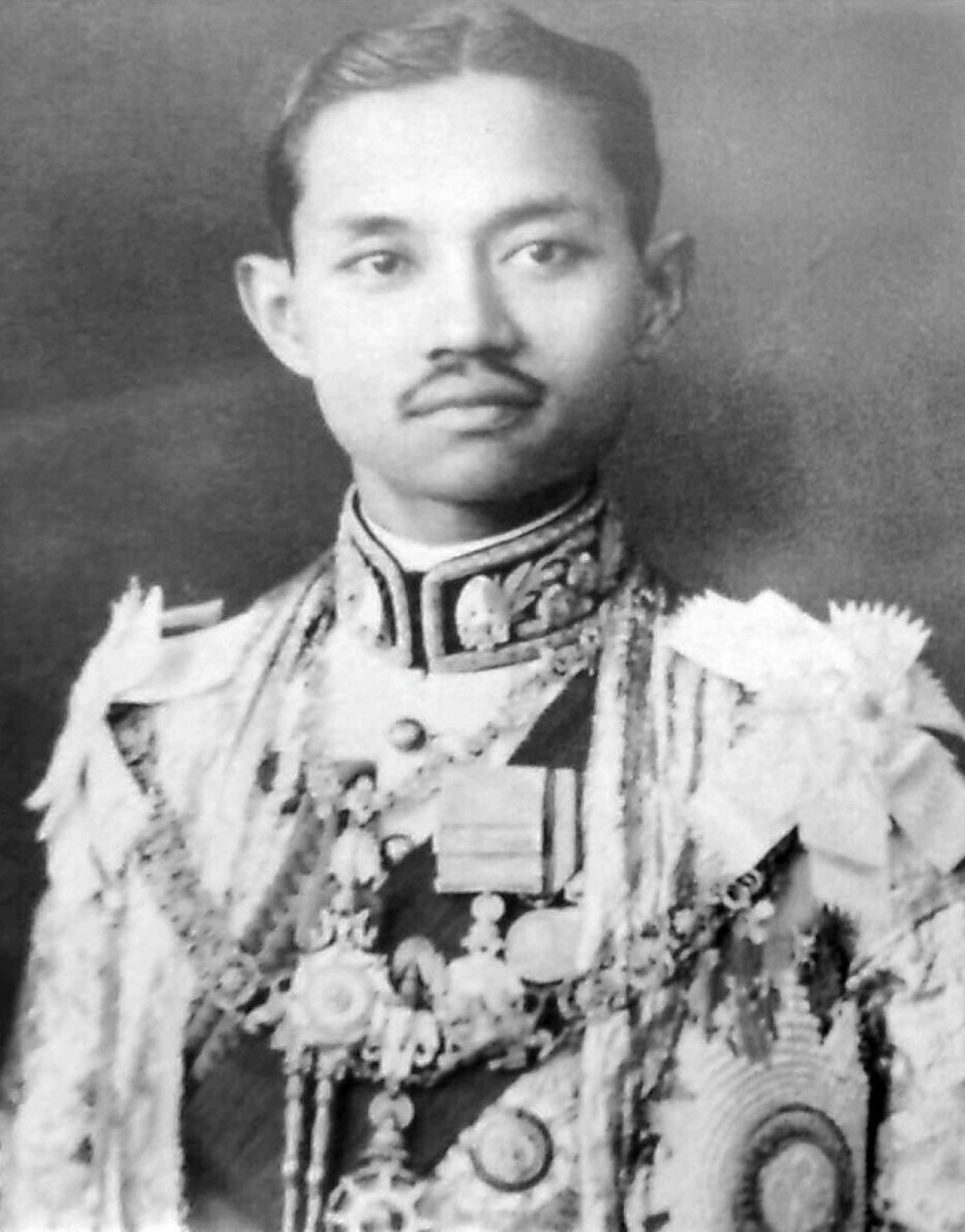
In this biography
Quick facts
- Born
- 5 December 1927
- Died
- 13 October 2016
- Birthplace
- Cambridge, Massachusetts, United States
- Country
- Thailand
- Nationality
- Thai
- Known for
- A seven-decade reign and royal development initiatives
- Regnal name
- Rama IX
- Reign
- 9 June 1946 – 13 October 2016
- Coronation
- 5 May 1950
- House
- Chakri dynasty
Why this life matters
Bhumibol became a central symbol of modern Thailand; his development work and interventions during political crises remain important, and debated, parts of his legacy.
Timeline
Key moments
Born in the United States
Born while his father studied medicine at Harvard University.
Became king
Succeeded his brother Ananda Mahidol on 9 June.
Crowned in Bangkok
Was formally crowned at the Grand Palace on 5 May.
Intervened during a political crisis
The collapse of military rule made the king’s public authority newly visible.
Addressed the Black May confrontation
Summoned the military-backed prime minister and protest leader during televised talks.
Received a UNDP lifetime award
Received the inaugural Human Development Lifetime Achievement Award.
Died after a 70-year reign
Died in Bangkok on 13 October.
A king born in Cambridge and educated in Switzerland
Bhumibol Adulyadej was born in Cambridge, Massachusetts, on 5 December 1927, into the Mahidol branch of Thailand’s Chakri dynasty. Much of his education took place around Lausanne in Switzerland. His life changed when his elder brother, King Ananda Mahidol, died on 9 June 1946 and Bhumibol succeeded him as king.
He returned to Switzerland to continue studying, shifting toward law and political science after accession. His coronation in Bangkok followed on 5 May 1950. Accession and coronation were separate milestones: Rama IX’s reign began in 1946, not in 1950. That distinction also explains why the sixtieth anniversary of his reign fell in 2006.
Royal projects: water, agriculture and local conditions
Provincial travel became a defining part of Bhumibol’s public role. Royal development programmes addressed agricultural livelihoods, water supply, environmental problems, health and communications. The Royal Development Projects Board’s historical account lists 4,685 projects under its responsibility for 1982–2002. That is a bounded administrative total, not a count of every project across his entire reign.
Water management illustrates the practical approach. The board describes reservoirs, drainage, irrigation and flood retention adapted to local terrain. Its Kaem Ling, or “Monkey Cheek”, example uses areas that temporarily hold floodwater before releasing it. Such programmes required agencies, engineering work and community maintenance; describing a royal initiative does not mean the king personally built each installation.
What did Sufficiency Economy mean?
Bhumibol’s Sufficiency Economy philosophy gained particular prominence after the 1997 Asian financial crisis. The UNDP’s 2007 Thailand Human Development Report examined its implications for households, communities, business and government. Its themes include moderation, responsible decisions and resilience against shocks, rather than growth pursued without regard to financial or environmental risk.
In that account, resilience can concern a family coping with illness or a poor harvest as well as an economy exposed to global volatility. The philosophy is therefore broader than telling everyone to become a subsistence farmer. The report connects it to sustainable growth and equitable benefits; publication by UNDP does not establish that every policy carrying the label achieved those aims.
Sources for this section: [9]
The 2006 UNDP award and international recognition
On 26 May 2006, UN Secretary-General Kofi Annan presented Bhumibol with UNDP’s first Human Development Lifetime Achievement Award. The citation recognised rural development, farming technologies, conservation and efforts to reduce damage from floods and droughts. It was a human-development award, not a Nobel Prize or an assessment of Thailand’s democratic institutions.
The distinction matters when evaluating the reign. International recognition focused on a particular field of work, while the king’s constitutional position and political influence raised different questions. Development projects, public devotion and constitutional history are connected aspects of the biography, but evidence for one should not be treated as a complete verdict on all the others.
Constitutional influence and the 1992 confrontation
Bhumibol reigned within a constitutional monarchy, not the absolute system that ended in 1932. Nevertheless, the U.S. State Department’s historical background note distinguishes his limited direct constitutional power from his substantial public authority. That influence became especially visible during the confrontation between the military-backed government and protesters in May 1992.
After troops violently suppressed demonstrations, a televised royal meeting formed part of the pressure that led Suchinda Kraprayoon to resign and fresh elections to follow. The episode did not end military intervention in politics: the same historical account records the 2006 coup. Bhumibol’s death on 13 October 2016 closed a seventy-year reign whose development work and relationship to political institutions require separate, careful assessment.
Quick answers
Frequently asked questions about Bhumibol Adulyadej
- Was Bhumibol Adulyadej Rama IX?
- Yes. Rama IX identifies his place in the Chakri dynasty’s sequence of kings.
- Did his reign begin in 1946 or 1950?
- He acceded on 9 June 1946. His coronation took place on 5 May 1950; it did not begin a new reign.
- What was his Sufficiency Economy philosophy?
- It emphasised moderation, responsible decisions and resilience to shocks. The UNDP’s 2007 report examined applications beyond subsistence agriculture.
- Which UN award did King Bhumibol receive?
- On 26 May 2006 he received UNDP’s first Human Development Lifetime Achievement Award, recognising his development work.
Keep exploring
Lives connected to this story
- Prajadhipok
Understand the earlier reign during which absolute monarchy ended in 1932.
- Suchinda Kraprayoon
Read about the prime minister whose appointment and resignation framed the May 1992 crisis.
- Chamlong Srimuang
Follow the protest leader’s part in the confrontation with military-backed government.
Sources and further reading
Explore the evidence
These references support the biography and offer further reading. Official records, first-person accounts and independent reporting provide different perspectives; image records document attribution and licensing.
- 1. Kanchanapisek NetworkBiography of His Majesty King Bhumibol Adulyadej
- 2. Royal Thai Embassy, DohaThailand’s International Monarch
- 3. Office of the Royal Development Projects BoardRoyal Development Projects
The project count covers the board’s stated 1982–2002 period, not the full reign. Institutional descriptions explain programme aims rather than independently measuring every claimed benefit.
- 4. United NationsSecretary-General’s address on the King and human development
- 5. United NationsUN General Assembly tribute to King Bhumibol Adulyadej
- 6. Wikimedia CommonsPortrait and licence record
- 7. Senate of ThailandThe Wisdom of the Monarch: biographical dates
The indexed Thai Senate publication corroborates the accession, coronation and death dates. Full PDF inspection is not claimed.
- 8. Royal Development Projects BoardWater-source projects and the Kaem Ling flood-retention approach
- 9. UNDP Thailand2007 Thailand National Human Development Report: Sufficiency Economy
The report concerns 2007; the webpage’s 2012 posting date is not the year the philosophy began. Its policy discussion is not a blanket endorsement of royal political influence.
- 10. United NationsKofi Annan’s award citation, 26 May 2006
The UN citation’s date and award description were available in indexed text. Direct opening returned a JavaScript verification page; unrestricted live access is not claimed.
- 11. U.S. Department of StateThailand historical background note, 3 January 2012
This archived 2012 background note supports the constitutional and 1992 chronology, not present-day Thai officeholders. Royal and UN commemorative sources are read alongside this separate political account.