
The short answer
Order 66/2523 changed Thailand’s communist counter-insurgency by making political participation, attention to grievances and reintegration central to state strategy. It helped reduce armed conflict, but its success depended on wider regional change and also expanded the military’s role in development and political organisation.
Chronology
A timeline of the turning points
The communist insurgency becomes an armed conflict
The Communist Party of Thailand expanded guerrilla organisation as the state relied heavily on military suppression and anti-communist law.
Mass violence drives activists toward the countryside
Students and other opponents joined insurgent areas after the Thammasat massacre and authoritarian closure.
Kriangsak begins a more conciliatory turn
Amnesty, political reopening and changing regional diplomacy weakened the logic of an exclusively coercive campaign.
Regional alliances shift
China’s conflict with Vietnam and Vietnam’s occupation of Cambodia changed Beijing’s relationship with Bangkok and the CPT.
Prem Tinsulanonda becomes prime minister
The former Second Army commander brought field experience and military authority into a parliamentary coalition government.
Order 66/2523 is issued
The directive made political objectives primary and required military operations to support a wider strategy of participation and reform.
Reintegration expands
Insurgents and supporters who left the forest could receive amnesty and return as participants in national development.
Order 65/2525 develops the political offensive
A follow-up plan extended democratic education, organisation and development within the security strategy.
The CPT loses organised capacity
Defections, internal division, regional isolation and sustained state pressure sharply reduced the insurgency.
Prem transfers office after an election
He declined another premiership and Chatichai Choonhavan became the first elected MP to lead government in the period.
What was Order 66/2523?
Prime Minister’s Office Order No. 66/2523 was issued on 23 April 1980, seven weeks after Prem Tinsulanonda became prime minister. The Buddhist Era number 2523 corresponds to 1980, so English sources also shorten the name to Order 66/23. Its subject was the policy for overcoming communist insurgency.
The directive did not abandon the security campaign. It changed the hierarchy inside it: political conditions were treated as decisive, and military action was supposed to support political objectives. This principle is commonly summarised as “politics leading the military.”
Why did the government change strategy?
Earlier campaigns often treated insurgency primarily as an armed threat to be eliminated. Yet coercion, official abuse, rural inequality and exclusion could generate the grievances on which the Communist Party of Thailand recruited. The influx of students after the 1976 massacre made the limits of repression especially visible.
Army reformers and officers with regional counter-insurgency experience had developed political alternatives before Prem took office. Kriangsak’s amnesties and parliamentary reopening also prepared the ground. Prem’s importance was that he possessed enough authority across government and the army to turn those ideas into national policy.
What did “politics leading the military” mean?
The order directed officials to address injustice, corruption and grievances rather than assume that every supporter was an irreconcilable enemy. It called for public participation, democratic development and administrative conduct capable of competing with communist claims about the state. Security forces remained involved, but battlefield success was no longer defined as the only route to victory.
Those leaving the insurgency were offered a route back into society and were often described as participants in the development of the Thai nation rather than criminals to be punished automatically. The language reduced the personal cost of defection and allowed families and local officials to support return.
Who developed and implemented the policy?
Prem signed and politically sponsored the order. Military writers often associate its intellectual development with the “Democratic Soldiers” and officers including Chavalit Yongchaiyudh and Harn Leenanond, who argued that administration, development and participation should shape counter-insurgency. Regional commands and the Internal Security Operations Command translated the approach into local programmes.
Attribution should not become a single-hero story. Field officers, defectors, civil servants and communities had already tested forms of accommodation. The order consolidated a wider learning process, and its impact depended on implementation that varied across regions.
Did Order 66/2523 defeat the Communist Party of Thailand?
It contributed substantially by making exit safer and by reducing some of the political grievances that sustained recruitment. Large numbers of members and supporters left the insurgency during the early 1980s, while the state gained intelligence and local legitimacy. The 1982 Order 65/2525 extended the political-offensive concept.
The decline cannot responsibly be credited to one document. The CPT suffered ideological and organisational divisions, while conflict among China, Vietnam and the Soviet Union transformed regional support. China’s growing strategic cooperation with Thailand reduced assistance to the CPT. Development, military pressure and exhaustion also mattered.
How did the order expand military political power?
A policy framed around democracy and participation could still enlarge the military’s domestic mission. ISOC and regional commands gained roles in administration, development, political education and mass organisation. Security institutions therefore became not only defenders of the state but active organisers of the political field.
This ambiguity is essential. The order offered reconciliation and reduced violence, but it did not transfer counter-insurgency entirely to elected civilian government. Military officers could present themselves as builders and guardians of democracy while retaining institutional authority beyond ordinary defence.
How did Order 66/2523 fit the wider Prem era?
Prem governed for eight years without holding an elected House seat. His coalitions joined parties and technocrats to an appointed Senate, palace support and military networks. The same balancing strategy visible in Order 66/2523—co-optation, selective reform and controlled participation—also characterised the political order often called Premocracy.
That system survived coup attempts in 1981 and 1985, recurring coalition disputes and economic adjustment. It opened more parliamentary space than direct military rule while preserving unelected centres of authority. Prem’s decision to step aside after the 1988 election completed a peaceful transfer, but it did not erase the military’s continuing power to intervene.
Continue the chronology
Related history guides
The 1979 Thai General Election
Begin with the elected House through which Prem succeeded Kriangsak.
Read the timeline22 December 1978The 1978 Constitution of Thailand
Understand the hybrid system of elected parties, appointed senators and an unelected premier.
Read the timeline1–3 April 1981The 1981 Young Turks Coup Attempt
Follow the first military challenge to Prem’s coalition and wider political strategy.
Read the timeline18 April 1983The 1983 Thai General Election
See how Prem’s security strategy coexisted with a stronger elected House and party coalition.
Read the timeline24 July 1988The 1988 Thai General Election
Continue to Prem’s decision to step aside and Chatichai’s regional economic turn.
Read the timeline20 October 1977The 1977 Thai Coup
Trace the earlier shift from Thanin’s repression toward Kriangsak’s accommodation.
Read the timeline23 February 1991The 1991 Thai Coup
Continue to the military intervention that followed the end of Prem’s balancing order.
Read the timelineConnected biographies
Five biographies connecting military reform, coalition government, regional diplomacy and the transition beyond Prem
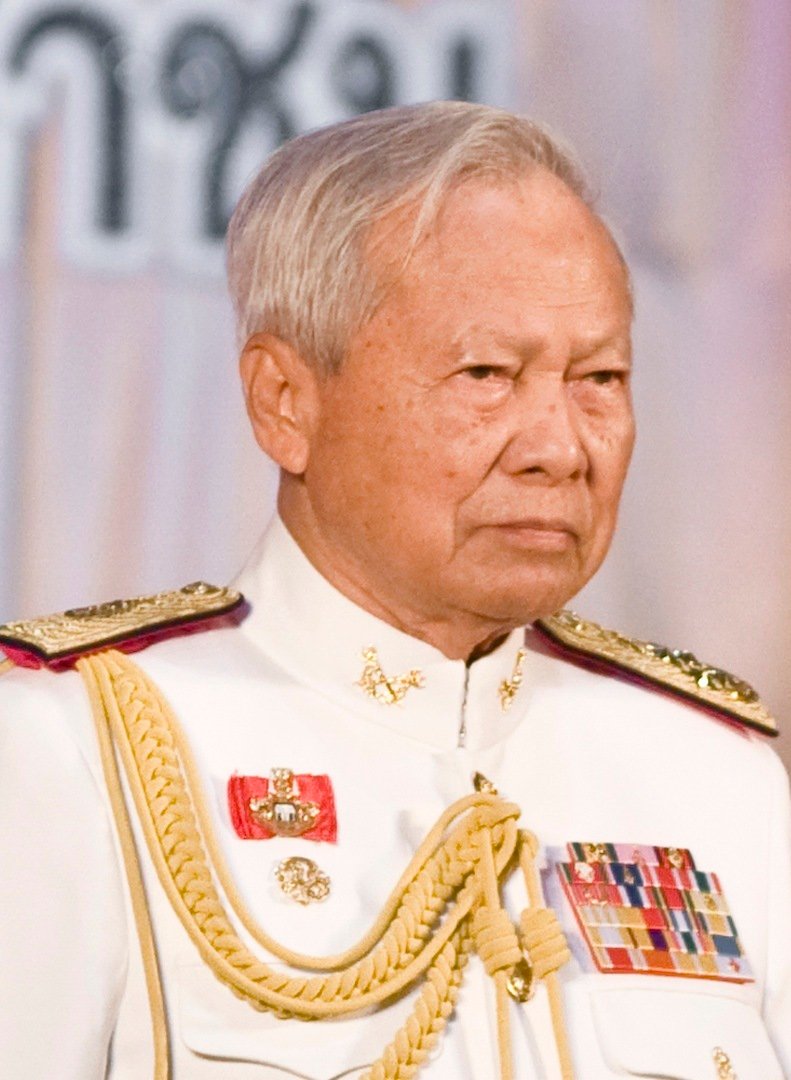 Thailand · Politics
1920—2019
Prem Tinsulanonda
16th Prime Minister of Thailand, 1980–1988The army commander who led Thailand through eight years of parliamentary coalition government before becoming a long-serving royal adviser and regent.Read biography Thailand · Politics
1932—
Chavalit Yongchaiyudh
Retired general and former prime ministerA former army commander who entered electoral politics, formed the New Aspiration Party and served as prime minister as the baht crisis became a regional financial shock.Read biography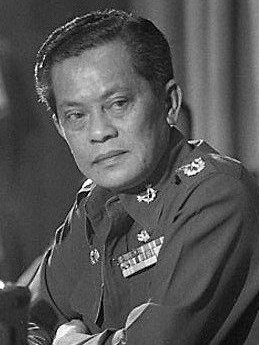 Thailand · Politics
1917—2003
Kriangsak Chamanan
15th Prime Minister of Thailand and military officerThe general who emerged from the October 1977 coup, relaxed parts of Thanin-era repression, restored an elected House and governed during the Indochina refugee crisis.Read biography Thailand · Politics
1927—2016
Bhumibol Adulyadej
King of Thailand, 1946–2016Thailand’s longest-reigning monarch, whose seven decades on the throne spanned rapid development, repeated political crises and profound social change.Read biography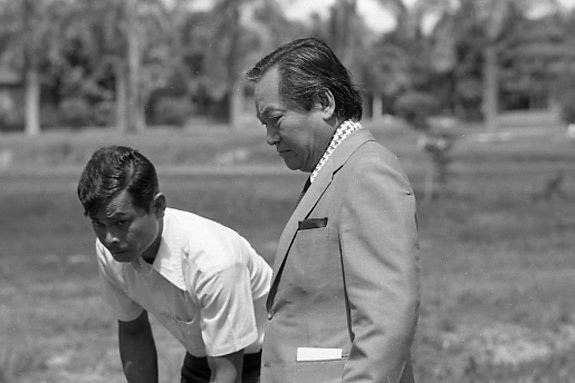 Thailand · Politics
1920—1998
Chatichai Choonhavan
Diplomat, party leader and former prime ministerThe elected prime minister who accelerated economic diplomacy with Indochina and led a booming coalition government until the military removed it in February 1991.Read biographyQuick answers
Common questions
- What does 66/2523 mean?
- It means the 66th Prime Minister’s Office order issued in Buddhist Era 2523, corresponding to 1980. English sources often shorten it to Order 66/23.
- When was Order 66/2523 issued?
- Prem Tinsulanonda’s government issued it on 23 April 1980.
- What was the order’s central principle?
- It placed political objectives ahead of military operations, calling for participation, attention to grievances and reintegration alongside security action.
- Did it offer an amnesty?
- The wider policy created routes for insurgents and supporters to leave the movement, avoid automatic punishment and return as participants in national development.
- Did one order end Thailand’s communist insurgency?
- No. It was important, but regional geopolitical change, CPT divisions, reduced external support, development and military pressure also drove the decline.
- What was Order 65/2525?
- It was a 1982 follow-up plan that expanded the political offensive and linked security policy to democratic organisation and development.
Primary and institutional sources
How this history was checked
Dates, legal milestones and historical claims are checked against the official and institutional records below. This article was reviewed on 3 October 2026.
- Journal of Arts and Thai Studies, Silpakorn UniversityA Paradigm Shift in Policy-making: The Evolution of Thailand’s Anti-Communism Strategy through Order No. 66/2523
- U.S. Army University PressThailand’s political counter-insurgency and Order 66/23
- Thailand National Reconciliation CommissionOvercoming Violence Through the Power of Reconciliation
- ANU PressA Genealogy of Bamboo Diplomacy: Order 66/2523 and regional change
- King Prajadhipok’s Institute JournalPrem Tinsulanonda and his major public policies, 1980–1988
- Library of CongressThailand: A Country Study
- Secretariat of the Prime Minister of ThailandOfficial directory of prime ministers of Thailand
- Wikimedia CommonsChavalit Yongchaiyudh portrait and CC BY-SA 4.0 licence record