
The short answer
Thai Rak Thai won 377 of 500 seats in 2005, giving Thaksin Shinawatra Thailand’s first modern single-party majority government. The landslide rewarded visible social programmes, economic recovery and party organisation. It also concentrated power so completely that the next political contest moved beyond ordinary parliamentary opposition.
Election results
Every party represented in the 2005 House
Only four parties won seats, and Thai Rak Thai held more than three quarters of the chamber.
| Political party | Total seats | Constituency | Party list |
|---|---|---|---|
| Thai Rak Thai | 377 | 310 | 67 |
| Democrat Party | 96 | 70 | 26 |
| Chart Thai Party | 25 | 18 | 7 |
| Mahachon Party | 2 | 2 | 0 |
Chronology
A timeline of the turning points
Thai Rak Thai delivers national programmes
Universal health coverage, village funds and debt relief made government policy visible in local communities.
Growth and rights controversies coexist
Strong economic performance accompanied killings in the drug campaign and escalating southern violence.
The Indian Ocean tsunami strikes
At least 5,300 people died in Thailand and emergency response became a central public concern.
Twenty-five parties contest 500 seats
A total of 2,259 candidates competed under the mixed system introduced by the 1997 Constitution.
Turnout exceeds 75 per cent
More than 33.6 million of 44.8 million registered voters participated.
Thai Rak Thai wins 377 seats
The governing party gained 129 seats and secured a majority without coalition partners.
The Democrats fall to 96 seats
Party leader Banyat Bantadtan accepted responsibility and announced his resignation.
A single-party cabinet takes office
Thaksin began a second term backed by the strongest elected House majority in Thai history to that date.
Opposition shifts outside parliament
Conflict over accountability, media, institutions and the Shin Corp sale expanded into mass protest.
Thaksin dissolves the House
An early election was called less than thirteen months after the landslide.
A military coup removes the government
The armed forces repealed the 1997 Constitution while Thaksin was abroad.
Why was Thai Rak Thai so strong before the election?
The first Thaksin government completed a full parliamentary term while implementing policies that voters could identify directly. Universal health coverage, village revolving funds, farm-debt relief and local-product promotion strengthened Thai Rak Thai’s organisation and reputation, particularly across the north and northeast.
Economic conditions also helped the incumbent. Real GDP grew 6.8 per cent in 2003 and 6.1 per cent in 2004 according to the IMF. Recovery had multiple causes, but the government successfully connected growth, domestic demand and programme delivery to its electoral brand.
What issues shaped the campaign?
The Indian Ocean tsunami struck Thailand only six weeks before polling day and killed at least 5,300 people in the country. The government’s rapid emergency response strengthened Thaksin’s leadership image. Thai Rak Thai also promised continued economic programmes and infrastructure investment.
The opposition focused on corruption, concentration of power, media pressure, bird-flu management and worsening violence in the southern border provinces. Human-rights criticism was severe after the 2003 drug campaign and the deaths at Krue Se and Tak Bai in 2004, but it did not produce a unified electoral alternative with comparable national reach.
What were the 2005 election results?
Thai Rak Thai won 377 of 500 seats, including 310 constituency seats and sixty-seven party-list seats. The Democrats fell from 128 seats to ninety-six. Chart Thai won twenty-five and the new Mahachon Party two, leaving only four parties represented in the House.
The Election Commission recorded 44,846,472 registered electors and 33,693,624 voters, a turnout of 75.13 per cent. Thai Rak Thai’s 129-seat gain gave it well above the 251 required to govern alone.
Why was the result historically unprecedented?
Thaksin became the first elected Thai prime minister to complete a full term and win a second consecutive mandate. Thai Rak Thai became the first party in the modern parliamentary era able to form a government without coalition partners. The outcome appeared to fulfil the 1997 Constitution’s goal of stable, programmatic party government.
The scale of victory also reduced ordinary parliamentary constraints. Even a unified opposition could not threaten the government in confidence votes, and internal party discipline became more important than bargaining among coalition partners. Stability and concentration were therefore two descriptions of the same result.
Where did support and opposition differ?
Thai Rak Thai dominated much of the north, northeast and central regions, where government programmes and candidate networks reinforced one another. The Democrats retained their principal strength in the south, although violence there complicated campaigning and governance.
Bangkok and national civil-society networks became increasingly important to extra-parliamentary opposition. The geographical divide was not absolute, but it helped turn later disputes into arguments about whose votes, institutions and public spaces could legitimately decide government.
Did the landslide resolve concerns about accountability?
No. Supporters treated the result as democratic approval of the government’s record. Critics argued that control of parliament intensified concerns about conflicts of interest, independent agencies, media influence and protection of rights. These were not interchangeable claims: a large mandate proved electoral support, but did not by itself answer allegations about how public power was exercised.
A balanced account must preserve both facts. Millions of voters endorsed policies that redistributed services and resources, while documented abuses—including drug-war killings and security-force violence in the south—required investigation regardless of popularity.
How did the 2005 victory lead toward the 2006 crisis?
The landslide left opposition parties with limited leverage inside the House, so conflict increasingly moved into media, courts, regulatory bodies and the street. Demonstrations expanded during 2005 and surged after the Shinawatra family sold its Shin Corp holdings to Temasek in January 2006 without a capital-gains tax liability under the transaction’s structure.
Thaksin dissolved parliament on 24 February and called an early election. The main opposition parties boycotted the April vote, constitutional rules prevented the House from being completed and courts annulled the result. The deadlock ended not through another completed election but through the military coup of 19 September 2006.
Continue the chronology
Related history guides
The 2001 Thai General Election
Compare the first Thai Rak Thai victory and its initial coalition.
Read the timeline2001–2005Thaksin’s First Government
Assess the policy record, economic recovery and rights controversies behind the vote.
Read the timeline11 October 1997The 1997 Constitution of Thailand
Read why the charter tried to produce stronger parties and stable cabinets.
Read the timeline2 April–8 May 2006The Annulled 2006 Thai General Election
Continue to the boycott, incomplete House and constitutional ruling that followed the landslide.
Read the timeline19 September 2006The 2006 Thai Coup
Continue to protest, the annulled election and military removal of the government.
Read the timeline1932–presentPrime Ministers of Thailand
Compare Thaksin’s route to office with elected, appointed and military premiers.
Read the timelineConnected biographies
Seven biographies connecting the landslide, opposition and the coming constitutional crisis
 Thailand · Politics
1949—
Thaksin Shinawatra
Businessman and former prime ministerA telecommunications entrepreneur who became prime minister in 2001, transformed Thai electoral politics and remained influential through two decades of conflict.Read biography Thailand · Politics
1961—
Sudarat Keyuraphan
Former public health minister and party leaderA former public health and agriculture minister who helped implement Thailand’s universal coverage scheme before later leading Pheu Thai’s 2019 campaign and Thai Sang Thai.Read biography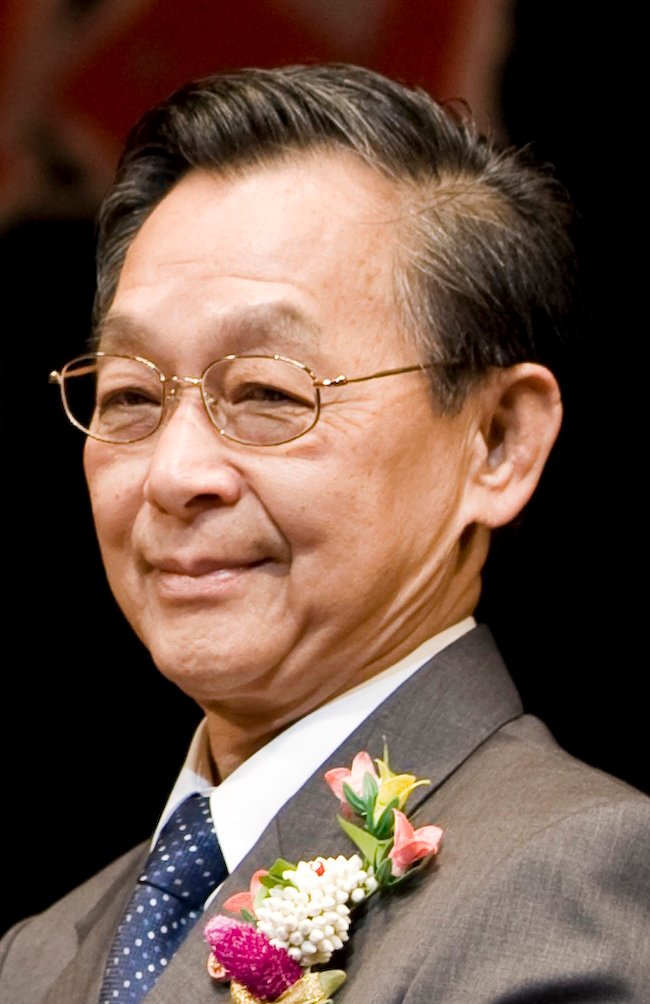 Thailand · Politics
1938—
Chuan Leekpai
20th Prime Minister of Thailand, 1992–1995 and 1997–2001The lawyer and veteran parliamentarian who led Thailand after the 1992 democratic transition and returned during the Asian financial crisis.Read biography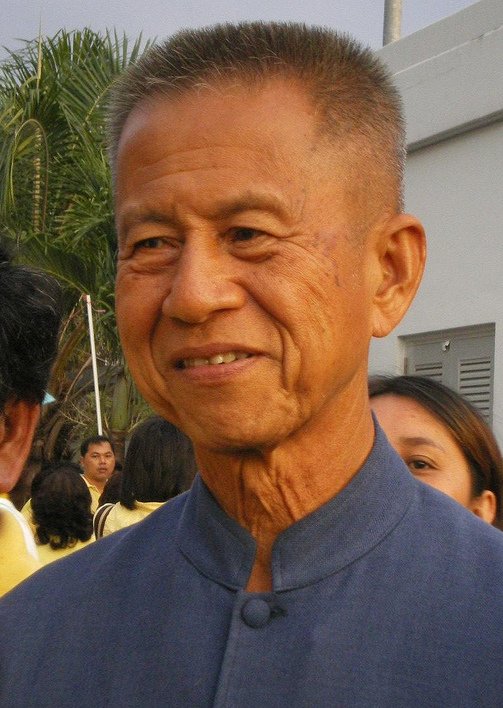 Thailand · Politics
1935—
Chamlong Srimuang
Former Bangkok governor, party leader and democracy activistThe former general and Bangkok governor whose austere public-service image, Palang Dharma movement and Black May leadership made him a major democratic campaigner.Read biography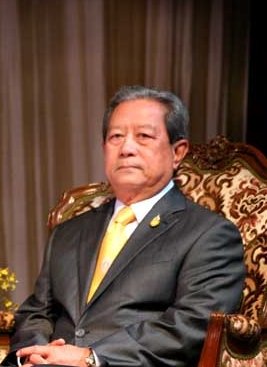 Thailand · Politics
1943—
Surayud Chulanont
24th Prime Minister of Thailand, 2006–2008The former army commander and privy councillor appointed prime minister after the 2006 coup, who oversaw a new constitution and Thailand’s return to elected government.Read biography Thailand · Politics
1927—2016
Bhumibol Adulyadej
King of Thailand, 1946–2016Thailand’s longest-reigning monarch, whose seven decades on the throne spanned rapid development, repeated political crises and profound social change.Read biography Thailand · Politics
1964—
Abhisit Vejjajiva
27th Prime Minister of Thailand, 2008–2011The Oxford-educated Democrat leader who became prime minister through a parliamentary coalition, launched crisis stimulus and governed during Thailand’s 2010 protest violence.Read biographyQuick answers
Common questions
- When was the 2005 Thai general election?
- It was held on 6 February 2005 for all 500 House seats.
- How many seats did Thai Rak Thai win in 2005?
- Thai Rak Thai won 377 seats: 310 constituency seats and sixty-seven party-list seats.
- What was voter turnout?
- The Inter-Parliamentary Union recorded 33,693,624 voters and turnout of 75.13 per cent.
- Why was Thaksin’s victory historic?
- He was the first elected Thai prime minister to complete a full term and win re-election, while Thai Rak Thai became the first modern party able to govern alone.
- How many seats did the Democrat Party win?
- The Democrats won ninety-six seats, down from 128 after the 2001 election.
- Did the 2005 election directly cause the 2006 coup?
- No. The result created a dominant government, but the coup followed a separate escalation involving protests, the Shin Corp sale, an opposition boycott, an annulled election and institutional deadlock.
Primary and institutional sources
How this history was checked
Dates, legal milestones and historical claims are checked against the official and institutional records below. This article was reviewed on 3 October 2026.
- Inter-Parliamentary UnionThailand parliamentary election, 6 February 2005
- International Monetary FundIMF concludes the 2004 Article IV consultation with Thailand
- International Monetary FundIMF concludes the 2005 Article IV consultation with Thailand
- Human Rights WatchWorld Report 2005: Thailand
- Human Rights WatchTimeline of Thailand’s war on drugs
- World Health OrganizationPolitical economy of primary-health-care reform in Thailand
- ConstitutionNet · International IDEAConstitutional history of Thailand
- Wikimedia CommonsThaksin Shinawatra portrait and public-domain record