
The short answer
Thailand’s Young Turks seized key sites in Bangkok on 1 April 1981 with an unusually large military force. Prem Tinsulanonda established a counter-command in Korat, the royal family visibly aligned with his side and regional forces isolated the rebels. The takeover collapsed two days later without a major battle.
Chronology
A timeline of the turning points
The Young Turks become coup makers
A network of middle-ranking Class 7 officers supplied operational force to the coups and political realignments of the late 1970s.
They help shift support from Kriangsak to Prem
Military pressure contributed to Kriangsak’s resignation and Prem’s appointment through the National Assembly.
The alliance with Prem deteriorates
Cabinet choices, military promotion and the distribution of influence divided the officers from the premier they had supported.
Prem refuses to lead a takeover
Accounts of the plot describe Class 7 officers seeking the prime minister’s cooperation before moving without him.
Rebel units seize key points in Bangkok
Forces under the Revolutionary Council occupied communications and government sites while announcing Prem’s removal.
Prem establishes authority from Korat
The prime minister reached the Second Army base at Nakhon Ratchasima and publicly denounced the takeover.
Royal presence changes the political balance
The royal family’s presence in the northeast visibly aligned the monarchy with Prem rather than the Bangkok coup command.
Regional forces rally to the government
Commands outside Bangkok, together with naval and air-force elements, isolated the rebels despite their large concentration of troops.
Loyal forces retake Bangkok
The takeover collapsed without a major battle, and leading conspirators fled or surrendered.
Arthit rises as the army is reorganised
Thirty-eight officers were discharged, and Arthit Kamlang-ek advanced after helping organise the loyalist response.
Who were Thailand’s Young Turks?
The name referred to a network of ambitious middle-ranking officers, many associated with Chulachomklao Royal Military Academy Class 7. They criticised senior-command patronage, corrupt politicians and social inequality, presenting a disciplined military transformation as the answer to weak government and communist challenge.
They were not democratic reformers in the ordinary electoral sense. The group had helped provide operational force for earlier military interventions and believed that officers could legitimately restructure politics. Their influence came from command of combat units around Bangkok and from solidarity built through academy and field-service networks.
Why did they turn against Prem?
The Young Turks had helped weaken Kriangsak Chamanan and supported Prem Tinsulanonda’s succession in March 1980. They expected influence over cabinet composition, promotion and the direction of government. Prem instead balanced their support against senior officers, parties, technocrats, the palace and other military factions.
A cabinet reshuffle and disputes over appointments deepened the rupture. More broadly, the officers believed the hybrid parliamentary order still protected self-interested politicians. What they described as national reform also served a factional struggle over who would control the army and inherit senior command.
What happened on 1 April 1981?
Rebel units seized important sites in Bangkok and announced a Revolutionary Council under General Sant Chitpatima, then deputy army commander. Manoonkrit Roopkachorn and other Class 7 officers formed the organisational core. Their forces were extensive enough that the first hours resembled many successful Thai coups.
Prem did not resign or remain isolated in the capital. He reached the Second Army base at Nakhon Ratchasima, commonly called Korat, and declared the coup leaders traitors. That created an alternative command centre from which loyal forces, radio messages and negotiations could reverse the apparent takeover.
Why did the royal family’s location matter?
King Bhumibol, Queen Sirikit and other members of the royal family were in the northeast during the crisis. Their visible association with Prem’s side denied the rebels the royal acceptance that had often helped transform a seizure of installations into recognised government. Contemporary reporting treated that alignment as decisive.
The episode should not be reduced to a single royal command. Regional-army loyalties, air-force and naval positions, factional hesitation and Prem’s own military network also mattered. Royal presence worked because it reinforced a coalition capable of acting against the coup, not because symbolism alone retook Bangkok.
How could a force controlling Bangkok still lose?
The rebels concentrated substantial combat power in the capital but failed to secure the whole chain of command. Second, Third and Fourth Army elements did not accept the takeover, while loyal naval and air-force support narrowed the council’s options. Prem retained a functioning government centre rather than becoming a captive or exile.
The conspirators also faced internal hesitation and lacked an uncontested senior leader who could translate force into a legitimate settlement. As opposition converged, the costs of fighting other Thai units rose. Loyal troops entered Bangkok on 3 April, and the rebellion dissolved without the large battle its troop numbers had made possible.
What changed inside the military afterward?
The failure abruptly reduced Class 7’s influence. Thirty-eight officers were discharged, and the command structure was reshuffled. Arthit Kamlang-ek, a key organiser of the response from the northeast, rose rapidly and became army commander in 1982. His ascent created a new factional centre rather than ending military competition.
Prem relinquished the army command later in 1981 but remained prime minister. This separation helped him govern as a broker above active command while preserving strong military ties. The government survived another failed coup in 1985, demonstrating that the 1981 result constrained but did not eliminate conspiratorial politics.
Why was the failed coup a constitutional turning point?
The elected House did not independently defeat the rebels, and Prem himself was an unelected general. Yet the failure showed that control of central installations was no longer sufficient. A successful takeover required wider military, royal and political acceptance than the Young Turks could obtain.
Prem’s survival strengthened the hybrid order built under the 1978 Constitution. Coalition parliament, appointed institutions and military networks continued to coexist for the rest of the decade. That stability supported gradual electoral expansion, although the successful 1991 coup later proved that the armed forces had not accepted permanent civilian supremacy.
Continue the chronology
Related history guides
Order 66/2523 and the Prem Era
Begin with Prem’s political strategy and the coalition government challenged by the Young Turks.
Read the timeline22 December 1978The 1978 Constitution of Thailand
Understand the hybrid constitutional order that survived the attempted takeover.
Read the timeline22 April 1979The 1979 Thai General Election
Trace the elected House and political transition through which Prem reached office.
Read the timeline18 April 1983The 1983 Thai General Election
Follow the constitutional confrontation and election held after the Young Turks lost influence.
Read the timeline9 September 1985The 1985 Thai Coup Attempt
Continue to the later rebellion organised through surviving Class 7 and armoured-unit loyalties.
Read the timeline20 October 1977The 1977 Thai Coup
Compare the successful takeover that helped elevate the same military generation.
Read the timeline23 February 1991The 1991 Thai Coup
Continue to the later intervention that succeeded after the Prem era ended.
Read the timelineConnected biographies
Four biographies connecting the challenged premiership, royal alignment, earlier military transition and the army’s later reorganisation
 Thailand · Politics
1920—2019
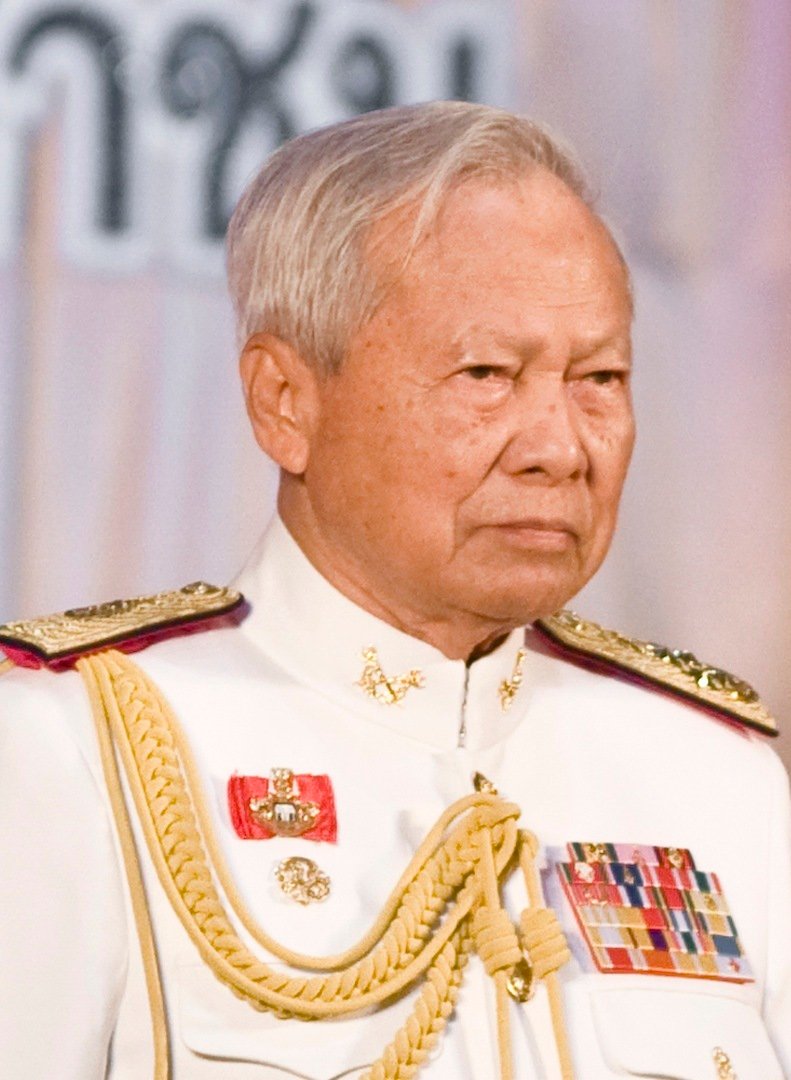
Prem Tinsulanonda
16th Prime Minister of Thailand, 1980–1988The army commander who led Thailand through eight years of parliamentary coalition government before becoming a long-serving royal adviser and regent.Read biography Thailand · Politics
1927—2016
Bhumibol Adulyadej
King of Thailand, 1946–2016Thailand’s longest-reigning monarch, whose seven decades on the throne spanned rapid development, repeated political crises and profound social change.Read biography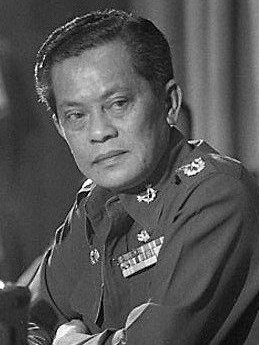 Thailand · Politics
1917—2003
Kriangsak Chamanan
15th Prime Minister of Thailand and military officerThe general who emerged from the October 1977 coup, relaxed parts of Thanin-era repression, restored an elected House and governed during the Indochina refugee crisis.Read biography Thailand · Politics
1932—
Chavalit Yongchaiyudh
Retired general and former prime ministerA former army commander who entered electoral politics, formed the New Aspiration Party and served as prime minister as the baht crisis became a regional financial shock.Read biographyQuick answers
Common questions
- When was the 1981 Thai coup attempt?
- It began on 1 April 1981 and collapsed on 3 April when forces loyal to Prem Tinsulanonda retook Bangkok.
- Why is it called the April Fools’ Coup?
- The attempt began on 1 April and failed within two days, producing the ironic English nickname alongside Thai names for the Young Turks rebellion.
- Who led the coup attempt?
- General Sant Chitpatima headed the announced Revolutionary Council, while Manoonkrit Roopkachorn and other Class 7 Young Turks formed its operational core.
- Where did Prem organise resistance?
- He established an alternative government and military command at the Second Army base in Nakhon Ratchasima, commonly called Korat.
- Why did the coup fail?
- The rebels lacked royal acceptance and nationwide military support, while regional armies, naval and air-force elements rallied to Prem’s side.
- Was there major fighting?
- The crisis ended without a major battle when the rebel coalition fragmented and loyal forces re-entered Bangkok on 3 April.
Primary and institutional sources
How this history was checked
Dates, legal milestones and historical claims are checked against the official and institutional records below. This article was reviewed on 3 October 2026.
- Southeast Asian Studies, Kyoto UniversityCoups in Thailand, 1980–1991: Classmates and military factions
- Institute of Public Policy StudiesThailand: State-Building, Democracy and Globalization
- Rangsit UniversityThe rebellion of the military in the government of General Prem Tinsulanonda
- Library of CongressThailand: A Country Study
- The Washington PostPrem establishes a counter-command after the 1 April takeover
- United Press InternationalThai forces end the short-lived coup, 3 April 1981
- National Archives of ThailandPrem Tinsulanonda Prime Minister Archives
- Wikimedia CommonsPrem Tinsulanonda portrait and CC BY 2.0 licence record