
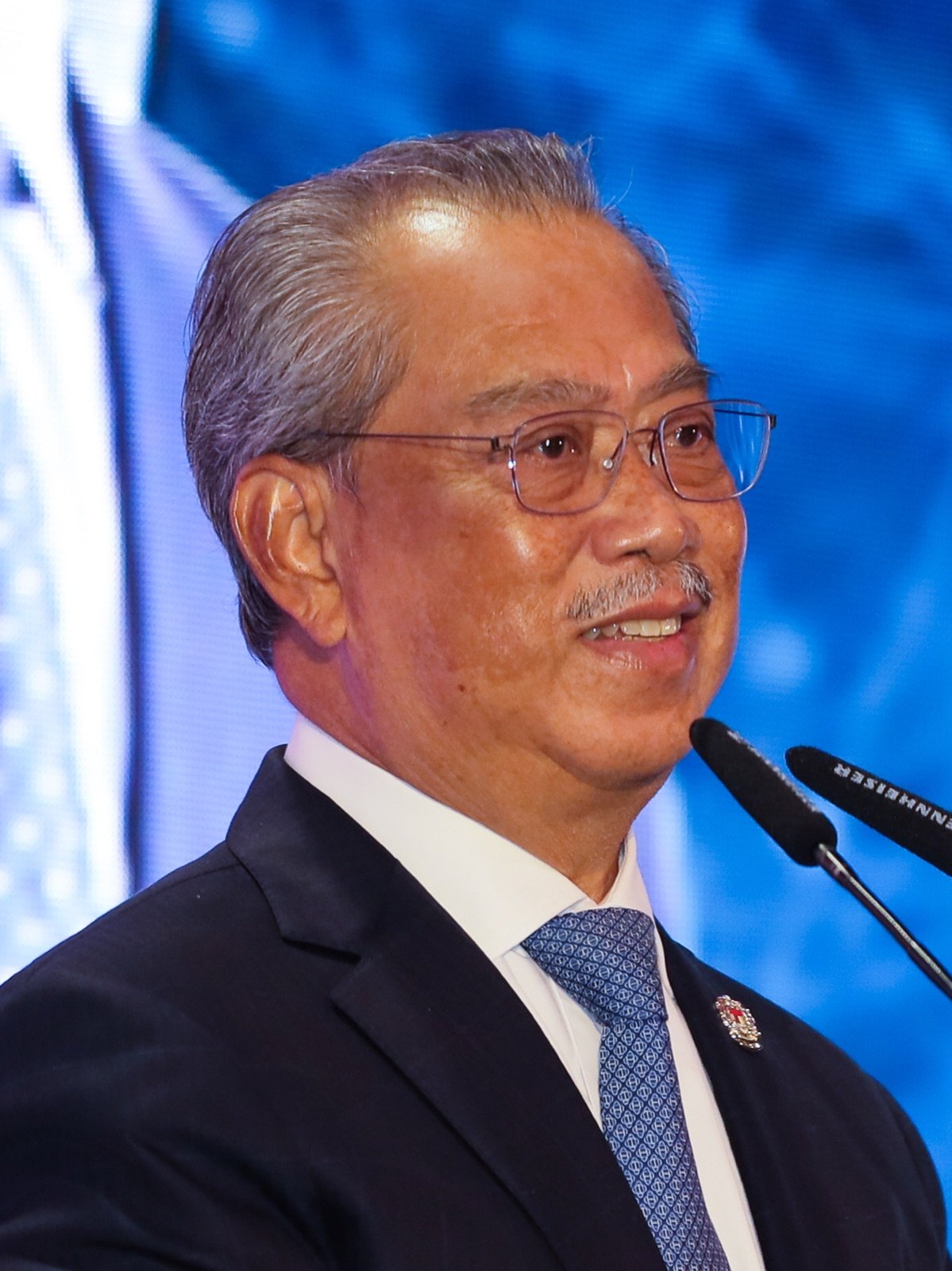
In this biography
Quick facts
- Born
- 15 May 1947
- Birthplace
- Muar, Johor
- Country
- Malaysia
- Nationality
- Malaysian
- Known for
- Leading Malaysia during the first phase of the COVID-19 pandemic
- Office
- Prime Minister, 2020–2021
- Earlier office
- Deputy Prime Minister, 2009–2015
- Constituency
- Pagoh
- Political base
- BERSATU and Perikatan Nasional
Why this life matters
Muhyiddin’s short premiership joined an unusual route to office with emergency governance, lockdowns, economic relief and a continuing struggle over parliamentary support.
Timeline
Key moments
Born in Muar
Born in Johor on 15 May.
Entered Parliament
Won the Pagoh parliamentary seat.
Led Johor
Served as Menteri Besar for nine years.
Became deputy prime minister
Served under Najib Razak while also holding the education portfolio.
Helped form BERSATU
Joined a new party after his dismissal from UMNO.
Became prime minister
Was appointed on 1 March after the collapse of the Pakatan Harapan government.
Pandemic controls began
The Movement Control Order and PRIHATIN relief package defined the first months of his administration.
Resigned after losing support
Submitted his resignation on 16 August after acknowledging the loss of a parliamentary majority.
Four decades in government
Muhyiddin was born in Muar in 1947 and entered Parliament in 1978. He served as Johor’s Menteri Besar from 1986 to 1995, then held federal portfolios including domestic trade, agriculture, international trade, education and home affairs.
As Najib Razak’s deputy prime minister from 2009, he was one of UMNO’s most senior leaders. He was removed from the cabinet in 2015 after publicly raising concerns about 1MDB, expelled from UMNO and became a founding leader of BERSATU.
His path from UMNO deputy to BERSATU founder explains why the 2020 government was not simply a continuation of either the pre-2018 BN administration or the PH cabinet elected in 2018.
The 2020 change of government
BERSATU joined Pakatan Harapan and won federal power in 2018. Muhyiddin became home minister. In February 2020, the coalition fractured after Mahathir’s resignation and a realignment commonly known as the Sheraton Move.
The Yang di-Pertuan Agong appointed Muhyiddin prime minister after consultations intended to determine who was likely to command majority confidence in the Dewan Rakyat. The new Perikatan Nasional administration took office without a general election, making parliamentary legitimacy a persistent issue throughout its life.
The constitutional question was who could command confidence in the existing Dewan Rakyat, not which bloc had won the most votes in 2018. That distinction is the key to understanding the change of prime minister without a new nationwide vote.
Government during the pandemic
Within weeks, COVID-19 became the government’s overriding challenge. A nationwide Movement Control Order began in March 2020. The administration announced the PRIHATIN economic package and later recovery measures to support households, workers and businesses through restrictions and recession.
Early public-health success was followed by renewed outbreaks, strained hospitals and repeated changes to movement rules. A state of emergency in 2021 suspended Parliament for several months, producing controversy over oversight even as vaccination and the National Recovery Plan expanded.
The timing compressed two different crises. Muhyiddin took office in early March 2020, and the nationwide Movement Control Order began on 18 March. The new administration’s legitimacy debate therefore unfolded while public-health operations were disrupted.
Loss of majority support
Muhyiddin’s coalition depended on a narrow and shifting majority. By August 2021, withdrawals of support made his position untenable. He resigned on 16 August, explicitly linking the decision to the constitutional requirement that a prime minister retain the confidence of the Dewan Rakyat.
His legacy is inseparable from the pandemic: emergency controls, welfare support and vaccination on one side; political uncertainty and contested accountability on the other. His route to office also accelerated Malaysia’s era of fluid coalitions.
His own resignation address explicitly invoked Article 43(4) after support was withdrawn. It is unusually direct primary evidence for how parliamentary confidence, rather than the expiry of an electoral term, can end a premiership.
Sources for this section: [5]
Quick answers
Frequently asked questions about Muhyiddin Yassin
- When was Muhyiddin Yassin Malaysia’s prime minister?
- He was Malaysia’s eighth prime minister from 1 March 2020 until his resignation on 16 August 2021.
- How did Muhyiddin become prime minister without a new election?
- After the governing coalition collapsed, the King appointed him on the basis that he was likely to command confidence in the existing Dewan Rakyat. No new general election preceded the appointment.
- When did the first nationwide Movement Control Order begin?
- The first nationwide MCO began on 18 March 2020, shortly after Muhyiddin took office. The PRIHATIN economic relief package followed on 27 March.
- Why did Muhyiddin resign in August 2021?
- He acknowledged that he had lost majority support in Parliament. His 16 August resignation address invoked Article 43(4), which concerns a prime minister who no longer commands confidence.
Keep exploring
Lives connected to this story
- Rina Harun
Read Rina Harun’s rural and women’s cabinet responsibilities and her later organisational role within Bersatu.
- Saifuddin Abdullah
Read the communications and multimedia minister in Muhyiddin’s government, whose two foreign-minister terms were separate appointments.
- Mahathir Mohamad
Read about the prime minister whose resignation preceded the February–March 2020 coalition change.
- Najib Razak
Explore the earlier administration in which Muhyiddin served as deputy prime minister.
- Ismail Sabri Yaakob
Follow his successor and the transition after the August 2021 resignation.
Sources and further reading
Explore the evidence
These references support the biography and offer further reading. Official records, first-person accounts and independent reporting provide different perspectives; image records document attribution and licensing.
- 1. Prime Minister’s Office of MalaysiaFormer Prime Ministers of Malaysia
- 2. Prime Minister’s Office speech archiveSpecial address on appointment as prime minister
This 2 March address directly explains the appointment and the absence of a new election. It is the officeholder’s account, not an independent ruling on every political dispute.
- 3. Prime Minister’s Office speech archiveAnnouncement of the new cabinet, 9 March 2020
- 4. Prime Minister’s Office of MalaysiaMarch 2020 Movement Control Order announcement
- 5. Prime Minister’s Office speech archiveResignation address, 16 August 2021
- 6. Parliament of MalaysiaParliament member archive: Pagoh
- 7. Wikimedia CommonsPortrait and CC BY 2.0 licence record
- 8. Prime Minister’s Office speech archive12 January 2021: emergency announcement and parliamentary arrangements
The January emergency announcement supplies the contemporaneous parliamentary arrangements; a later resignation speech alone is not used to establish them.
- 9. Ministry of Finance / PMOPRIHATIN official English booklet: MCO and relief chronology
The official relief booklet distinguishes the 18 March MCO start from the 27 March PRIHATIN announcement. No inference about the effectiveness of all measures is drawn from the programme announcement.

