
The short answer
Malaysia currently combines two powerful functions in one constitutional office: advising and representing the federal government, and controlling federal criminal prosecutions. A 2026 bill proposes separation, but this guide distinguishes the law in force from the reform still before Parliament.
The criminal-justice chain
Five roles that should not be confused
A public controversy can pass through investigation, prosecution and judgment while government lawyers perform a separate advisory function.
| Role | Core function | Typical decision | What it does not prove |
|---|---|---|---|
| Attorney General | Advise and represent the federal government | Government legal position, drafting or civil-litigation strategy | Criminal guilt or innocence |
| Public Prosecutor | Control federal criminal prosecutions | Whether to institute, conduct or discontinue proceedings | The final verdict |
| Investigation agency | Gather evidence under its governing law | What to investigate and what material to refer | A conviction or an unrestricted power to charge |
| Trial court | Decide law, evidence, guilt and sentence | Judgment on the case presented in court | Whether every suspected offence should be charged |
| Parliament | Make the legal framework and scrutinise institutions | Constitutional amendments, statutes, budgets and oversight | Individual guilt or day-to-day prosecution direction |
Chronology
A timeline of the turning points
Article 145 creates a constitutional Attorney General
The independence Constitution makes the Attorney General the principal legal adviser and gives the officeholder prosecutorial authority, joining two different public functions in one office.
A substituted Article 145 creates the current appointment model
The redesigned provision moves appointment to the King acting on prime-ministerial advice and provides for service during the King’s pleasure, while retaining the combined legal-advice and prosecution functions.
The revised Criminal Procedure Code takes effect nationwide
Act 593 confirms that the Attorney General is the Public Prosecutor and controls criminal prosecutions and proceedings under the Code.
The MACC Act preserves Public Prosecutor control
Act 694 establishes MACC as the specialised investigator but requires prosecutions under the Act to be instituted by or with the consent of the Public Prosecutor.
Sundra Rajoo recognises exceptional judicial review
The Federal Court holds that prosecutorial discretion is not wholly immune from review, although intervention remains confined to appropriate, rare and exceptional cases.
Institutional reform work moves toward a separation model
A government task force, comparative studies and parliamentary engagement develop options for separating legal advice from federal prosecution.
Mohd Dusuki Mokhtar becomes Attorney General
The former head of the AGC Trial and Appellate Division takes office under Article 145 and, under the existing framework, also serves as Public Prosecutor.
A constitutional separation bill receives first reading
The Constitution (Amendment) (No. 2) Bill 2026 proposes a distinct Public Prosecutor’s office, a fixed term and consequential changes to the Constitution.
A parliamentary committee revises the safeguards
The Dewan Rakyat sends the bill to a special select committee. Its report proposes a stronger parliamentary role, no prime-ministerial role in the appointment and a non-renewable seven-year term.
The dual office remains the current law
The second reading remains pending ahead of the October parliamentary sitting. The proposed separation is therefore not described here as an enacted or operative change.
Are the Attorney General and Public Prosecutor different people?
Under Malaysia’s current Constitution, they are two roles held by the same person. Article 145 makes the Attorney General the legal adviser to the Yang di-Pertuan Agong, Cabinet and ministers. The same officeholder exercises the Public Prosecutor’s discretion to institute, conduct or discontinue federal criminal proceedings, subject to the constitutional exceptions.
The titles describe functions, not two existing federal officeholders. When the Attorney General advises a ministry on a bill, contract or constitutional question, the office acts as government legal adviser. When it evaluates an investigation paper or directs a criminal case, it acts through the Public Prosecutor function.
That distinction matters even before any reform. Advice to government, civil representation, law drafting and prosecution use different professional judgments. Saying that the roles are combined does not mean every lawyer in the Attorney General’s Chambers performs both tasks.
What does the Attorney General do?
Article 145(2) requires the Attorney General to advise the King, Cabinet or any minister on legal matters and to perform other legal duties referred or assigned by the King or Cabinet. The Attorney General’s Chambers supplies that work through advisory, drafting, civil, international-affairs, law-revision and other specialist divisions.
The federal government also needs representation in litigation. Federal counsel appear in constitutional, administrative, commercial and other civil proceedings involving the government. Drafting lawyers prepare bills and subsidiary legislation, while international-law officers advise on treaties, disputes and Malaysia’s external obligations.
The Attorney General is not the private lawyer of a prime minister. The client is the constitutional government and the office carries public-law duties. Legal professional judgment, confidentiality, candour to the court and the rule of law continue to matter even though appointment is made on the prime minister’s advice.
What powers belong to the Public Prosecutor?
Article 145(3) gives the Attorney General, acting as Public Prosecutor, discretion to institute, conduct or discontinue proceedings for an offence. The constitutional text excludes proceedings before a Syariah court, Native Court or court-martial, which operate under their own legal frameworks.
The Criminal Procedure Code states that the Attorney General is the Public Prosecutor and has control and direction of criminal prosecutions and proceedings under the Code. The Public Prosecutor can act personally or through authorised Deputy Public Prosecutors and other prosecuting officers where legislation permits.
Discretion is not a judicial finding of guilt. A decision to charge means the prosecution has chosen to place an allegation before a court; the prosecution must still prove every element to the required standard. A decision not to charge may reflect evidence, admissibility, public interest, jurisdiction or further investigation and is not by itself a factual declaration that nothing happened.
Who investigates and who prosecutes?
Police, MACC, regulators and other authorised agencies investigate within their respective laws. They receive reports, interview witnesses, search or seize under legal powers, obtain expert material and prepare investigation papers. The investigating body may recommend action, but a recommendation is not the charge itself.
Prosecutors assess whether admissible evidence supports each offence, whether more investigation is required and whether proceedings should begin or continue. The Public Prosecutor may direct further work or decline prosecution. Statutes such as the MACC Act expressly require Public Prosecutor consent even though specialist investigators built the file.
Courts then decide legal objections, admissibility, guilt, sentence and appeals. Keeping these stages separate protects accuracy: investigation establishes a suspected case, prosecution presents a legal case and judgment determines the result before the court.
What is a Deputy Public Prosecutor?
A Deputy Public Prosecutor, commonly called a DPP, is a legally authorised prosecutor who exercises delegated prosecution functions under the Public Prosecutor’s direction. DPPs review files, frame charges, conduct trials and appeals, advise investigators and make procedural decisions in court.
The Public Prosecutor cannot personally conduct every criminal matter. Delegation creates an operational prosecution service while preserving constitutional control in the office. Some enforcement agencies also work with prosecutors assigned to particular fields, but the investigator and prosecutor remain legally distinct roles.
A DPP’s duty is not to obtain a conviction at any cost. Prosecutors must act fairly, disclose material as required, respect the accused’s rights and assist the court toward a just determination. A strong prosecution service needs professional independence together with review, reasons, ethics and consistent policy.
Can a court review a prosecution decision?
Courts generally respect the wide discretion conferred by Article 145. They do not routinely substitute their own view on whether a charge should have been brought and ordinarily cannot command the Public Prosecutor to pursue a case the office has discontinued.
The discretion is not a licence to act outside the Constitution. In Sundra Rajoo, the Federal Court recognised that prosecutorial action can be amenable to judicial review in appropriate, rare and exceptional circumstances. Bad faith, illegality or a constitutionally impermissible basis may therefore raise a justiciable public-law question.
Judicial review of legality is different from a criminal trial. Even if a prosecution decision is challenged, the reviewing court is not deciding the accused’s guilt. The available remedy depends on the pleaded wrong, evidence and procedural stage.
What is the difference between a DNAA and an acquittal?
Section 254 of the Criminal Procedure Code allows the Public Prosecutor to inform the court before judgment that the prosecution will not continue. The proceedings are then stayed and the accused is discharged. The statute says that discharge does not amount to an acquittal unless the court directs otherwise.
A discharge not amounting to an acquittal—DNAA—ends the current proceeding without finally barring a later charge for the same offence. An acquittal gives the accused the protection attached to that final result, subject to any lawful prosecution appeal. A conviction means the court found the offence proved, subject to appeal or later legal relief.
A DNAA is therefore neither a conviction nor a declaration of innocence. Reporting should state the order precisely and explain whether the prosecution offered a reason, whether the court directed an acquittal and whether later proceedings remain legally possible.
How is the Attorney General appointed and removed?
Under Article 145(1), the Yang di-Pertuan Agong appoints a person qualified to be a Federal Court judge on the advice of the prime minister. The current Attorney General is Tan Sri Mohd Dusuki Mokhtar, who took office on 12 November 2024.
Article 145(5) provides that the Attorney General holds office during the pleasure of the King and may resign. In constitutional practice, the King ordinarily acts on advice except where the Constitution provides discretion. The office does not carry the same removal tribunal and fixed retirement protection as a superior-court judge.
These arrangements are central to the reform debate because the Attorney General may have to assess cases involving members of the executive whose prime minister advises the appointment. That structural concern does not prove interference in every decision, but it creates a recurring conflict-of-interest risk and problem of public confidence.
Why separate the Attorney General and Public Prosecutor?
The case for separation begins with incompatible appearances. A legal adviser is expected to protect the government’s lawful interests and give confidential advice. A prosecutor must decide impartially whether members of that government, its opponents or any other person should face criminal proceedings.
Separation can reduce that conflict, create specialised leadership and make responsibility clearer. It does not automatically guarantee independence. Appointment, tenure, removal, budget, staffing, prosecution policy, reporting, ethics and judicial review determine whether a new office can act fairly and be held accountable.
Independence also cannot mean secrecy without reasons. A prosecution service handles sensitive evidence and must protect trials, victims and witnesses, yet consistent public guidelines and reasoned explanations in major discontinuance decisions can strengthen equality before the law without turning Parliament into a case-by-case prosecutor.
What does the 2026 separation proposal contain?
The Constitution (Amendment) (No. 2) Bill 2026 proposes a distinct constitutional Public Prosecutor. The original bill created Article 145A, transferred prosecution and Pardons Board functions, provided for a Senior Deputy Public Prosecutor and allowed the Attorney General to continue the function during transition until the new officeholder was appointed.
After scrutiny, the parliamentary special select committee proposed stronger safeguards. Its July report called for appointment by the King on advice of the Judicial and Legal Service Commission, parliamentary scrutiny of the recommended candidate, no role for the prime minister or Cabinet, a non-renewable seven-year term, a code of ethics and authority for supporting legislation.
Those are proposals until the required constitutional amendment passes both Houses with the necessary support, receives the constitutional completion steps and comes into force. A committee report, first reading or announced target date does not itself split the office.
Where does the reform stand now?
The bill received its first reading on 23 February 2026 and was referred to a special select committee on 3 March. The committee reported in July, but the second reading was postponed so the revised model could be presented to the Conference of Rulers.
As reviewed on 4 October 2026, the separation had not been enacted. The next Dewan Rakyat sitting was due to begin on 5 October, and public statements anticipated further consideration, but the present legal position remained the combined Attorney General and Public Prosecutor under Article 145.
Readers should verify three things before treating the reform as complete: the final constitutional text passed by Parliament, the date of royal assent and gazettal, and the commencement notice or transitional appointment. This page uses an explicit review date because each of those facts can change.
Continue the chronology
Related history guides
How Malaysia’s Courts Work
Map the courts that try cases and exceptionally review prosecutorial legality.
Read the timeline1967–presentMACC: History, Powers and Oversight
Understand why investigation authority and prosecution authority remain separate.
Read the timeline1957–presentHow Malaysia’s Parliament Works
Follow the constitutional amendment process required to separate the offices.
Read the timeline2009–presentThe 1MDB Scandal
See how investigators, prosecutors, courts and foreign authorities handled different parts of one scandal.
Read the timelineBiography context
Explore Malaysia through connected lives
Explore Malaysia
Browse political biographies and institutional history in one connected archive.
Explore the biographiesReform contextMalaysia’s Reformasi Movement
Place prosecutorial independence inside the broader institutional-reform agenda.
Explore the biographiesAppointment contextMalaysia’s Constitutional Monarchy
Understand formal royal appointment and the constitutional operation of advice.
Explore the biographiesConnected biographies
Four prime ministers connected to prosecution, reform and public accountability debates
 Malaysia · Politics
1939—2025
Abdullah Ahmad Badawi
Fifth Prime Minister of MalaysiaA career civil servant and politician whose premiership opened with a reform mandate and Malaysia’s largest parliamentary victory.Read biography Malaysia · Politics
1953—
Najib Razak
Sixth Prime Minister of MalaysiaA political heir who led Malaysia for nine years before an historic election defeat and convictions in the SRC International and main 1MDB cases.Read biography Malaysia · Politics
1925—
Mahathir Mohamad
Fourth and seventh Prime Minister of MalaysiaA physician-politician whose two premierships—separated by fifteen years—made him the longest-serving and one of the most consequential leaders in Malaysian history.Read biography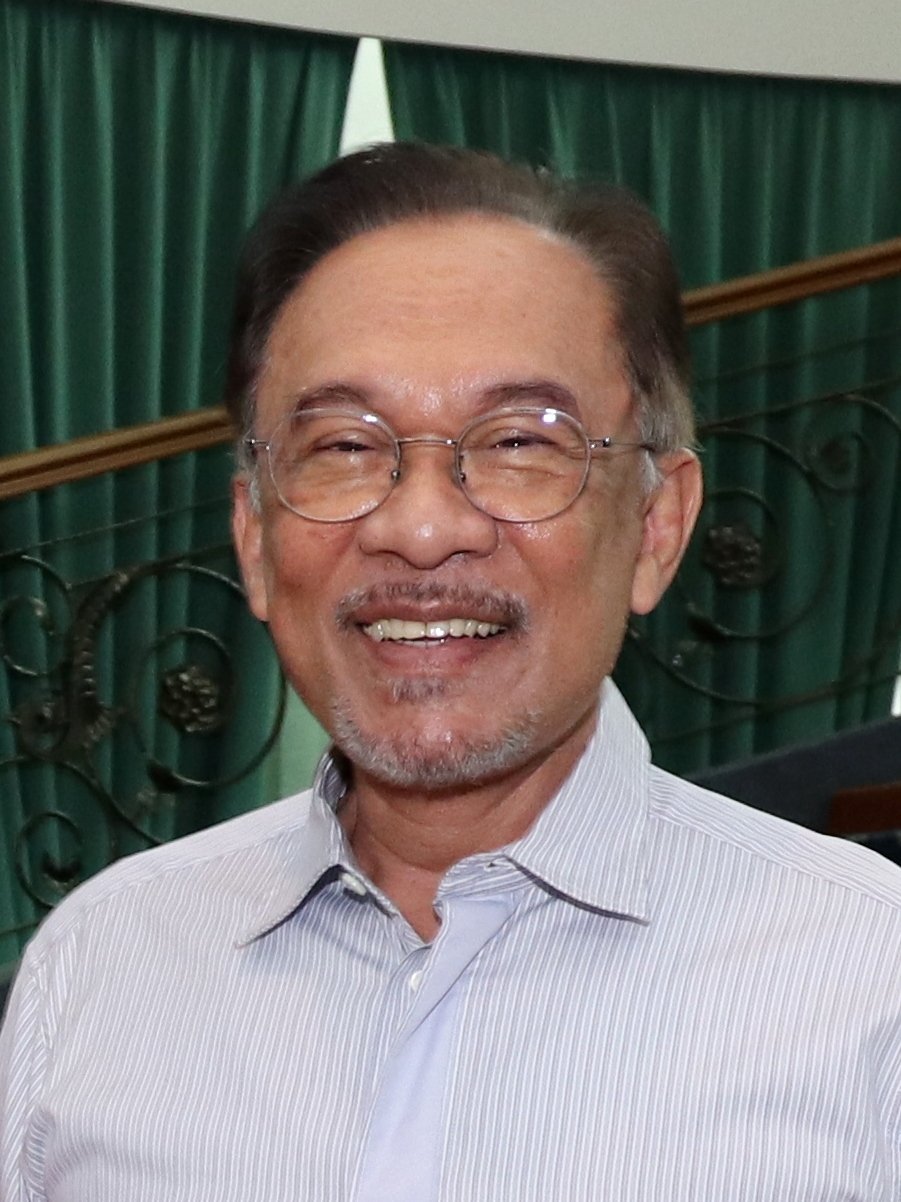 Malaysia · Politics
1947—
Anwar Ibrahim
Tenth Prime Minister of MalaysiaA student activist turned government minister, opposition leader and Malaysia’s tenth prime minister after one of the longest routes to national office.Read biographyQuick answers
Common questions
- Is Malaysia’s Attorney General also the Public Prosecutor?
- Yes. Under the current Article 145 and Section 376 of the Criminal Procedure Code, the Attorney General also performs the federal Public Prosecutor role.
- What is the difference between the two roles?
- The Attorney General advises and represents the federal government; the Public Prosecutor controls decisions to institute, conduct or discontinue federal criminal proceedings.
- Does MACC decide whether to prosecute a corruption case?
- No. MACC investigates, while Section 58 of the MACC Act requires prosecution by or with the consent of the Public Prosecutor.
- What does a Deputy Public Prosecutor do?
- A DPP reviews investigation papers, advises investigators and conducts criminal proceedings under authority delegated within the Public Prosecutor’s office.
- What does DNAA mean in Malaysia?
- It means discharge not amounting to an acquittal. The current proceeding ends, but the order does not finally prevent a later charge for the same offence.
- Can Malaysian courts review prosecutorial discretion?
- Yes, but only in appropriate, rare and exceptional public-law circumstances. Courts do not ordinarily replace the Public Prosecutor’s assessment of a case.
- Has Malaysia separated the Attorney General and Public Prosecutor?
- Not as of this page’s review on 4 October 2026. A constitutional amendment bill and committee recommendations were pending further parliamentary consideration.
- Who is Malaysia’s Attorney General in 2026?
- Tan Sri Mohd Dusuki Mokhtar, appointed with effect from 12 November 2024, remains listed by the Attorney General’s Chambers as Attorney General.
Primary and institutional sources
How this history was checked
Article 145 and the Criminal Procedure Code supply the law now in force. The parliamentary report and bill record the proposed separation; official appointment records identify the current officeholder, while judicial and Malaysian Bar sources explain review and safeguards. This article was reviewed on 4 October 2026.
- Attorney General’s Chambers of MalaysiaFederal Constitution — Current Official Legislation Portal
- Attorney General’s Chambers of MalaysiaCriminal Procedure Code — Act 593
- Judiciary of MalaysiaCriminal Benchbook — Discharge under Section 254
- Judiciary of MalaysiaJudicial Review of Prosecutorial Discretion after Sundra Rajoo
- IIUM Law JournalThe Attorney General as Public Prosecutor in Malaysia: From Quasi-Judicial to Executive
- Attorney General’s Chambers of MalaysiaOfficial Staff Directory — Attorney General’s Office
- BernamaMohd Dusuki Mokhtar Appointed Attorney General
- Parliament of MalaysiaSpecial Select Committee Report and Draft AG–Public Prosecutor Amendments — DR 11/2026
- BernamaFirst Reading of the AG–Public Prosecutor Separation Bill
- BernamaCommittee Recommendations for Appointment and a Seven-Year Term
- BernamaCabinet Agrees to Strengthen Parliament’s Appointment Role
- Malaysian BarAG–Public Prosecutor Separation Requires Transparency and Safeguards
- Malay MailBill Still Pending before the October 2026 Dewan Rakyat Sitting