
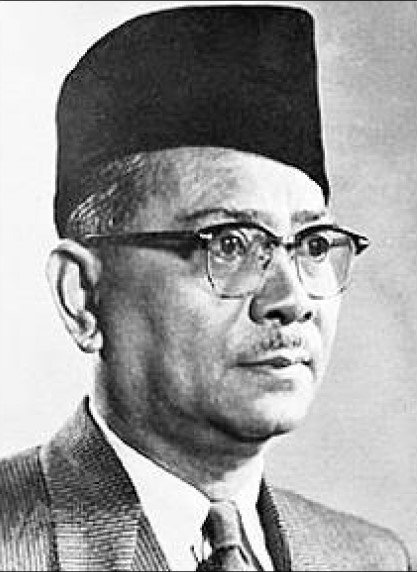
In this biography
Quick facts
- Born
- 8 February 1903
- Died
- 6 December 1990
- Birthplace
- Alor Setar, Kedah
- Country
- Malaysia
- Nationality
- Malaysian
- Known for
- Leading Malaya to independence and helping form Malaysia
- Full name
- Tunku Abdul Rahman Putra Al-Haj ibni Almarhum Sultan Abdul Hamid Halim Shah
- Office
- Prime Minister, 1957–1970
- Political party
- United Malays National Organisation (UMNO)
- Also known as
- Bapa Kemerdekaan · Father of Independence
Why this life matters
Tunku’s career connects the end of British rule, coalition politics, independence in 1957 and the formation of Malaysia in 1963.
Timeline
Key moments
Born in Alor Setar
Born into Kedah’s royal household, the son of Sultan Abdul Hamid Halim Shah and Che Menjalara.
Led UMNO
Won the presidency of UMNO and helped build a multi-ethnic electoral alliance.
Became Chief Minister
Led the Alliance to victory in the first federal general election and headed the elected government.
Independence and premiership
Led the independence negotiations and became the first prime minister of the Federation of Malaya.
Formation of Malaysia
Oversaw the creation of Malaysia with Malaya, Sabah, Sarawak and Singapore.
Emergency government after May violence
A state of emergency followed the May 13 violence; Abdul Razak headed the National Operations Council while Tunku remained prime minister.
Left office
Resigned as prime minister after thirteen years in office.
From Kedah to national politics
Tunku Abdul Rahman was born in Alor Setar in 1903 and studied in Malaya, Bangkok and Britain. His education and early public service exposed him to both colonial administration and the social life of ordinary Malayans.
He entered national political leadership in 1951, when he became president of UMNO. He helped strengthen cooperation between UMNO, the Malayan Chinese Association and the Malayan Indian Congress, forming the Alliance coalition that would dominate the independence period.
Negotiating independence
After the Alliance won the 1955 federal election, Tunku became chief minister. He led negotiations with Britain that culminated in the Federation of Malaya becoming independent on 31 August 1957.
The negotiated transfer of power and the Alliance’s multi-ethnic structure became central to his public legacy. At independence, Tunku became the country’s first prime minister.
The Alliance won 51 of the 52 elected seats in the July 1955 federal election and presented the result as a mandate for independence. A U.S. diplomatic-series note records Tunku calling for Malayanisation of the civil service, an amnesty initiative aimed at ending the Emergency and a commission on constitutional reform. Self-government and security were discussed together.
That election mandate was a stage on the road to independence, not the agreement itself. Tunku led a delegation to London in 1956, where the date of 31 August 1957 was set. The campaign promise, the negotiations and independence were distinct events.
The formation of Malaysia
Tunku later proposed a wider federation. Malaysia was formed on 16 September 1963 from Malaya, Sabah, Sarawak and Singapore. Singapore left the federation in 1965.
His government also faced the Communist insurgency, regional confrontation with Indonesia and the difficult work of balancing communal representation inside a new federation.
The 1969 emergency and the end of his premiership
Violence after the May 1969 general election brought a state of emergency on 15 May. Parliament was suspended and a National Operations Council, headed by deputy prime minister Abdul Razak Hussein, administered the country. Tunku remained prime minister during this period, but the emergency changed where governing authority was exercised.
Tunku announced his resignation on 31 August 1970; Razak succeeded him on 21 September. Treating this as an ordinary handover would obscure the deaths, political rupture and emergency administration that preceded it. The Perdana chronology supplies dates, while fuller accounts of the violence and its causes still require independent historical study.
Legacy
Tunku left office in 1970. He remains closely associated with independence, the early practice of coalition government and the creation of Malaysia.
His legacy is celebrated nationally, but understanding his period also requires studying the compromises, tensions and institutions that shaped the country’s first years of self-government.
Quick answers
Frequently asked questions about Tunku Abdul Rahman
- Why is Tunku Abdul Rahman called the Father of Independence?
- He led the Alliance government and negotiations with Britain that brought independence to the Federation of Malaya on 31 August 1957.
- Was Tunku prime minister of Malaya or Malaysia?
- Both. He became Malaya’s first prime minister in 1957 and continued as the first prime minister of Malaysia after the wider federation formed on 16 September 1963.
- Which territories formed Malaysia in 1963?
- The Federation of Malaya, Sabah, Sarawak and Singapore formed Malaysia. Singapore separated in 1965; Brunei did not join.
- What changed after the May 1969 violence?
- An emergency was declared on 15 May and Abdul Razak headed the National Operations Council. Tunku remained prime minister but governing authority shifted during the emergency; Razak succeeded him in September 1970.
Keep exploring
Lives connected to this story
- Lee Kuan Yew
Read about Singapore’s merger with Malaysia and its separation in 1965.
- Abdul Razak Hussein
Follow the emergency administration and the premiership that succeeded Tunku.
- Fuad Stephens
Explore Sabah’s leadership and place in the formation of Malaysia.
Sources and further reading
Explore the evidence
These references support the biography and offer further reading. Official records, first-person accounts and independent reporting provide different perspectives; image records document attribution and licensing.
- 1. Prime Minister’s Office of MalaysiaFormer Prime Ministers of Malaysia
- 2. Perdana Leadership FoundationBiografi Tunku Abdul Rahman
Institutional biography covering the 1955 election, independence negotiations and the distinction between Malaya in 1957 and Malaysia in 1963.
- 3. Perdana Leadership FoundationProclamation of Malaysia
- 4. U.S. Department of State, Office of the HistorianEditorial note on Malaya’s 1955 federal election
Editorial note in the U.S. diplomatic-document series records the Alliance’s 1955 election victory and Tunku’s stated priorities. It is not a transcript of the later independence negotiations.
- 5. Perdana Leadership FoundationTunku Abdul Rahman Putra Al-Haj: historical timeline
Compiled chronology dates the 1969 emergency, National Operations Council and September 1970 succession. Its commemorative framing is not an independent assessment of the crisis.
- 6. Prime Minister’s Office of MalaysiaArchived speech: 15 May 1969 emergency and National Operations Council
The archived speech corroborates 15 May 1969 and Abdul Razak’s National Operations Council role, correcting the 14 May date in the cited Perdana infographic. The speech’s political interpretation of the violence is not adopted.


