In this biography
Quick facts
- Born
- 16 October 1803
- Died
- 12 October 1859
- Birthplace
- Willington Quay, Northumberland, England
- Country
- United Kingdom
- Nationality
- English
- Known for
- Rocket, the London and Birmingham Railway and tubular railway bridges
- Father
- George Stephenson
- Manufacturing company
- Robert Stephenson & Co, established 1823
- Rainhill success
- Rocket, 1829
- Major railway appointment
- London and Birmingham, 1833
- ICE presidency
- 1855–1857
Why this life matters
His career connects early locomotive building with the finance, workforce and engineering judgement needed for a national railway system.
Timeline
Key moments
Born at Willington Quay
He grew up in a family closely connected with colliery machinery.
Mining and science training
An apprenticeship with Nicholas Wood preceded study in Edinburgh.
A factory and overseas experience
The Newcastle company was established before his work for a Colombian mining concern.
Rocket wins at Rainhill
The locomotive was built under his direction for the trials.
Railways and bridges
London and Birmingham work preceded the major Tyne and Menai crossings.
Death in London
Stephenson died on 12 October and was buried in Westminster Abbey.
Education in a mining family
Robert Stephenson was born on 16 October 1803 at Willington Quay, near Newcastle. His father George worked with colliery engines and later became a prominent railway engineer. Robert received schooling at Bruce’s academy in Newcastle, where mathematics complemented the practical knowledge available around the mines.
In 1819 he was apprenticed to the colliery viewer Nicholas Wood at Killingworth. Science classes at Edinburgh followed in 1822. This combination of surveying, mining and formal study prepared him for a career that would involve both machinery and the ground through which railways were built.
A manufacturing business and a difficult overseas venture
Robert Stephenson & Co was established at Newcastle in 1823 to make stationary and locomotive engines. Its name should not imply that Robert worked alone: George Stephenson, commercial partners and skilled workshop employees made the concern possible.
Robert left in 1824 to work for a British mining association in Colombia. The venture proved difficult, and he returned in 1827, meeting Richard Trevithick on the homeward journey. Back at Newcastle, directing the works gave him a central role in improving and supplying locomotives.
Rocket and the move from engines to routes
Rocket was built under Robert’s direction and won the Rainhill Trials in October 1829. Its success belonged to a developing workshop tradition as well as an individual designer. It was a later machine than Locomotion No. 1, which the company had supplied for the Stockton and Darlington Railway’s 1825 opening while Robert was abroad.
His responsibilities widened further when he became chief engineer of the London and Birmingham Railway in 1833. Surveying, tunnels, earthworks, contracts and construction required a much larger organisation than locomotive manufacture. The line opened in stages in 1837–1838.
Bridges, testing and collaboration
The High Level Bridge at Newcastle and the Royal Border Bridge at Berwick became prominent parts of the railway landscape. The Conwy and Britannia tubular bridges explored a different structural approach: trains passed through large iron tubes rather than over a conventional open girder.
At Britannia, William Fairbairn contributed to the development and testing of the tubular design. Stephenson’s bridge work also extended overseas, including the Victoria Bridge at Montreal. These projects required manufacture, experimentation and construction teams; attributing them to one famous engineer alone conceals much of their practical making.
The failure at the River Dee
On 24 May 1847 a span of the Dee bridge at Chester failed beneath a passenger train. Four passengers and the locomotive’s stoker died. Stephenson had favoured its system of cast-iron girders reinforced with wrought-iron trussing, but earlier fractures and the investigation exposed the design’s vulnerability.
He argued that a derailment had preceded the bridge failure. The National Railway Museum’s account of the parliamentary investigation says the evidence did not support that explanation. The disaster belongs beside his successful bridges: it demonstrates the limits of judgement and materials, and the human cost when a structure fails.
Sources for this section: [4]
Professional authority and a lasting railway network
Stephenson became MP for Whitby in 1847 and remained in Parliament until his death. Elected president of the Institution of Civil Engineers in 1855, he occupied a position of authority in a profession increasingly responsible for expensive public infrastructure.
He died in London on 12 October 1859 and was buried in Westminster Abbey. His importance lies in the combination of locomotive production and large civil works. The networks associated with him depended on investors, surveyors, contractors and labourers, whose work turned designs into operating transport.
Quick answers
Frequently asked questions about Robert Stephenson
- Was Robert Stephenson the same person as George Stephenson?
- No. Robert was George’s son. They collaborated through railway projects and the Newcastle works, but Robert developed his own career in locomotive manufacture, railways and bridges.
- Did Rocket open the Stockton and Darlington Railway?
- No. Locomotion No. 1 hauled the ceremonial train in 1825. Rocket was built for the Rainhill Trials in 1829.
- Why is the Dee bridge disaster part of his legacy?
- Stephenson was responsible for its engineering. Its collapse killed five people and exposed serious problems with trussed cast-iron girders, making it an essential qualification to accounts of his bridge successes.
Keep exploring
Lives connected to this story
- George Stephenson
His father’s colliery engineering and role in early public railways.
- Richard Trevithick
An earlier high-pressure steam pioneer whom Robert met in 1827.
- Thomas Telford
An earlier generation of transport engineering and the separate Menai suspension bridge.
- William Fairbairn
Fairbairn supplied experimental and manufacturing work for Stephenson’s tubular railway bridges.
- Thomas Brassey
Read Brassey’s railway-contracting career and distinguish construction organisation from the work of a project’s engineer.
- George Parker Bidder
Explore George Parker Bidder’s work: combining railway and dock engineering with a founding role in the Electric Telegraph Company.
- Washington Roebling
Explore Washington Roebling’s work: directing construction of the Brooklyn Bridge after John Augustus Roebling’s death.
Sources and further reading
Explore the evidence
These references support the biography and offer further reading. Official records, first-person accounts and independent reporting provide different perspectives; image records document attribution and licensing.
- 1. Science Museum GroupRobert Stephenson: biographical collection record
Birth, apprenticeship, works, Rocket and public-life passages were read. Its conflation of the Conwy and Britannia crossings and some railway superlatives are not repeated.
- 2. Encyclopædia Britannica (1911) / WikisourceStephenson, Robert: historical biography
The complete short 1911 entry was read; its compressed family narrative is supplemented by institutional records.
- 3. Institution of Civil EngineersRobert Stephenson: education, locomotives and railways
Education, Colombia and London–Birmingham passages were read. Its railway-first wording and promotional ranking of engineers are not adopted.
- 4. National Railway MuseumAn early railway disaster in the parliamentary papers
The museum author’s account of the parliamentary papers was read. The full original accident report and reader comments were not used as independent evidence.
- 5. Institution of Civil EngineersMenai crossings: Fairbairn and the tubular bridge
- 6. National Railway MuseumShildon, the Cradle of the Railways and Locomotion No. 1
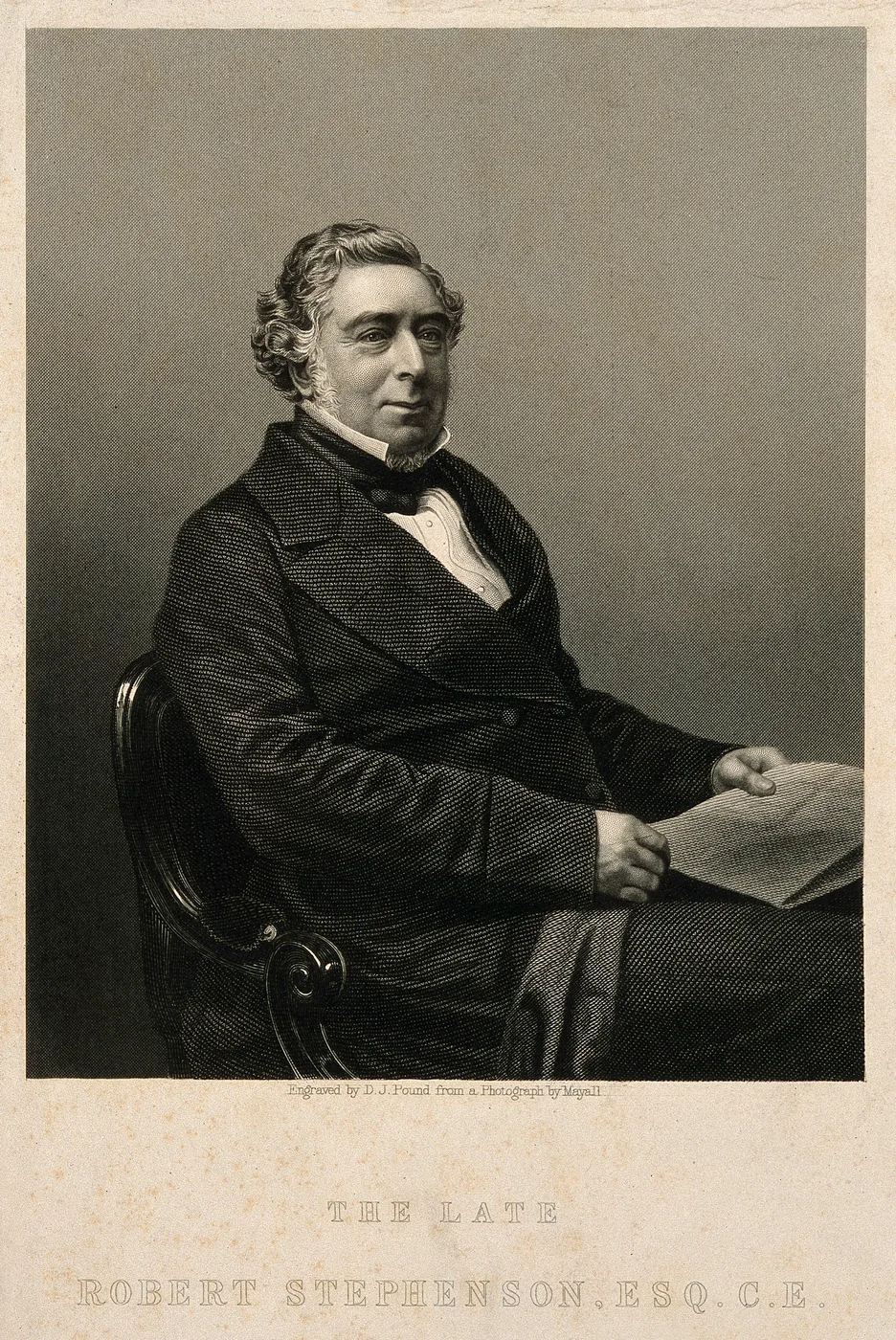
- 7. Wellcome Library / Wikimedia CommonsPound after Mayall: Robert Stephenson, image and revision record
- 8. Creative CommonsAttribution 4.0 International