
In this biography
Quick facts
- Born
- 1789
- Died
- 1874
- Birthplace
- Kelso, Scotland
- Country
- United Kingdom
- Nationality
- British
- Known for
- Iron structures, tubular-bridge experiments and boiler inspection
- Known for
- Iron structures, tubular-bridge experiments and boiler inspection
- Field
- Millwright, manufacturer and experimental engineer
Why this life matters
William Fairbairn moved from millwright work into iron manufacturing, combining structural experiments with the practical organisation of workshops and boiler safety.
Timeline
Key moments
Born in Kelso
Fairbairn later trains as a millwright.
Tube experiments
Experiments investigate proposed tubular railway structures.
Inspection and professional leadership
Boiler inspection and engineering leadership become significant parts of his work.
From colliery engines to Manchester
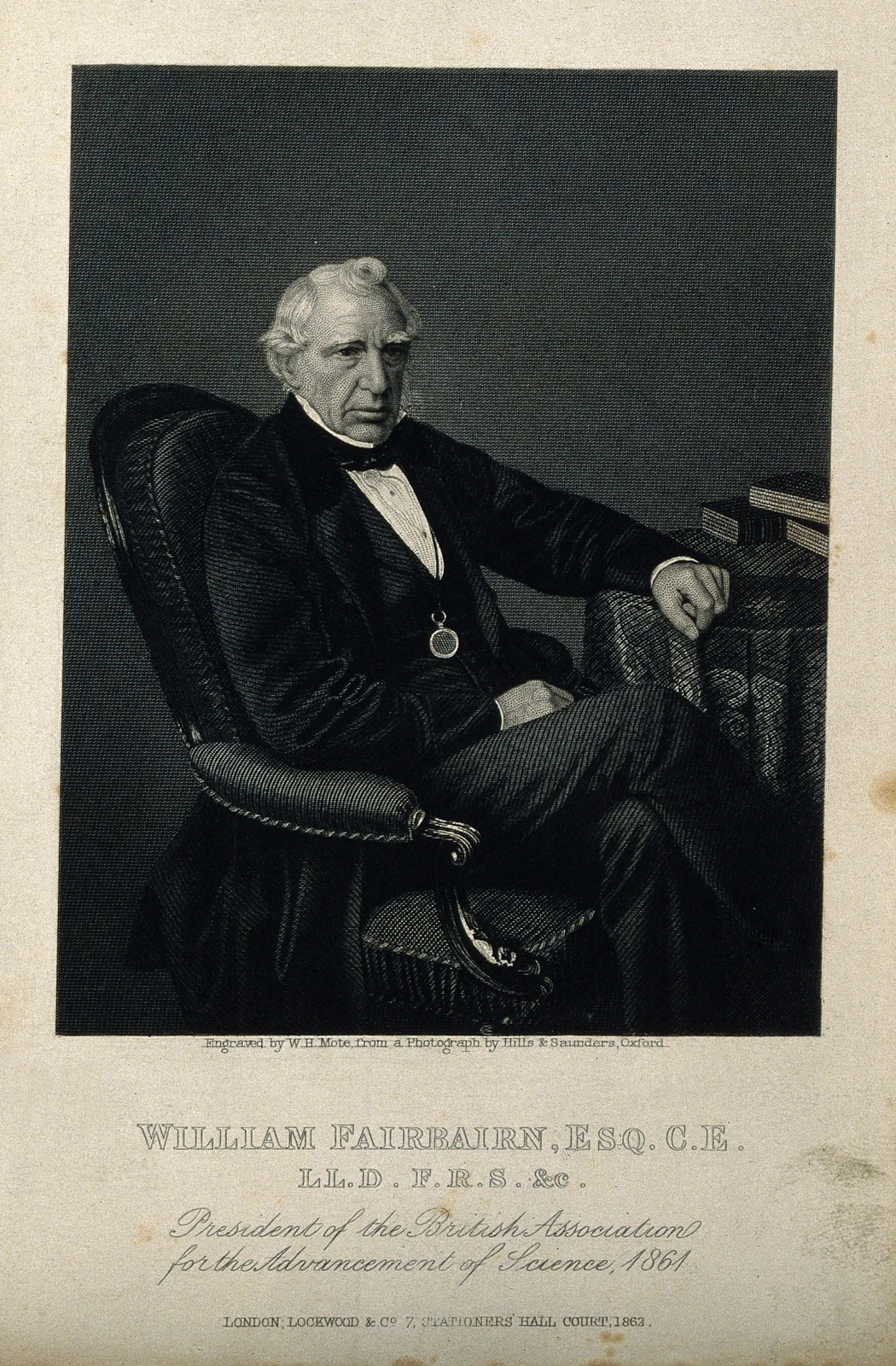
William Fairbairn was born in Kelso in 1789 and apprenticed as a millwright near Newcastle. At Percy Main colliery he became responsible for engines and met George Stephenson. After working in Newcastle and London, he moved to Manchester. A partnership with James Lillie grew from supplying machinery to a cotton mill. The business expanded into mill equipment and light iron steamships, giving Fairbairn experience across several connected manufacturing activities.
Iron needed experimental questions
Fairbairn collaborated with Robert Stephenson and Eaton Hodgkinson on the tubes proposed for railway bridges at Conwy and the Menai Strait. Tests examined more than whether a piece of iron could carry a load. The shape and distribution of the plates affected whether a tube’s top wrinkled under compression or its bottom tore in tension. Hodgkinson’s published account identifies the experiments at Fairbairn’s works while also asserting his own contributions. The project was a negotiation among research, manufacture and bridge design.
Manufacture, inspection and public work
Fairbairn’s interests also included boilers and the properties of riveted iron. Concern about destructive boiler explosions helped bring an inspection service and the Manchester Steam Users’ Association into existence in 1854. The same year he became president of the Institution of Mechanical Engineers. He was elected a Fellow of the Royal Society in 1850 and died in 1874. His career shows experimental investigation operating inside commercial engineering, where testing a material, making a structure and organising its continued inspection addressed different stages of responsibility.
Quick answers
Frequently asked questions about William Fairbairn
- What is William Fairbairn known for?
- William Fairbairn moved from millwright work into iron manufacturing, combining structural experiments with the practical organisation of workshops and boiler safety.
Keep exploring
Lives connected to this story
- Robert Stephenson
Stephenson’s bridge project required experimental evidence about large wrought-iron tubes.
- John Smeaton
Smeaton’s earlier model experiments offer a comparison in how engineers linked tests with full-size works.
Sources and further reading
Explore the evidence
These references support the biography and offer further reading. Official records, first-person accounts and independent reporting provide different perspectives; image records document attribution and licensing.
- 1. Science Museum GroupWilliam Fairbairn
Institutional or professional historical account used for the named life events, projects and contributions discussed in this article.
- 2. Royal Society, Science in the MakingWilliam Fairbairn
Institutional or professional historical account used for the named life events, projects and contributions discussed in this article.
- 3. Eaton Hodgkinson / ETH Library e-raraExperimental inquiries on wrought-iron tubes,1849report,p115
Hodgkinson’s1849 participant account describes the tube tests. The guide follows the documented failure modes and preserves his perspective on collaboration.