
The short answer
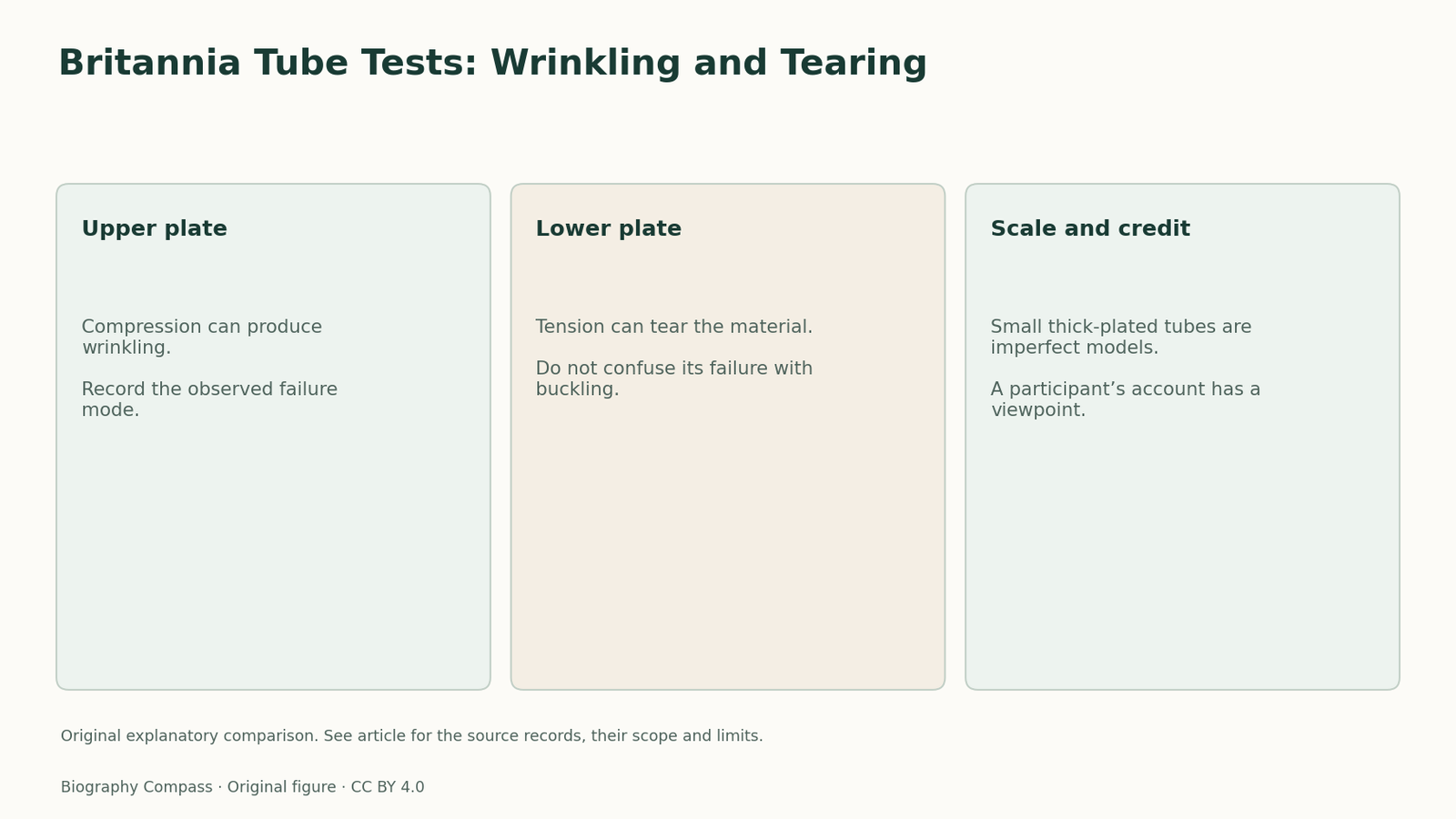
A tube could fail in two different places for different reasons. The experiments made that distinction visible before a full-size railway crossing was complete.
Compare the evidence
Britannia Tube Tests: Wrinkling and Tearing
Keep the observations and the conclusions they support together.
| Record | What it supports | What it does not establish |
|---|---|---|
| Tube-test observations | Top compression produced wrinkling; bottom tension could produce tearing. | Breaking load alone does not identify the governing failure. |
| Hodgkinson’s narrative | The work connected Stephenson, Fairbairn and Hodgkinson. | A participant’s credit account needs its perspective retained. |
The result depended on where failure began
Hodgkinson’s1849 report describes tubes supported at their ends and loaded at the middle. Some failed when the bottom plates tore apart. Others failed when compressed top plates wrinkled. Both results could be reported as a breaking load, yet they exposed different weaknesses. A useful record therefore needs the failure location and the form of deformation as well as the load. Strength was a property of a configured structure, not merely the name of its metal.
Sources for this section: [3]
Why strengthen a top plate?
For these simply supported tests, the upper region was compressed while the lower region was stretched. If the top wrinkled first, adding material or stiffening there could postpone that failure. It did not follow that adding the same amount anywhere would have the same effect. The report also warns that early small tubes could use relatively thick plates and were not adequate models of the intended bridge. Scaling up changed the practical availability and proportions of material.
Sources for this section: [3]
Read collaboration and evidence together
Hodgkinson records Stephenson’s request for data, Fairbairn’s manufacturing involvement and his own experimental suggestions. That is a participant’s account with an identifiable perspective. Place two headings above a comparison sheet: failure mechanism and allocation of credit. Under the first, distinguish wrinkling from tearing; under the second, identify who says which work was done. The exercise preserves a concrete engineering result without treating one participant’s narrative as a complete settlement of every priority dispute or as a modern design calculation.
Continue the chronology
Related history guides
Smeaton’s Waterwheels: Speed and Work
Read Smeaton’s waterwheel experiments through their measure of useful work, distinguishing wheel speed, lifted load and the duration of a comparison.
Read the timeline1761–1831London Bridge 1831: Which John Rennie?
Separate John Rennie the elder’s bridge design from his son’s construction responsibility and the 1831 opening, using institutional biographical records.
Read the timelineBiography context
Explore United Kingdom through connected lives
Connected biographies
People behind the records
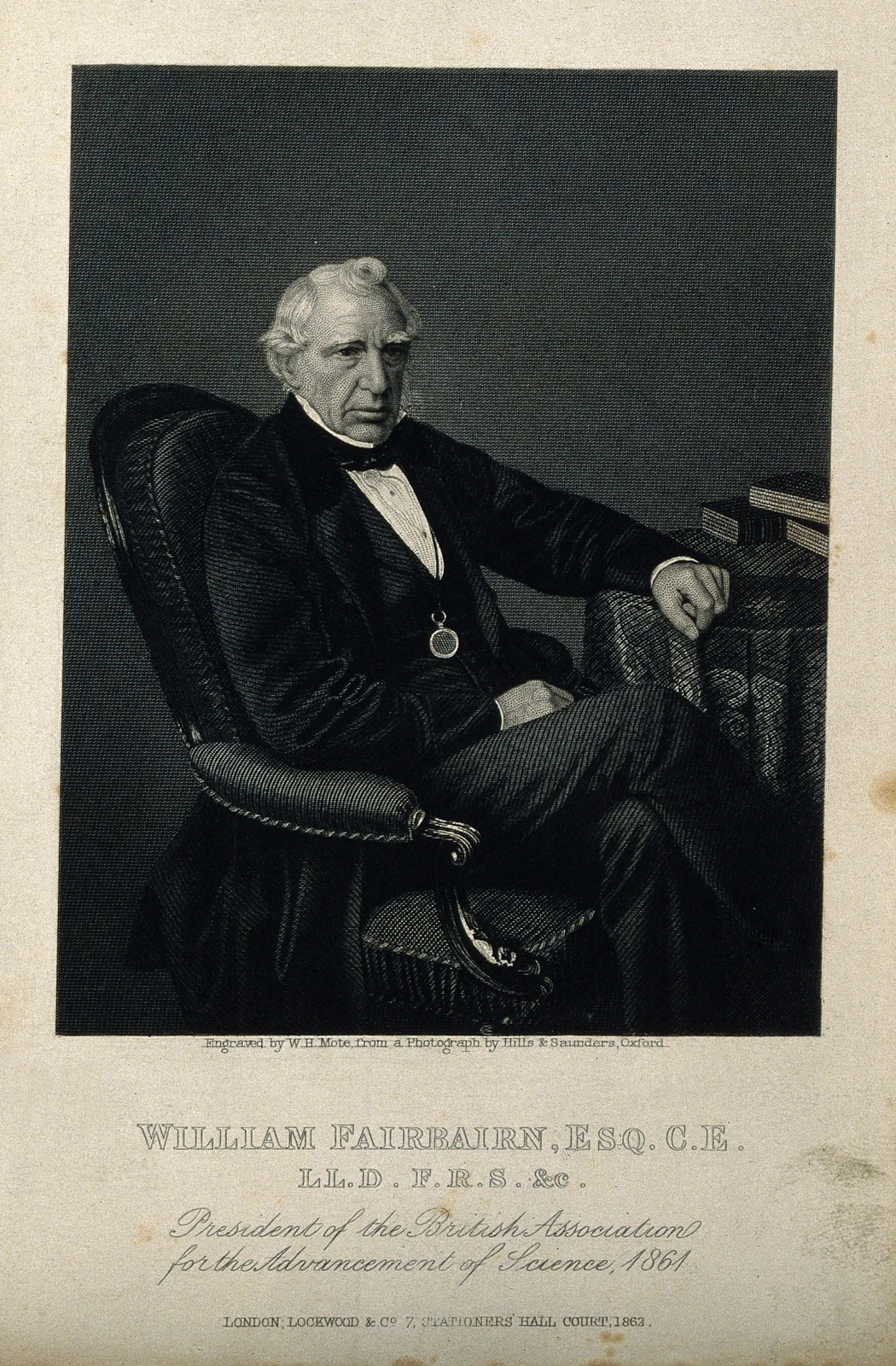
1789–1874
William Fairbairn
Millwright, manufacturer and experimental engineerWilliam Fairbairn moved from millwright work into iron manufacturing, combining structural experiments with the practical organisation of workshops and boiler safety.Read biography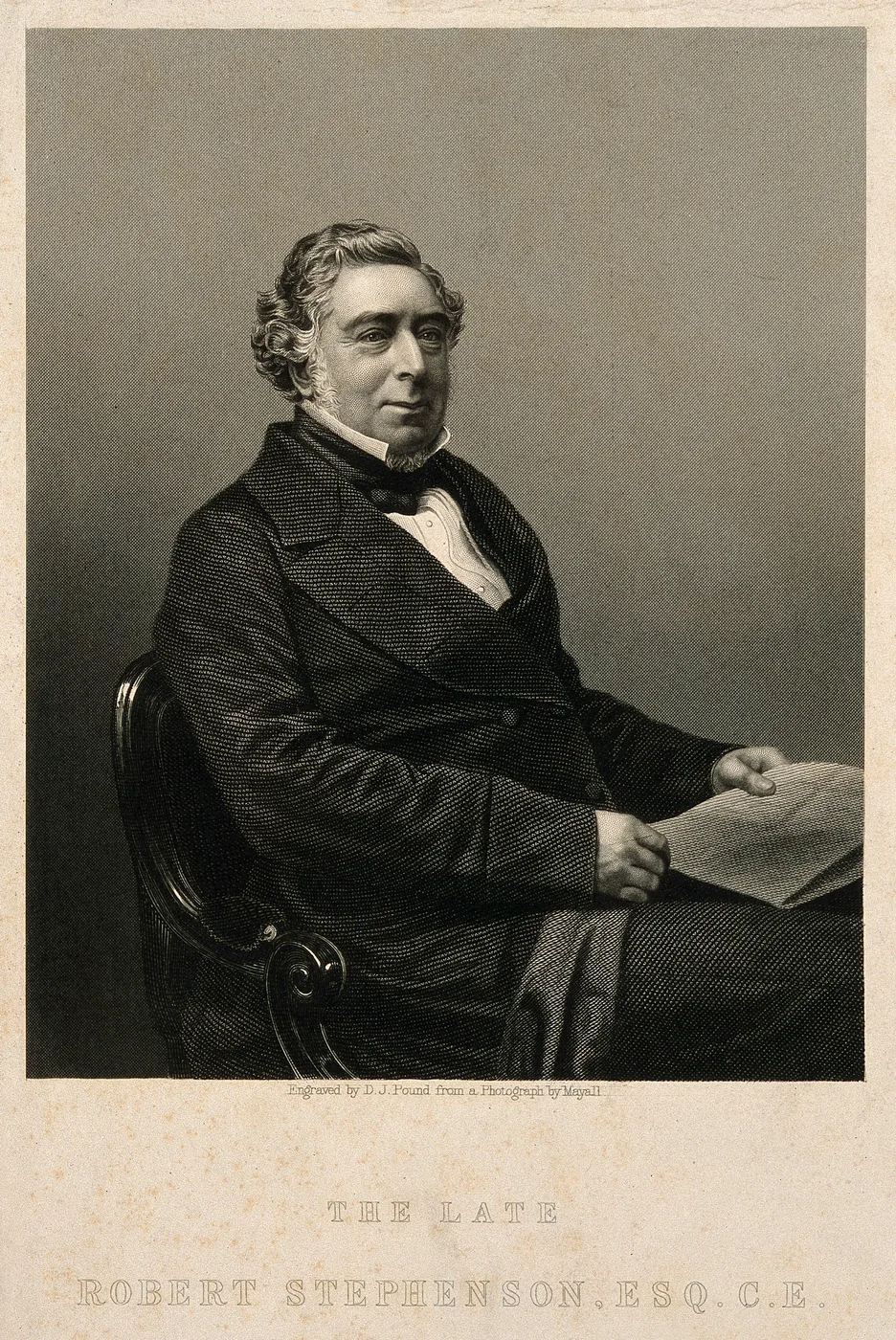
1803–1859
Robert Stephenson
Locomotive manufacturer and civil engineerRobert Stephenson helped turn railway engineering into a large manufacturing and construction enterprise. George Stephenson’s son, he directed locomotive production, led major railway works and designed ambitious bridges, while the fatal Dee bridge collapse exposed the consequences of structural failure.Read biography1724–1792
John Smeaton
Instrument maker and civil engineerJohn Smeaton combined instrument making, measured experiments and consulting work on lighthouses, mills, waterways and other civil engineering projects.Read biographyQuick answers
Common questions
- What did the Britannia tube tests establish before full-size construction?
- The tests distinguished top-plate wrinkling under compression from bottom-plate tearing under tension. They showed why plate proportions and stiffening mattered, and why a small thick-plated tube was not automatically a sound full-size model.
Primary and institutional sources
How this history was checked
The sources distinguish institutional biographies, participant accounts and records of individual objects. The related biography gives context for their use. This article was reviewed on 7 November 2026.