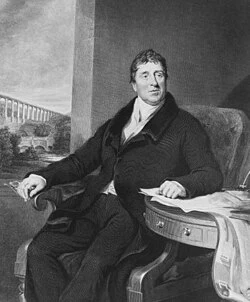
In this biography
Quick facts
- Born
- 9 August 1757
- Died
- 2 September 1834
- Birthplace
- Glendinning, Westerkirk, Dumfriesshire, Scotland
- Country
- United Kingdom
- Nationality
- Scottish
- Known for
- Roads, canals, aqueducts and the Menai Suspension Bridge
- First trade
- Stonemason
- Ellesmere Canal appointment
- 1793
- Pontcysyllte Aqueduct
- Completed in 1805
- Menai Suspension Bridge
- Opened in 1826
- Professional role
- First president of the Institution of Civil Engineers
Why this life matters
Telford helped establish civil engineering as a profession able to organise connected transport systems and ambitious structures on behalf of companies and public authorities.
Timeline
Key moments
Born in Dumfriesshire
The son of a shepherd, Telford grew up in rural Scotland.
Mason and architect
Apprenticeship and work in Edinburgh and London developed his skills.
Ellesmere Canal
A broad engineering appointment led to major aqueduct work.
Scottish infrastructure
Canal, road and harbour projects occupied much of his mature career.
Menai construction
A suspension bridge completed an important link on the Holyhead road.
Death in London
Telford died on 2 September and was buried in Westminster Abbey.
A practical beginning in rural Scotland
Thomas Telford was born at Glendinning in the parish of Westerkirk, Dumfriesshire, on 9 August 1757. His father John, a shepherd, died a few months later, leaving his mother Janet to raise him. Parish schooling and an apprenticeship in stonemasonry gave him the beginnings of a practical education rather than a university training.
Work around Langholm was followed by experience in Edinburgh and then London, where he arrived in 1782 and worked on Somerset House. Learning to draw and observing buildings broadened his skills. His later career did not abandon this craft background: understanding stone, workmanship and construction remained essential when his responsibilities grew to the scale of bridges and transport networks.
Patronage, surveying and the move into engineering
William Pulteney became an important patron, helping bring Telford to Shropshire. Work at Shrewsbury included buildings, streets and drainage, followed by public-works responsibilities. Such appointments required estimates, supervision and relationships with local authorities. An engineer’s authority depended on people willing to commission projects and trust the judgement behind their cost.
In 1793 Telford became engineer and general agent to the Ellesmere Canal concern. The title covered several tasks, from surveying and architectural design to overseeing construction. He organised costly infrastructure for companies and public bodies, coordinating technical decisions with financial administration. His achievements involved decisions about routes, contracts and resources alongside the shape of individual structures.
Aqueducts and the work of connected transport
The Ellesmere scheme aimed to link major river systems. At Chirk and Pontcysyllte, crossing deep valleys required more than ordinary canal excavation. Pontcysyllte’s construction, from 1795 to 1805, made an elevated waterway a central feature of the route. These works joined masonry and iron in structures whose purpose was the reliable passage of commercial traffic.
Telford’s output is best understood as a network of projects rather than a list of monuments. Canals needed water supplies, locks, embankments and maintenance. Roads required drainage and durable foundations as well as bridges. Contractors, specialist ironworkers and labourers carried out this work, while changing routes altered the economic opportunities of the settlements they served.
Scottish development and imperfect outcomes
In Scotland Telford worked on roads, harbours and the Caledonian Canal, with William Jessop assisting the canal undertaking. The route exploited the Great Glen’s lochs and joined them with artificial cuts and locks. Neptune’s Staircase, a flight of eight locks, remains a particularly visible example of the scale of its masonry and water-control systems.
The canal opened in 1822, but completion did not mean that every construction problem had been resolved. Scottish Canals records later failures of materials and remedial work by James Walker in the 1840s. A balanced account includes repair and adaptation, not just ceremonial opening dates. Public infrastructure creates continuing obligations that extend beyond the life of its first designer.
Holyhead, Menai and the people behind a bridge
Government improvements to the route between London and Holyhead brought Telford to the Menai Strait. The crossing mattered to communication with Ireland, and its design had to accommodate shipping as well as road traffic. Construction began in 1819; the suspension bridge opened in January 1826 with a main span of roughly 176 metres.
William Provis served as resident engineer, and William Hazledine supplied tested ironwork. Parliamentary scrutiny, financial support and construction labour were indispensable. The slender roadway later needed strengthening against wind. Calling the bridge Telford’s is a useful attribution of direction and design, but it should not remove the other people or the subsequent engineering that kept it in use.
A profession and a carefully remembered life
As the first president of the Institution of Civil Engineers, Telford gave a young organisation contacts, prestige and practical leadership. He helped it secure its Royal Charter in 1828 and left money, books and papers to support its future. His work also extended through advice on projects abroad, showing the growing international reach of British engineering expertise.
Telford never married and died at his Westminster home on 2 September 1834. He was buried in Westminster Abbey. The familiar story of a shepherd’s son becoming a great engineer is supported by his rise, but it can conceal institutional support and hard construction labour. ICE records convict labour on his early Montford bridge: infrastructure’s benefits and the circumstances of its building both deserve attention.
Quick answers
Frequently asked questions about Thomas Telford
- Was Thomas Telford Scottish?
- Yes. He was born in Dumfriesshire and trained as a mason in Scotland before working across Britain and advising on overseas projects.
- Did he build Menai Bridge alone?
- No. He directed the project, with resident engineer William Provis, ironmaster William Hazledine, contractors, workers and public authorities all contributing.
- Was the Caledonian Canal finished without problems?
- It opened in 1822, but later material failures required substantial remedial work. Opening, technical performance and long-term maintenance are different measures of success.
- When was Telford buried?
- Westminster Abbey gives 10 September 1834. The Dictionary of Welsh Biography gives 9 September; this profile follows the burial institution for that detail.
Keep exploring
Lives connected to this story
- William George Armstrong
A later engineer whose commercial enterprise also depended on water, manufacture and infrastructure.
- Joseph Whitworth
A contrasting career in workshop precision and the institutions of professional engineering.
Sources and further reading
Explore the evidence
These references support the biography and offer further reading. Official records, first-person accounts and independent reporting provide different perspectives; image records document attribution and licensing.
- 1. Institution of Civil EngineersThomas Telford: life, roads, canals and professional leadership
The institutional biography was read, including patronage, professional leadership and the explicit Montford convict-labour detail. Promotional superlatives and large project totals are not used as audited counts.
- 2. William Llewelyn Davies / Dictionary of Welsh BiographyTelford, Thomas: Welsh and border works (1959)
The full short 1959 article was read. Its declared scope is Wales and the borders, not a comprehensive life. Its claim of practical completion in April 1825 is not substituted for the public opening in January 1826.
- 3. Scottish CanalsCaledonian Canal history and heritage
The construction/opening and later defect entries were read. Conflicting project-duration figures are omitted; the 1822 opening is consistently supported.
- 4. Scottish CanalsNeptune’s Staircase: construction and operation
- 5. Westminster AbbeyThomas Telford: death, burial and commemoration
The Abbey’s 10 September burial date takes precedence over the 9 September date in the older Welsh biography.
- 6. Institution of Civil EngineersMenai crossings: construction and structural systems
- 7. American Society of Civil EngineersMenai Suspension Bridge: historic engineering landmark
- 8. Royal Society / PubMed CentralAn amateur’s contribution to the design of Telford’s Menai Suspension Bridge (2015), indexed design discussion
Indexed passages on Provis, experiments and design were read; direct opening encountered a browser challenge. No claim is made to reading every calculation or the cited original drawings.
- 9. RCAHMS / Wikimedia CommonsRaddon after Lane: Thomas Telford, 1838, image and revision record
- 10. National Portrait GalleryWilliam Raddon: artist authority entry in collection results
NPG’s artist entry gives Raddon as active 1817–died 1848; Getty instead supplies an active 1817–1862 range. The image credit states the NPG attribution and does not turn Getty’s activity range into a lifespan.
- 11. National Portrait GallerySamuel Lane, 1780–1859: artist authority record
- 12. Creative CommonsPublic Domain Mark 1.0