
The short answer
How did underwater foundation work and remote engineering supervision fit the project?
Read the records together
Contributions,evidence and scope
Different records illuminate different parts of this particular undertaking.
| Record | What the record establishes | What remains distinct |
|---|---|---|
| RPI life and archive record | Establishes education and professional context. | A catalogue is not every surviving letter. |
| Construction accounts | Describe caissons and the consequences of illness. | Limited site presence does not by itself prove loss of authority. |
| 1883 official publication | Names chief, assistants and communications work. | A public tribute is not a complete management diary. |
A foundation had to be excavated below the river
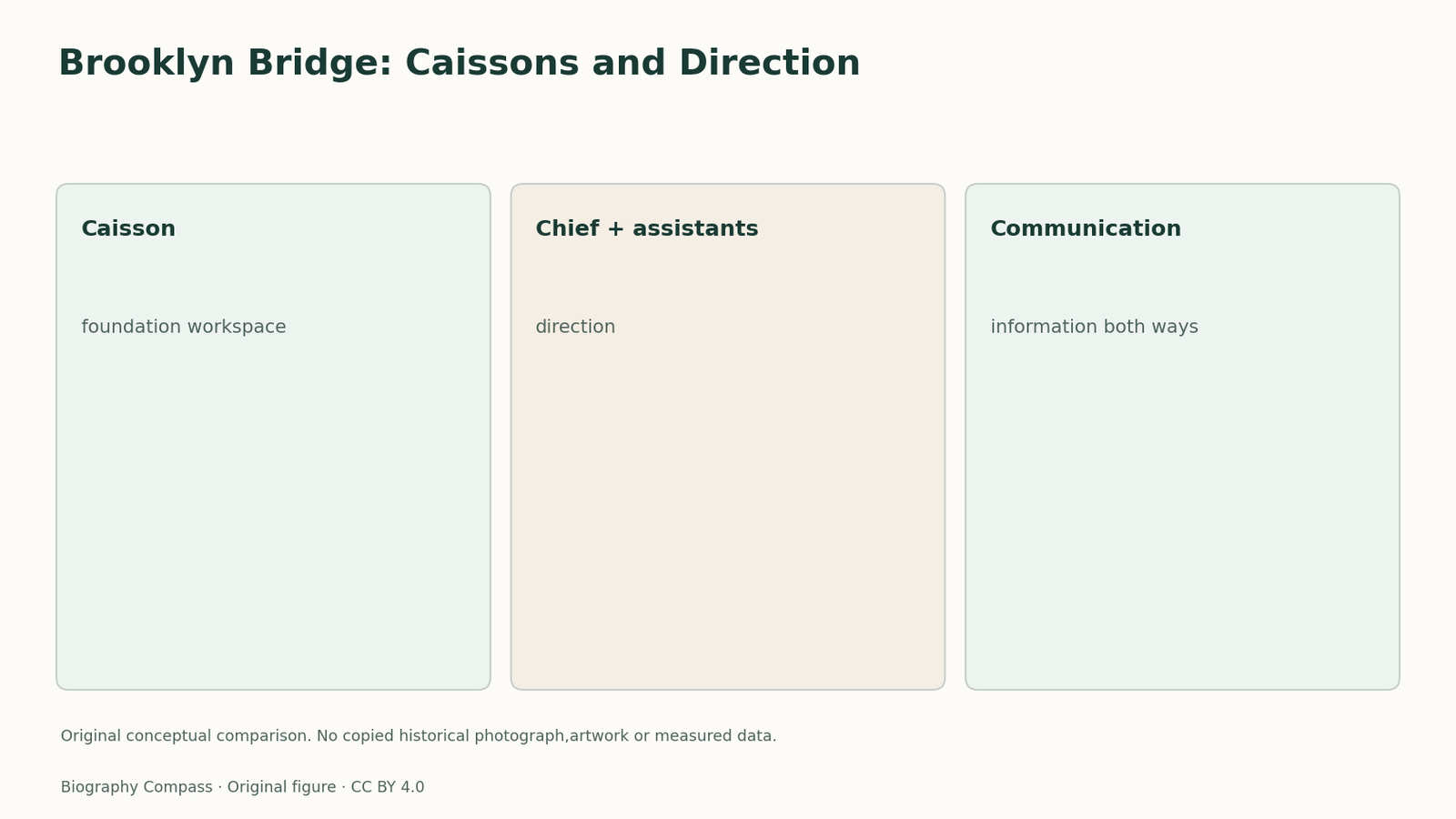
The Brooklyn Bridge’s towers required foundations constructed beneath water. Pneumatic caissons created enclosed working spaces in which excavation could proceed while the structure descended. The Library of Congress account explains this foundation method and the health risks associated with working under pressure. The construction question therefore joined the physical removal of material with the conditions under which people worked. A tower rising above the river was only the visible part of a system whose difficult early work took place below it. This account concerns the historical arrangement, not instructions for pressurised work or a retrospective medical diagnosis of every worker.
Site access and engineering authority were not identical
Washington’s illness limited his ability to be physically present at the bridge, but the project retained a chain of communication and direction. The 1883 official officers’ list still names him chief engineer, and the opening address describes his direction of execution. That evidence should be read beside accounts of Emily’s role and the assistant engineers. A person need not stand beside every operation to exercise formal engineering responsibility. Conversely, the formal title does not erase the work that made remote direction possible. The project’s organisation became especially important when personal circumstances changed.
Communication linked design decisions with execution
Hewitt’s opening address credits Emily with maintaining communication between the directing engineer and those carrying out the work. The same publication names assistant engineers and foremen and honours workers exposed to danger. This is more informative than assigning every decision either to Washington alone or to a complete replacement. It suggests questions that can be followed in drawings, instructions and correspondence: what information travelled, who needed it and how work proceeded. The oration is a contemporary public tribute, so its praise is kept distinct from a full day-by-day reconstruction of the project’s management.
Sources for this section: [4]
Diagram a change in working conditions
Draw a line from chief engineer to assistant engineers to site work. Add a return line for observations and questions. Then insert a communications link representing Emily’s documented contribution. Ask whether removing the chief engineer’s daily site presence necessarily deletes every line in the diagram. The checked answer is no: the records show continuing formal direction supported by communication and a team. This original exercise is an organisational model rather than a recovered historical chart. It also preserves the foundation workers as participants in the undertaking rather than treating the caisson only as a clever device below a celebrated bridge.
Continue the chronology
Related history guides
Niagara 1855: A Railway Suspension Bridge
Examine how Roebling’s Niagara railway suspension bridge combined cables, deck stiffness and construction decisions to carry changing railway loads.
Read the timeline1870s–1883Emily Roebling: Communication and Engineering Credit
Compare Emily Warren Roebling’s documented bridge communications with the official engineering roster, explaining substantive work and formal credit.
Read the timelineBiography context
Explore United States through connected lives
Connected biographies
People behind this work
1837–1926
Washington Roebling
Civil engineer and bridge chief engineerWashington Roebling is remembered for directing construction of the Brooklyn Bridge after John Augustus Roebling’s death.Read biography
1803–1859
Robert Stephenson
Locomotive manufacturer and civil engineerRobert Stephenson helped turn railway engineering into a large manufacturing and construction enterprise. George Stephenson’s son, he directed locomotive production, led major railway works and designed ambitious bridges, while the fatal Dee bridge collapse exposed the consequences of structural failure.Read biography
1806–1859
Isambard Kingdom Brunel
Consulting civil engineer for railway, bridge, dock and steamship enterprisesIsambard Kingdom Brunel ran an engineering practice serving railway and maritime companies. As the Great Western Railway’s engineer, he helped connect London and Bristol in 1841. His ships and structures combined technical ambition with financial risk and depended on investors, contractors and workers.Read biographyQuick answers
Common questions
- Did Washington cease being chief engineer when ill?
- The 1883 publication still lists him as chief engineer and describes continuing direction supported by Emily and assistant engineers.
Primary and institutional sources
How this history was checked
The cited records distinguish contemporary accounts,official catalogues and later institutional or scholarly interpretation. The comparison and worked exercise are original editorial material. This article was reviewed on 7 November 2026.