
The short answer
How did engineering assessment and finance contribute differently to an early telegraph network?
Read the records together
Contributions,evidence and scope
Different records illuminate different parts of this particular undertaking.
| Record | What the record establishes | What remains distinct |
|---|---|---|
| Engineering biography | Records a founding role and wider practical career. | Founder does not mean sole apparatus inventor. |
| Museum chronology | Dates company creation and nationalisation. | A short life record is not an investment account. |
| Archive finding aid | Identifies telegraph and account-book holdings. | Catalogue categories do not reveal every document’s contents. |
An instrument was only one part of a network
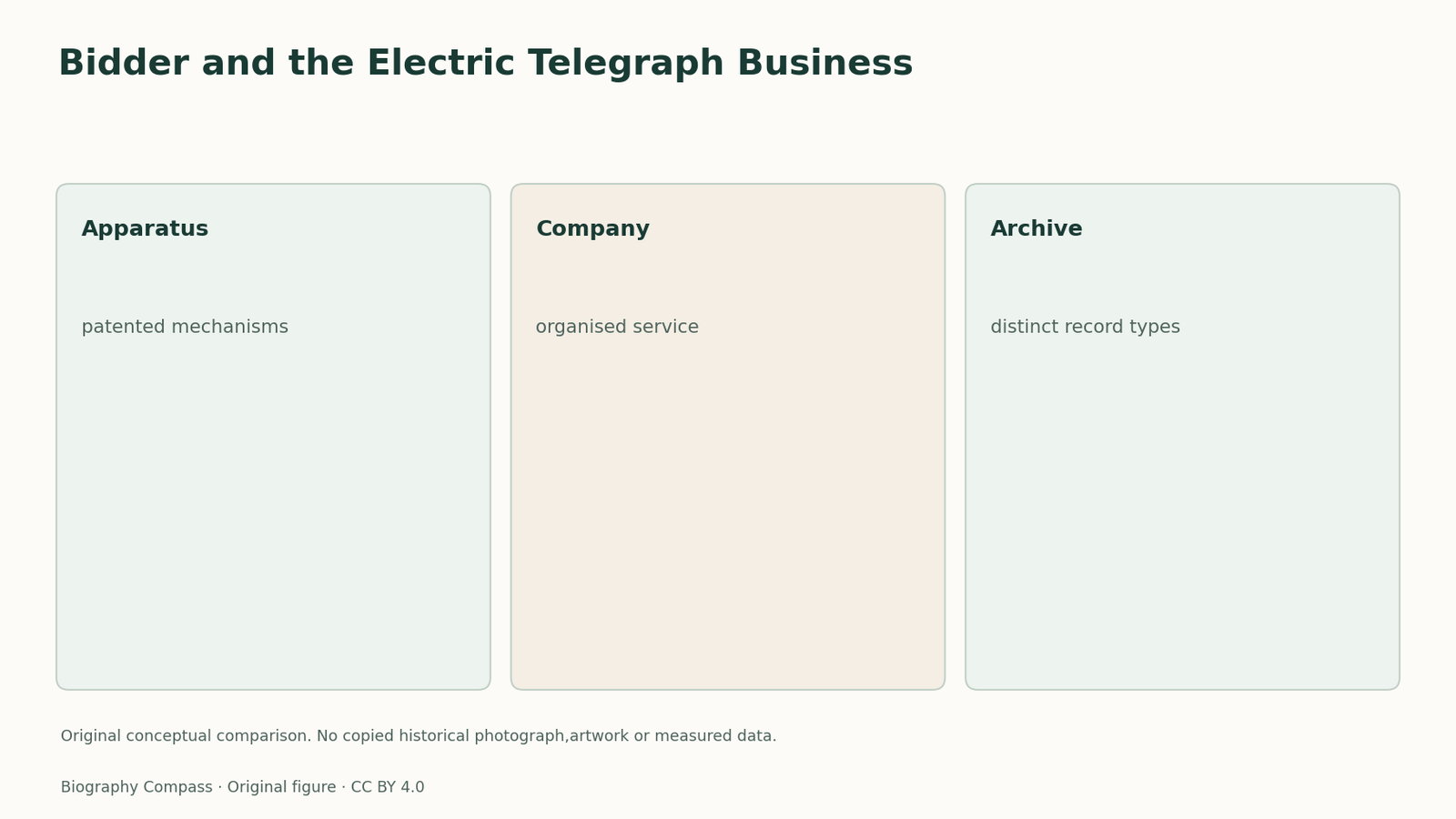
The Electric Telegraph Company needed more than a working demonstration. Instruments had to be connected by lines, maintained, operated and supported by an organisation able to obtain customers and meet costs. Bidder’s documented role was in helping establish that organisation with Cooke in 1845–46. This gives him a place in the history of telegraphy without changing him into the sole inventor of its apparatus. The distinction is useful for many technologies: a technical device and a company that offers a service are related objects, but they do not have the same history or the same set of contributors.
Railway experience supplied a commercial setting
Bidder already worked within railways and docks, where infrastructure combined technical decisions with company finance and parliamentary authority. His telegraph interests therefore belonged to an existing practical career. The museum record identifies both the founding period and his continuing association with the business. It does not provide a complete investment account in the short biography. The appropriate inference is that network organisation required contributions beyond apparatus design, not a numerical claim about the return on Bidder’s investment or an assertion that a particular railway contract alone made the company successful.
An archive guide shows where further questions live
The Science Museum finding aid separates diaries, railway papers, an account book and a section on the electric telegraph. That arrangement is evidence about the surviving collection, not evidence that every letter within it supports the same conclusion. It suggests a productive research method: match a question to a document type. A patent can address a claimed mechanism, a company account can address expenditure, and correspondence can reveal what its author said to a particular recipient. In this article the catalogue is used to identify those different research possibilities; it is not passed off as a reading of the underlying accounts.
Sources for this section: [4]
Map four tasks without inventing a balance sheet
Create a table with apparatus, line infrastructure, service operation and company finance. Put Cooke’s and Wheatstone’s patented work in the first row, and Bidder’s founding role in the organisational and finance discussion. Do not infer the amount of any investment from the word founder. Next, place the 1870 nationalisation in a separate ownership row. It did not mean that all telegraphy began that year. The supported answer is a task map that can guide further document reading. This original exercise deliberately stops short of assigning every maintenance decision or calculating profits. It explains the company as a means of organising a service, which is a different achievement from devising a single telegraph instrument.
Continue the chronology
Related history guides
Atlantic Cable Testing: Fault and Signal
Learn why a submarine cable’s integrity and its signal behaviour required different tests, using Varley’s historical account and an original model exercise.
Read the timeline1837–1845Cooke and Wheatstone: Patent and Partnership
Compare Cooke and Wheatstone’s patent partnership, needle and dial instruments and operating service, using museum objects and historical accounts.
Read the timelineBiography context
Explore United Kingdom through connected lives
Connected biographies
People behind this work
1806–1878
George Parker Bidder
Civil engineer and telegraph-company founderGeorge Parker Bidder is remembered for combining railway and dock engineering with a founding role in the Electric Telegraph Company.Read biography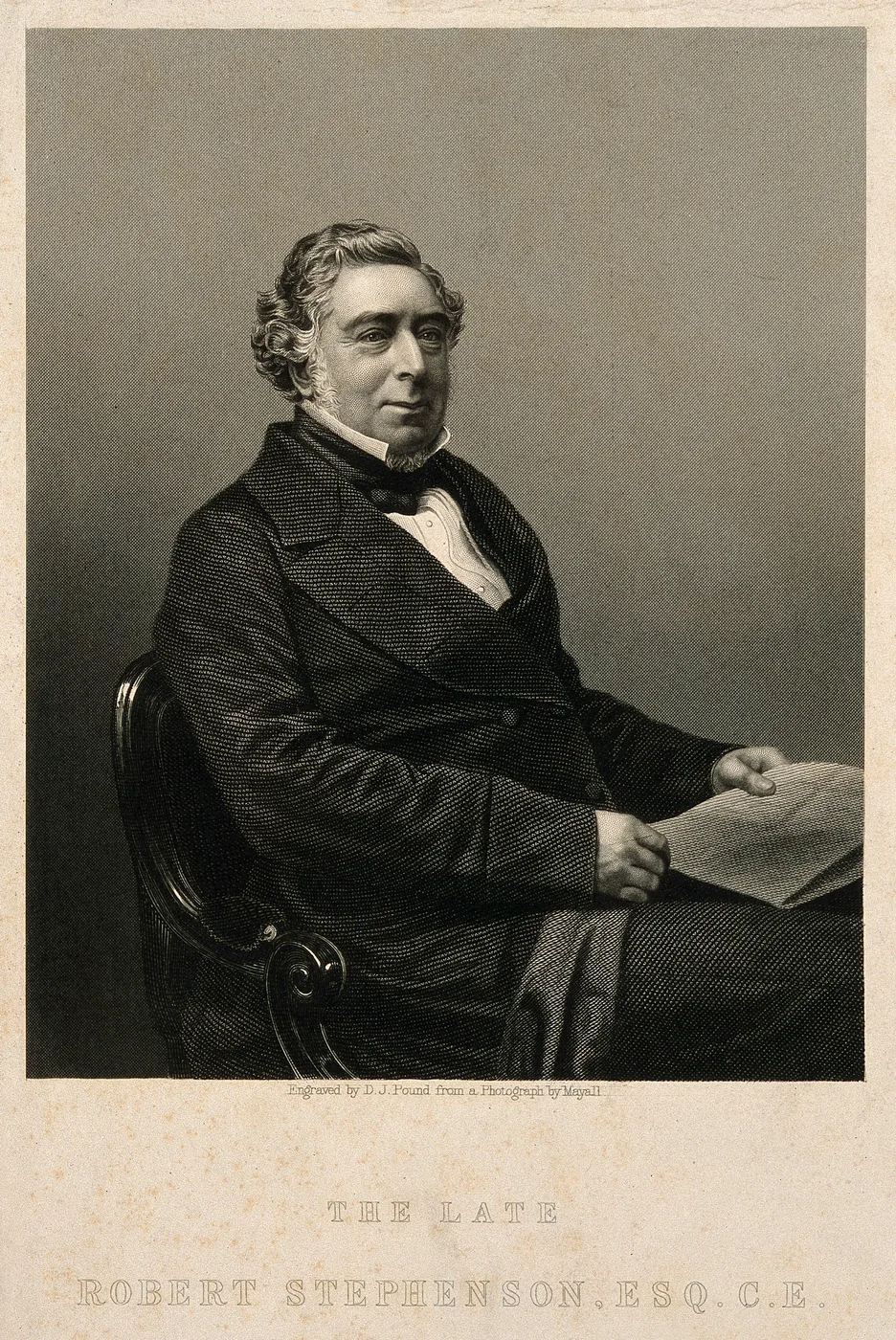
1803–1859
Robert Stephenson
Locomotive manufacturer and civil engineerRobert Stephenson helped turn railway engineering into a large manufacturing and construction enterprise. George Stephenson’s son, he directed locomotive production, led major railway works and designed ambitious bridges, while the fatal Dee bridge collapse exposed the consequences of structural failure.Read biography1779–1844
Joseph Clement
Precision engineer and machine-tool makerJoseph Clement supplied the precision workshop, manufacturing drawings and specialised tools that turned part of Charles Babbage’s Difference Engine design into working machinery.Read biographyQuick answers
Common questions
- Was Bidder the sole inventor of the electric telegraph?
- No. His documented contribution included company formation and practical engineering; the apparatus had other inventors and contributors.
Primary and institutional sources
How this history was checked
The cited records distinguish contemporary accounts,official catalogues and later institutional or scholarly interpretation. The comparison and worked exercise are original editorial material. This article was reviewed on 7 November 2026.