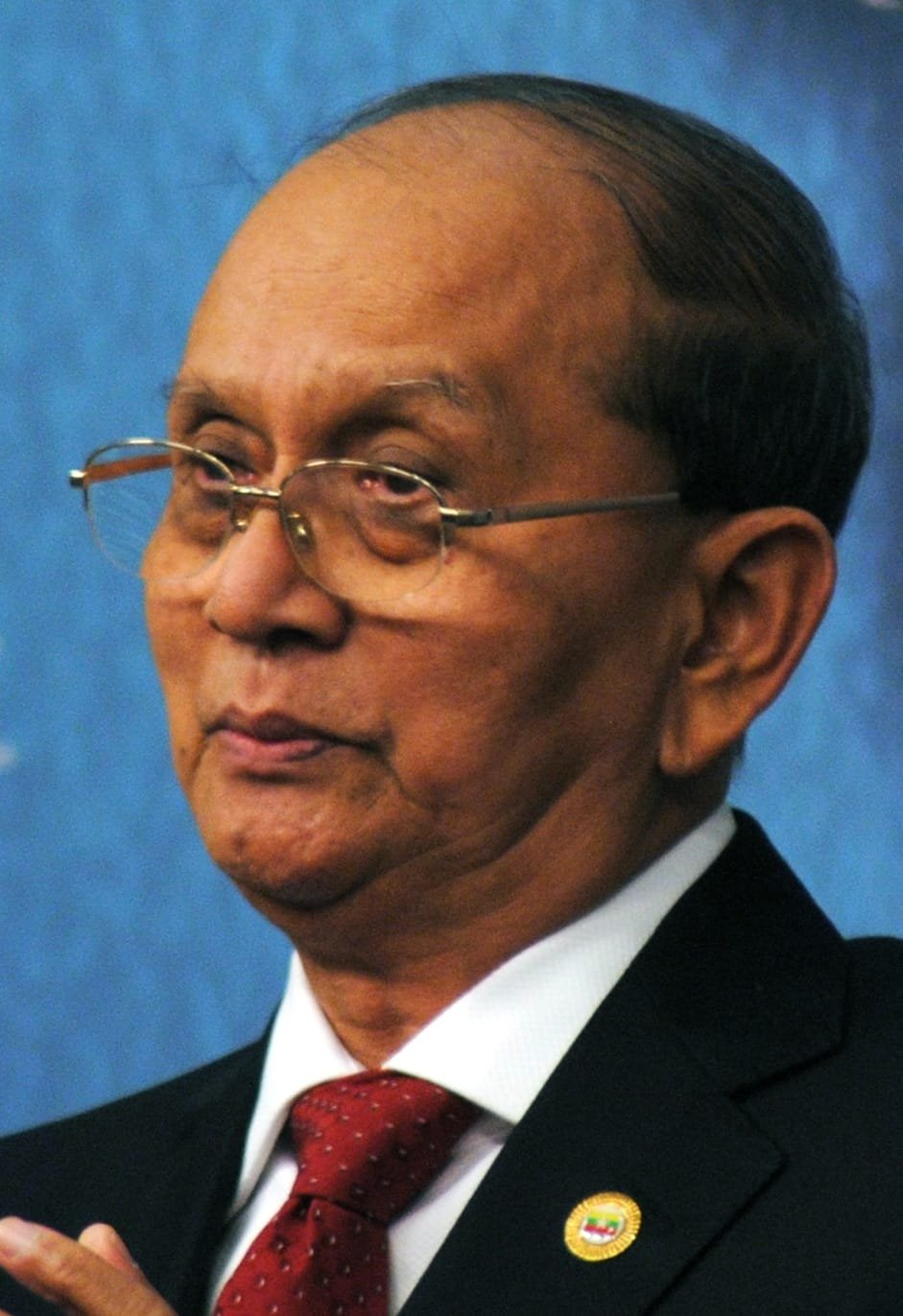
In this biography
Quick facts
- Born
- 20 April 1945
- Birthplace
- Kyonku village, Ngapudaw Township, British Burma
- Country
- Myanmar
- Nationality
- Burmese
- Known for
- Opening political and economic space while governing inside the military-designed 2008 Constitution
- Prime minister
- 2007–2011
- President
- 30 March 2011–30 March 2016
- Political party
- Union Solidarity and Development Party
- Peace agreement
- Nationwide Ceasefire Agreement · 2015
Why this life matters
Thein Sein made Myanmar’s limited transition possible, but the reforms operated within constitutional military safeguards and left grave ethnic and human-rights crises unresolved.
Timeline
Key moments
Born in the Ayeyarwady Delta
Born on 20 April in Kyonku village in what is now Ngapudaw Township.
Graduated from the Defence Services Academy
Began a military career that later included regional command and senior staff roles.
Became prime minister
Succeeded Soe Win during the final years of direct SPDC government.
Moved from general to president
Retired from the army, entered the USDP and was elected president by parliament.
NLD entered parliament
By-elections brought Aung San Suu Kyi and other opposition members into the legislature.
Signed a ceasefire and held a competitive election
Eight armed organisations signed the NCA before the NLD won the November poll.
Transferred presidential office
Htin Kyaw took office after the first peaceful transfer between competing political forces in decades.
From delta village to the senior military government
Thein Sein was born in an Ayeyarwady Delta village in 1945 and graduated from the Defence Services Academy in 1968. He advanced through command and staff positions during decades when the armed forces controlled both government and much of the formal economy. By the 1990s and 2000s he held senior regional and national responsibilities inside the State Peace and Development Council system.
He became secretary-1 of the SPDC and then prime minister in 2007 after Soe Win’s illness. As prime minister he represented a government confronting the Saffron Revolution, Cyclone Nargis and international isolation. He retired from the military before the 2010 election, led the military-backed USDP and entered the new constitutional parliament created under Than Shwe’s transition plan.
A reform presidency inside military safeguards
Parliament’s presidential electoral college selected Thein Sein in February 2011, and he took office when the SPDC dissolved on 30 March. His inaugural programme acknowledged poverty, ethnic conflict and weak institutions. The government released significant numbers of political prisoners, relaxed pre-publication censorship, permitted trade unions and protests under new laws and opened regular dialogue with Aung San Suu Kyi.
The changes were substantial but bounded. The 2008 Constitution still reserved 25% of parliamentary seats for the military, protected its control of the defence, home and border ministries and gave it a veto over most constitutional amendments. Thein Sein was therefore a civilian president who had been a senior general, operating alongside an armed forces command beyond ordinary cabinet control.
Economic reopening and an incomplete peace process
The government re-engaged international financial institutions, changed investment rules and allowed greater access to telecommunications and private enterprise. Thein Sein’s 2011 decision to suspend the Chinese-backed Myitsone Dam became a prominent signal that public opposition could influence a major project. Sanctions eased as foreign governments responded to releases, by-elections and expanded political participation.
Peace talks produced bilateral ceasefires and, in October 2015, a Nationwide Ceasefire Agreement with eight ethnic armed organisations. Several major groups did not sign, however, and fighting continued in Kachin and northern Shan areas. Communal violence in Rakhine State from 2012, continuing Rohingya statelessness and restrictions on humanitarian access exposed the severe human-rights limits of the reform period.
The 2015 election and a peaceful handover
The November 2015 general election was the decisive test of the opening. The Carter Center found that the vote was competitive and that results broadly reflected the will of voters, while documenting serious structural defects, including military-reserved seats, unequal citizenship rules and the disenfranchisement of most Rohingya. The NLD won a commanding parliamentary majority and the USDP accepted the result.
Thein Sein left office on 30 March 2016 and Htin Kyaw became president. The peaceful handover distinguished this transition from the military’s refusal to honour the 1990 election. Yet it did not create civilian supremacy, and the 2021 coup demonstrated how much constitutional and coercive power remained with the armed forces. His legacy is consequently double-sided: genuine political opening achieved through a system that preserved the institution capable of ending it.
Quick answers
Frequently asked questions about Thein Sein
- Who is Thein Sein?
- Thein Sein is a president of Myanmar from 2011 to 2016. Thein Sein made Myanmar’s limited transition possible, but the reforms operated within constitutional military safeguards and left grave ethnic and human-rights crises unresolved.
- What is Thein Sein best known for?
- Thein Sein is best known for opening political and economic space while governing inside the military-designed 2008 Constitution.
- When and where was Thein Sein born?
- Thein Sein was born on 20 April 1945 in Kyonku village, Ngapudaw Township, British Burma.
Sources and further reading
Explore the evidence
These references support the biography and offer further reading. Official records, first-person accounts and independent reporting provide different perspectives; image records document attribution and licensing.
- 1. World Economic ForumThein Sein · career and public-service profile
- 2. United Nations General AssemblySituation of human rights in Myanmar · A/66/354/Add.1
- 3. The Carter CenterObserving Myanmar’s 2015 General Elections · final report
- 4. United Nations PeacemakerNationwide Ceasefire Agreement
- 5. United NationsSecretary-General’s remarks on Myanmar’s 2016 transition
- 6. Wikimedia Commons2013 portrait and CC BY 2.0 licensing record