
In this biography
Quick facts
- Born
- 18 May 1987
- Birthplace
- Songkhla, Thailand
- Country
- Thailand
- Nationality
- Thai
- Known for
- Leading the People’s Party to 120 House seats in Thailand’s 2026 election
- Born
- 18 May 1987, Songkhla
- Party leadership
- Leader of the People’s Party since 9 August 2024
- 2026 election
- People’s Party won 120 of 500 House seats
- Prime-minister vote
- 119 votes on 19 March 2026
Why this life matters
Natthaphong connects Thailand’s technology sector and parliamentary budget oversight to the reform movement that continued from Future Forward through Move Forward into the People’s Party.
Timeline
Key moments
Born in Songkhla
Born on 18 May in southern Thailand and later raised in Bangkok.
Built a cloud-services company
Led Absolute Management Solutions after studying computer engineering at Chulalongkorn University.
Joined Future Forward
Entered a new reform party before Thailand’s first general election after the 2014 coup.
Won a Bangkok constituency
Entered the House as Future Forward MP for Bangkok’s twenty-eighth constituency.
Moved to Move Forward
Continued in parliament with the successor group after the Constitutional Court dissolved Future Forward.
Returned as a party-list MP
Won a second term and chaired parliamentary work examining the preparation and management of the national budget.
Became People’s Party leader
Took charge of the new organisation formed by MPs who survived Move Forward’s dissolution.
Received appointment as opposition leader
Became the formal leader of the opposition in the House of Representatives.
Led the party to 120 seats
The People’s Party finished second overall while winning the largest number of party-list seats.
Contested the prime-minister vote
Received 119 House votes against 293 for Anutin Charnvirakul, with eighty-six abstentions.
Organised a shadow cabinet
Presented a policy team intended to scrutinise the new government and demonstrate an alternative programme.
Computer engineering and a cloud-services company
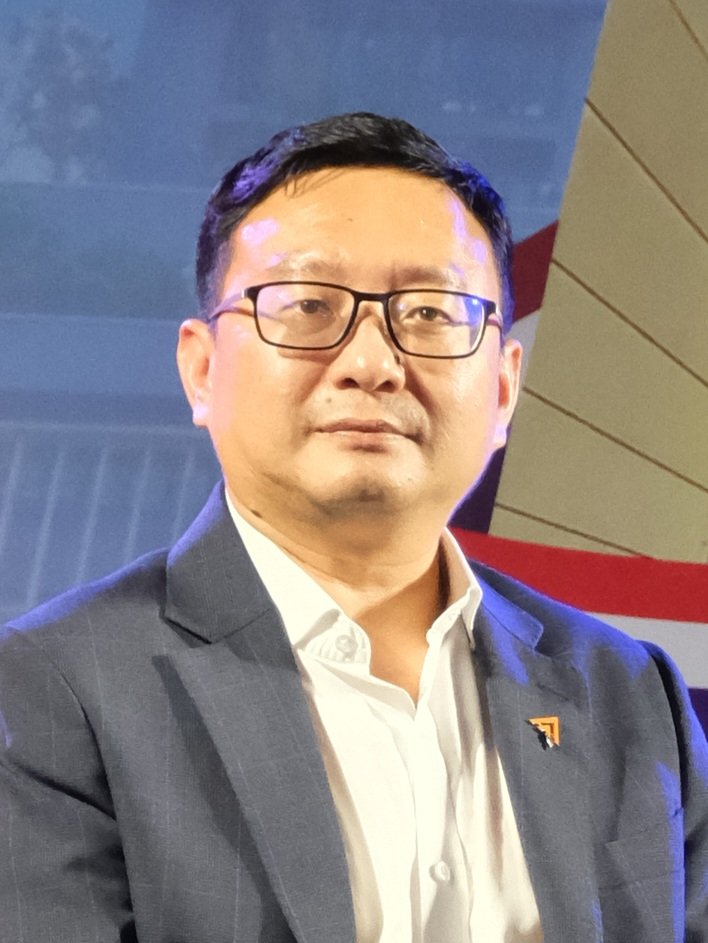
Natthaphong Ruengpanyawut was born in Songkhla on 18 May 1987 and grew up in Bangkok. He attended Taweethapisek School before completing a bachelor’s degree in computer engineering at Chulalongkorn University. His studies coincided with the 2006 military coup, an event he later described as important to his political awakening.
After university, Natthaphong built a career in enterprise technology rather than joining a traditional political network. The People’s Party’s 2026 candidate profile records him as chief executive of Absolute Management Solutions from 2007 to 2019. The company provided cloud and information-technology services, giving him experience with digital infrastructure, organisational management and the practical constraints facing smaller businesses.
Future Forward and a first House seat
Natthaphong joined the Future Forward Party in 2018 and won Bangkok’s twenty-eighth constituency in the March 2019 general election. Future Forward linked younger voters, decentralisation, economic competition and reform of military influence. His technology background made him a natural participant in parliamentary work on digital government, data and emerging technology rather than a politician known mainly for factional brokerage.
The Constitutional Court dissolved Future Forward in February 2020 over a loan from party leader Thanathorn Juangroongruangkit. Natthaphong was not among the executives banned in that ruling, so he and most surviving MPs continued through the Move Forward Party. The transition established a pattern that would define his career: organisational continuity across court-ordered party dissolution, combined with a growing focus on how state institutions spend money and use information.
Budget scrutiny and the Move Forward opposition
Natthaphong returned to the House on Move Forward’s party list after the May 2023 election. Party records identify him as chair of the House committee studying budget preparation and administration, chair of a special committee examining an annual budget bill and a Thai representative to the ASEAN Inter-Parliamentary Assembly. Parliament also records his participation in work on regulation and promotion of artificial intelligence.
These assignments placed him at the intersection of technology and legislative oversight. Rather than treating digital policy only as a technology-sector issue, he argued for government systems that could be audited, measured and made easier for citizens to use. Budget scrutiny also gave him visibility inside the party as it became the largest opposition bloc after winning the 2023 election but failing to assemble a government under the joint House–Senate prime-minister selection rules then in force.
Leading the People’s Party after dissolution
On 7 August 2024, the Constitutional Court dissolved Move Forward and imposed ten-year political bans on eleven executives over the party’s campaign to amend Penal Code Article 112. Natthaphong was not included among the banned executives. Two days later, the surviving parliamentary group reorganised as the People’s Party and selected him as leader, succeeding the better-known Pita Limjaroenrat and Chaithawat Tulathon generation at the front of Thailand’s progressive movement.
A royal command appointed Natthaphong leader of the opposition on 1 October 2024 because he led the largest party outside government and held no ministerial or presiding parliamentary office. He combined that constitutional role with party-building beyond Bangkok. The challenge was to preserve Move Forward’s reform identity while expanding constituency organisation, presenting an economically credible governing team and operating within legal boundaries that had already ended two predecessor parties.
The 2025 transition and an early election
After the Constitutional Court removed Prime Minister Paetongtarn Shinawatra in August 2025, the People’s Party used its House votes to support Bhumjaithai leader Anutin Charnvirakul for prime minister without joining his cabinet. Natthaphong presented the arrangement as a temporary agreement tied to an early dissolution and constitutional reform. The decision gave Anutin a parliamentary route to office while keeping the People’s Party formally in opposition.
The arrangement attracted competing judgments. Supporters said an opposition party had extracted a timetable for returning power to voters and advancing a new constitution. Critics argued that it enabled a conservative coalition and gave the government leverage over the timetable. The House was dissolved on 11 December 2025, and the general election was scheduled for 8 February 2026 alongside a separate constitutional referendum.
Second place in 2026 and a renewed opposition role
Natthaphong entered the 2026 campaign as the People’s Party’s leading prime-ministerial candidate. The final 500-seat distribution gave the party 120 seats: eighty-eight constituencies and thirty-two party-list seats. It led the nationwide list allocation but finished behind Bhumjaithai’s 192 seats. Bhumjaithai then formed the core of a governing coalition with Pheu Thai, leaving the People’s Party as the largest opposition force.
The newly elected House considered Anutin and Natthaphong for prime minister on 19 March. Anutin received 293 votes, Natthaphong 119 and eighty-six MPs abstained. The People’s Party subsequently presented a shadow cabinet to organise scrutiny by policy field. As of this biography’s review on 3 October 2026, Natthaphong remained party leader and the central parliamentary alternative to Anutin’s coalition, with his longer-term significance dependent on whether the reform movement can translate repeated national support into durable institutions and executive power.
Quick answers
Frequently asked questions about Natthaphong Ruengpanyawut
- Who is Natthaphong Ruengpanyawut?
- Natthaphong Ruengpanyawut is a leader of Thailand’s People’s Party and opposition leader. Natthaphong connects Thailand’s technology sector and parliamentary budget oversight to the reform movement that continued from Future Forward through Move Forward into the People’s Party.
- What is Natthaphong Ruengpanyawut best known for?
- Natthaphong Ruengpanyawut is best known for leading the People’s Party to 120 House seats in Thailand’s 2026 election.
- When and where was Natthaphong Ruengpanyawut born?
- Natthaphong Ruengpanyawut was born on 18 May 1987 in Songkhla, Thailand.
Sources and further reading
How this biography was checked
Core dates and offices are checked against the sources below. This profile was last reviewed on 3 October 2026.
- People’s PartyNatthaphong Ruengpanyawut — 2026 party-list candidate profile
- House of Representatives of ThailandAppointment of Natthaphong Ruengpanyawut as leader of the opposition
- National Assembly of ThailandMember of the House of Representatives profile
- Constitutional Court of ThailandRuling No. 20/2567 dissolving the Move Forward Party
- People’s PartyHistory of the People’s Party
- Inter-Parliamentary UnionThailand House election, 8 February 2026
- Public Relations Department of ThailandAnutin Charnvirakul elected prime minister with 293 votes
- People’s PartyPeople’s Party shadow cabinet
- TIMENatthaphong Ruengpanyawut profile
- Wikimedia CommonsNatthaphong portrait and CC BY-SA 4.0 licence record