
The short answer
The 1962 coup did more than replace one government. It ended Burma’s parliamentary era, placed military officers over national institutions and launched an economic system built on nationalisation and isolation. Its failures shaped the uprising twenty-six years later.
Chronology
A timeline of the turning points
Military caretaker government
Ne Win governed temporarily after a split in U Nu’s AFPFL coalition.
Civilian government restored
U Nu’s Union Party won the election and returned him to office.
Military coup
Troops detained U Nu and other leaders, dissolved parliament and created a Revolutionary Council.
Burmese Way announced
The council published its programme for a socialist, state-directed political economy.
Student protest crushed
Security forces fired on students at Rangoon University; the Students’ Union building was demolished.
Major nationalisation
Banks and large parts of trade and industry passed into state control.
One-party constitution
The BSPP became the constitutional centre of a nominally civilian socialist republic.
Economic crisis became uprising
Demonetisation and falling living standards helped trigger the movement that ended the BSPP era.
Why did the military seize power in 1962?
U Nu’s return to office in 1960 revived debates about Buddhism, party competition and constitutional reform. Leaders from several ethnic states pressed a “federal principle” that would give the states greater autonomy and restructure the union.
Ne Win and the Revolutionary Council claimed the union risked disintegration. That was the military’s justification, not a neutral proof that a coup was unavoidable. On 2 March troops arrested civilian and ethnic leaders, dissolved parliament and replaced constitutional government by decree.
What was the Burmese Way to Socialism?
The programme mixed military nationalism, state planning, socialist language and selective Buddhist ideas. The council created the Burma Socialist Programme Party, restricted other political organisations and steadily subordinated administration, media and civic life to the new order.
The system was distinct from a simple Soviet copy, but it shared a preference for one-party control and public ownership. A 1974 constitution gave those arrangements a civilian legal form without creating competitive politics.
How did nationalisation affect the economy?
Banks, wholesale trade, large industries, schools and many services were nationalised. Foreign businesses and many residents of Indian and Chinese descent left, removing capital, commercial knowledge and networks from the formal economy.
State monopolies did not eliminate markets; they displaced activity into black-market channels. Export weakness, exchange controls and isolation reduced investment and living standards. The result was a long decline from one of postwar Asia’s better-endowed economies to United Nations least-developed-country status in 1987.
How was opposition controlled?
The regime quickly demonstrated that political control would be enforced with violence. Security forces fired on Rangoon University students in July 1962, and the historic Students’ Union building was destroyed the next day.
Censorship, detention and surveillance narrowed public debate while armed conflict continued in ethnic regions. The military presented centralisation as national unity, but coercion deepened many of the political conflicts the coup claimed to solve.
Why did the system end in 1988?
By the 1980s the formal economy was strained by debt, shortages and repeated currency interventions. The 1987 cancellation of banknotes destroyed savings without adequate compensation and intensified student anger.
Protest spread after police violence in March 1988. Ne Win resigned his party chairmanship in July and the BSPP order collapsed during the August uprising, but a new military council took power in September. The socialist era ended; military dominance did not.
Continue the chronology
Related history guides
The Earlier Caretaker Government
Compare the parliamentary handover and electoral return with the non-consensual takeover of 1962.
Read the timeline1947—1948Panglong and Independence
Understand the parliamentary and federal settlement the coup displaced.
Read the timeline1988The 8888 Uprising
Follow the nationwide movement that ended the socialist party state.
Read the timeline2008—todayMyanmar’s 2008 Constitution Explained
Compare direct military government with the protected powers built into the later constitution.
Read the timeline1948—2026Myanmar Presidents and Heads of State
See why the presidency disappeared under military councils and how the office later returned.
Read the timeline1948—2026Myanmar Prime Ministers
Compare U Nu’s parliamentary cabinet with the Revolutionary Council and later socialist premiers.
Read the timelineConnected biographies
Eight lives connecting the coup to the executive offices it abolished, socialist rule, federalism and cultural resistance
1916—1989
Win Maung
Third president of the Union of BurmaThe Karen politician and former cabinet minister who served as president from 1957 until soldiers removed and imprisoned him in 1962.Read biography
1907—1995
U Nu
First prime minister of independent BurmaThe writer, student activist and AFPFL politician who became independent Burma’s first prime minister and the central civilian leader of its parliamentary era.Read biography
1915—1987
Ba Swe
Second prime minister of independent BurmaThe student nationalist, socialist organiser and defence minister who briefly succeeded U Nu as prime minister during Burma’s parliamentary era.Read biography
c. 1895—1962
Sao Shwe Thaik
First president of the Union of BurmaThe saopha of Yawnghwe who helped bring Shan participation into the Panglong settlement and became the independent union’s first head of state.Read biography
c. 1910—2002
Ne Win
Military ruler of Burma from 1962 to 1988The general who overthrew U Nu, nationalised much of the economy and built a one-party military state that lasted until the 1988 uprising.Read biography1919—1993
Sein Win
Prime minister of socialist Burma from 1974 to 1977The independence-era soldier and Revolutionary Council member who became prime minister when military rule was recast as a one-party constitutional system.Read biography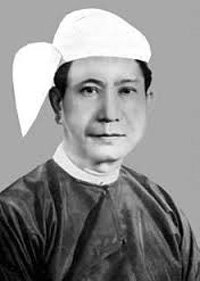
1918—1996
San Yu
General and fifth president of BurmaThe wartime independence soldier and senior general who succeeded Ne Win as president inside Burma’s one-party socialist state.Read biography1951—
San Minn
Modern and experimental artistThe painter associated with Yangon’s experimental art circles whose coded images tested the boundaries of expression under military rule.Read biographyQuick answers
Common questions
- When was the 1962 coup in Burma?
- The military seized power on 2 March 1962.
- Who led the 1962 coup?
- General Ne Win led the takeover and chaired the new Revolutionary Council.
- What was the Burmese Way to Socialism?
- It was the military government’s programme of one-party rule, nationalisation, economic planning and restricted foreign contact.
- Why did Ne Win overthrow U Nu?
- The military cited threats to national unity and federal reform. Historians treat that as the coup leaders’ rationale, not proof that military intervention was necessary.
- When did the Burmese Way to Socialism end?
- The BSPP political order collapsed during the 1988 uprising; the military then established a new governing council.
Primary and institutional sources
How this history was checked
Dates, legal milestones and historical claims are checked against the official and institutional records below. This article was reviewed on 4 October 2026.