In this biography
Quick facts
- Born
- 17 April 1916
- Died
- 4 July 1989
- Birthplace
- Hlezeit village, Bassein District, British Burma
- Country
- Myanmar
- Nationality
- Burmese
- Known for
- Serving as the final president of Burma’s first parliamentary republic before the 1962 coup
- Ethnic community
- Karen
- Education
- Rangoon University · BA
- President
- 13 March 1957–2 March 1962
- Detention
- 1962–1967 after the military coup
Why this life matters
Win Maung’s removal marks the break between Burma’s first constitutional republic and twelve years of direct Revolutionary Council rule.
Timeline
Key moments
Born in the Irrawaddy delta
Born on 17 April in Hlezeit village in Bassein District.
Entered national government
Won election and held cabinet responsibilities including mines, transport and communications.
Became president
Succeeded Ba U through a joint parliamentary election.
Remained head of state during caretaker rule
The presidency continued while Ne Win temporarily headed the cabinet before new elections.
Removed in the military coup
Soldiers detained Win Maung as the Revolutionary Council suspended constitutional government.
Died in Yangon
Died on 4 July after a long illness.
A Karen politician in the independence generation
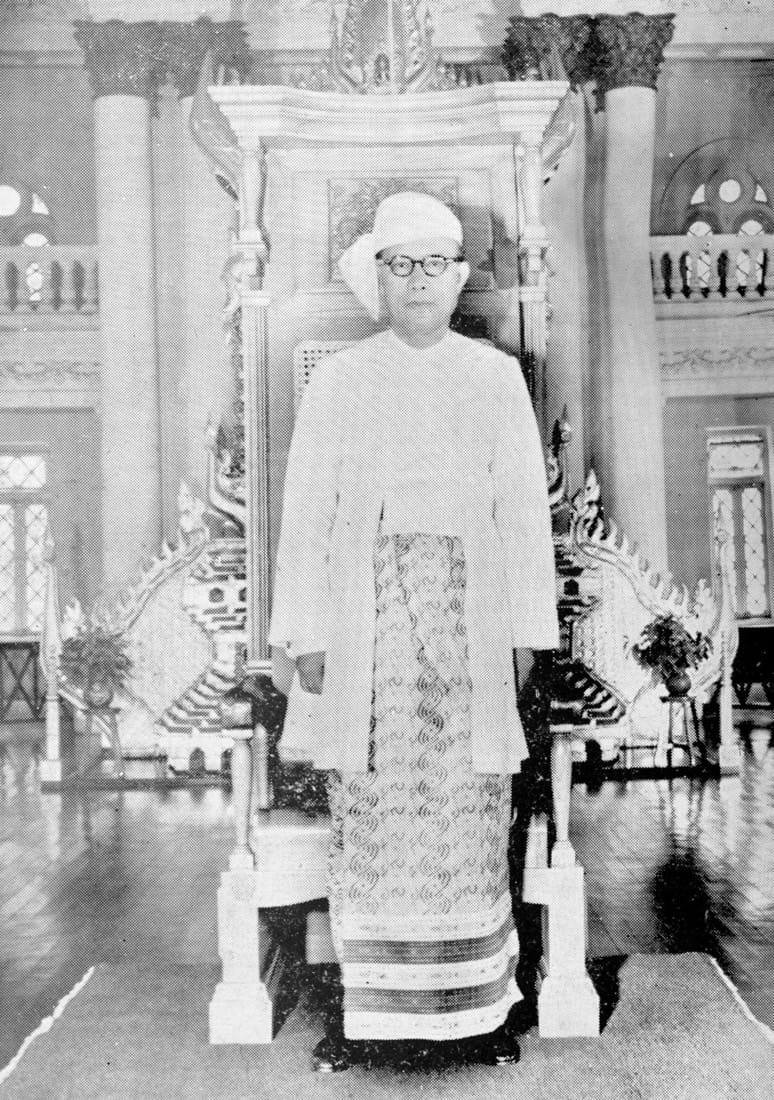
Win Maung was born into a Karen family in the Irrawaddy delta in 1916 and graduated from Rangoon University. He entered politics during the transition to independence and served in the parliamentary order led by the Anti-Fascist People’s Freedom League. His ethnic background mattered in a union already fighting a Karen insurgency, but his career developed inside the national governing coalition rather than an armed ethnic organisation.
After the 1947 election he held ministerial responsibilities that included mines, transport and communications. Those portfolios placed him inside a government attempting to restore infrastructure and state administration while civil conflict affected much of the country. By the mid-1950s he had the cabinet experience and parliamentary backing needed for nomination to the largely ceremonial but symbolically important presidency.
President across the AFPFL split and caretaker government
Parliament selected Win Maung to succeed Ba U in March 1957. Under the 1947 Constitution, the prime minister and cabinet directed government while the president served as constitutional head of the Union. His term nevertheless spanned an unusually unstable sequence: U Nu returned to office, the AFPFL split and General Ne Win headed a caretaker cabinet from 1958 to 1960 before elections restored U Nu.
Win Maung remained president through those changes, which shows that the 1958 transfer to a caretaker government did not itself abolish constitutional institutions. The arrangement ended only when Ne Win seized power on 2 March 1962. The Revolutionary Council detained Win Maung and U Nu, suspended the Constitution and eliminated the presidency rather than appointing a successor under it.
Imprisonment and the end of the first republic
Win Maung spent roughly five years in detention after the coup. The presidency did not reappear until 1974, when a new one-party Constitution created a different office inside the Burma Socialist Programme Party state. Treating Ne Win as Win Maung’s ordinary presidential successor would therefore conceal a twelve-year period in which the constitutional office ceased to exist.
He later lived in retirement and died in Yangon on 4 July 1989. Contemporary obituaries remembered him as the last president of a democratically elected Burmese government before military rule. His biography is thus a marker of institutional rupture: parliamentary selection in 1957, continuity through a caretaker cabinet and removal by force in 1962.
Quick answers
Frequently asked questions about Win Maung
- Who was Win Maung?
- Win Maung was a third president of the Union of Burma. Win Maung’s removal marks the break between Burma’s first constitutional republic and twelve years of direct Revolutionary Council rule.
- What is Win Maung best known for?
- Win Maung is best known for serving as the final president of Burma’s first parliamentary republic before the 1962 coup.
- When and where was Win Maung born?
- Win Maung was born on 17 April 1916 in Hlezeit village, Bassein District, British Burma.
- When did Win Maung die?
- Win Maung died on 4 July 1989.
Sources and further reading
Explore the evidence
These references support the biography and offer further reading. Official records, first-person accounts and independent reporting provide different perspectives; image records document attribution and licensing.
- 1. Los Angeles Times archiveMahn Win Maung · obituary
- 2. The IrrawaddyMyanmar’s Presidents Since Independence
- 3. Office of the Historian, U.S. Department of StateThe 1962 coup and suspension of constitutional government
- 4. United Nations Digital LibraryConstitution of the Union of Burma (1947)
- 5. Network Myanmar archive1989 Burma Press Summary · obituary record
- 6. Wikimedia Commons1958 portrait and public-domain record