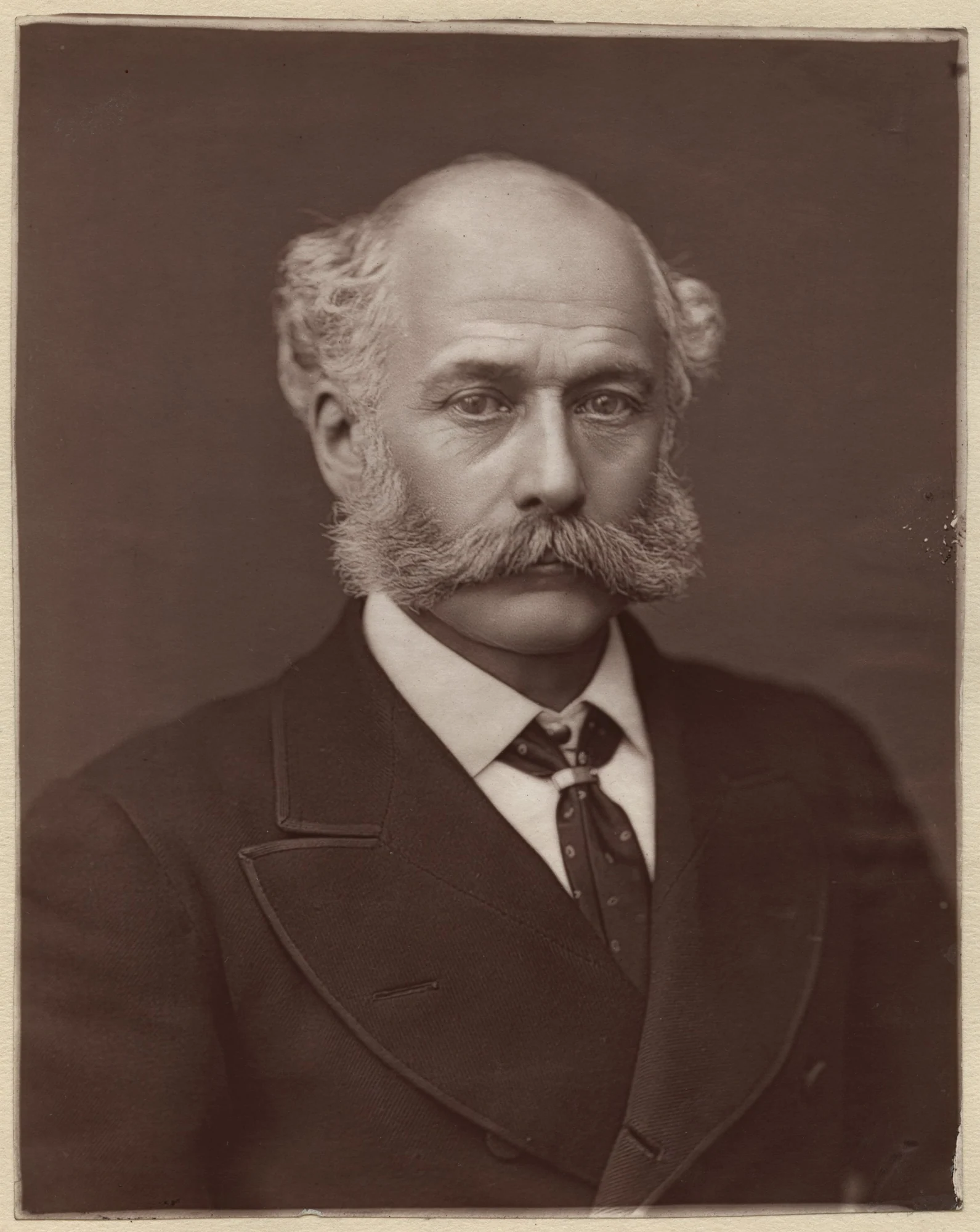
In this biography
Quick facts
- Born
- 1819
- Died
- 1891
- Birthplace
- Not independently established
- Country
- United Kingdom
- Nationality
- Not independently established
- Known for
- London’s system of main drainage and Thames embankments
Why this life matters
He organised local sewers, intercepting mains, pumping stations and outlets as a metropolitan network.
Timeline
Key moments
Metropolitan Commission
Appointed assistant surveyor.
Main drainage planning
Leads engineering for the Metropolitan Board of Works.
Published paper
Explains the main drainage and interception scheme.
ICE presidency
Serves as president of the Institution of Civil Engineers.
Engineering before main drainage
Bazalgette’s early consulting work included surveying and projects connected with canals, dockyards and railways. That work prepared him for a setting in which the route of a structure mattered as much as the structure itself. He joined the Metropolitan Commission of Sewers and was its engineer before the creation of the Metropolitan Board of Works.
London already had local sewers, with many outlets into the river. The practical problem was the relationship among those outlets, the tides and the growing city. Replacing a pipe at a single street would have left the metropolitan pattern largely intact.
Joining separate drains into a system
As chief engineer to the new board, Bazalgette developed main drainage works that intercepted local flows and took them farther downriver. The hot summer of 1858 made the smell politically impossible to ignore, but proposals and institutional work predated that crisis. The resulting project combined sewers, pumping, embankments and arrangements at the outlets.
His 1865 paper is valuable because it traces how the system worked in parts. Some routes could move flow by gradient. In other places pumps raised it so that it could continue. The paper provides a designer’s account of a constructed network and of work still in progress.
A city-scale contribution
The scheme changed where much waste entered the river, a different claim from saying the first design provided modern treatment. Public health effects also depend on other conditions, including water supply. Bazalgette went on to serve as president of the Institution of Civil Engineers in 1884. His career can be read as an example of coordinating many works with a public purpose and keeping their roles distinct.
Quick answers
Frequently asked questions about Joseph Bazalgette
- What is an intercepting sewer?
- It is a main sewer positioned to collect flows from other drains before those flows reach their earlier outlets.
Keep exploring
Lives connected to this story
- Isambard Kingdom Brunel
Compare how another Victorian engineer coordinated routes, structures and public institutions.
- Thomas Newcomen
Compare mechanical lifting in mine drainage with the pumping stage of an urban network.
- Jesse Hartley
Explore Jesse Hartley’s work: organising Liverpool dock construction and the Albert Dock’s warehouse system.
- Thomas Hawksley
Explore Thomas Hawksley’s work: developing urban water systems and advocating constant service rather than intermittent household supply.
- William Lindley
Explore William Lindley’s work: designing Hamburg’s water and sewer infrastructure and later municipal systems in continental Europe.
- James Mansergh
Explore James Mansergh’s work: planning major municipal water and sewage schemes, including Birmingham’s Elan Valley supply.
Sources and further reading
Explore the evidence
These references support the biography and offer further reading. Official records, first-person accounts and independent reporting provide different perspectives; image records document attribution and licensing.
- 1. Institution of Civil EngineersSir Joseph Bazalgette
- 2. Joseph W. Bazalgette, ICE proceedings, digitised by UCLOn the main drainage of London, and the interception of the sewage from the River Thames
Selected passages cover the predecessor commission, intercepting sewers, pumping and outfalls. It is the chief engineer’s contemporary report, not an epidemiological study.
- 3. Institution of Civil EngineersLondon sewer system