
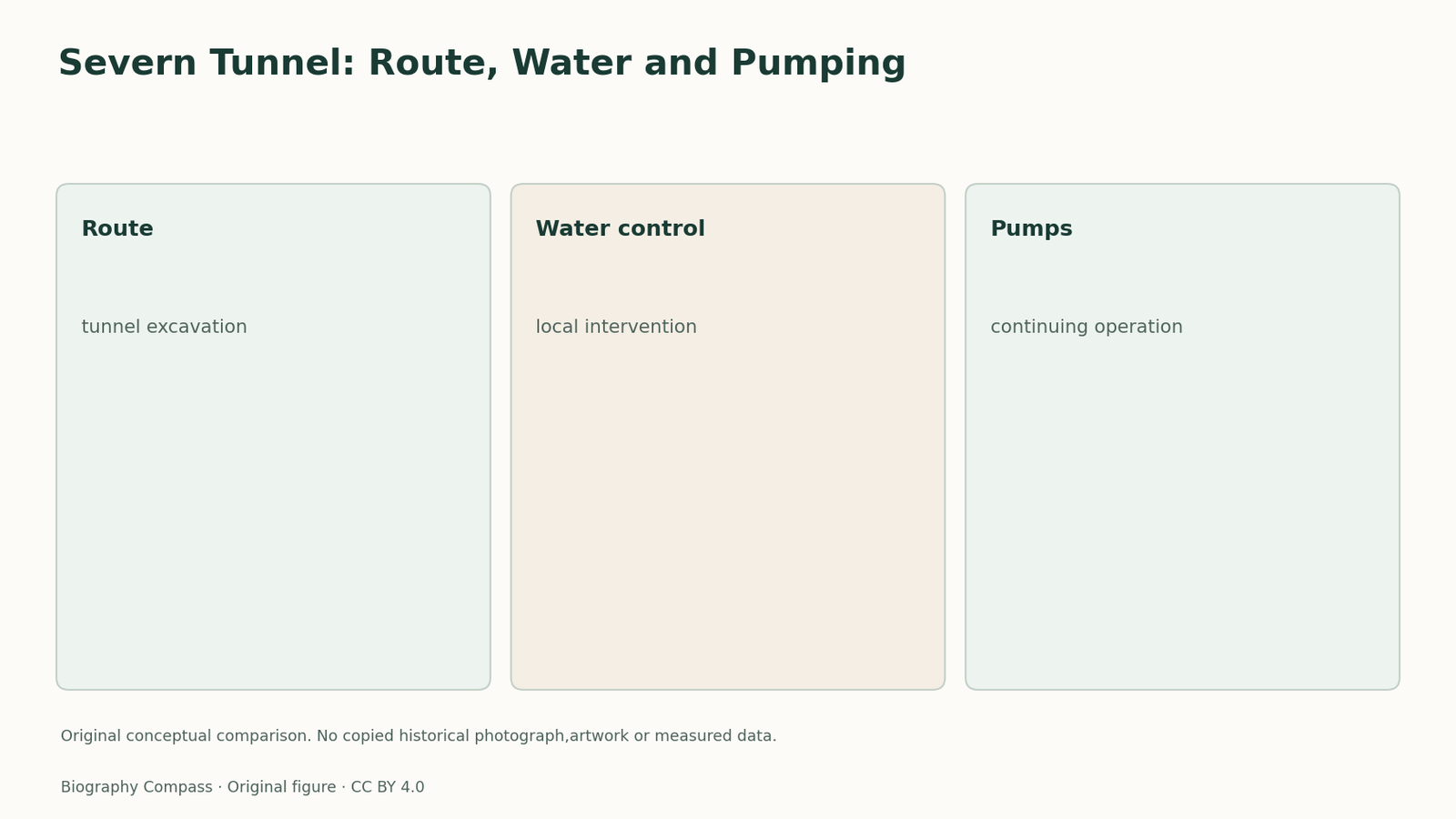
The short answer
Why was a completed tunnel also a continuing pumping operation?
Read the records together
Contributions,evidence and scope
Different records illuminate different parts of this particular undertaking.
| Record | What the record establishes | What remains distinct |
|---|---|---|
| Historic England gazetteer | Separates design, chief engineering and building roles. | Does not allocate every site decision. |
| Museum heritage account | Identifies flooding, diving intervention and continuing pumps. | A dramatic repair is not the entire construction history. |
| Parliamentary evidence | Dates passengeropening 1886 and discusses operation. | Modern operating figures are not Victorian measurements. |
The crossing was also an underground water problem
The Severn Tunnel shortened a railway journey that had required a long route around the estuary. Its excavation began in 1873 and the first passenger services ran in 1886. The engineering crossed geological layers as well as a political boundary between England and Wales. Water entering the workings therefore had to be managed throughout construction. The National Railway Museum identifies the 1879 encounter with the Great Spring as a major interruption. A finished route under the river could not be assessed solely by whether two headings met: workers also had to make a passage that could remain drained and maintained.
Several people solved different parts of the work
Historic England’s gazetteer names Richardson, Hawkshaw and Walker with different responsibilities. The museum account adds diver Alexander Lambert and the use of Henry Fleuss’s breathing apparatus in the flooded workings. These records reveal a project whose difficulties required design, contracting, site labour and specialised intervention. A chief engineer’s name is therefore a way into the organisation, not a replacement for everyone else’s contribution. The sources describe the importance of the diving work without making one dramatic episode the sole explanation for completing the tunnel. Construction continued through a wider system of engineering decisions and labour.
Controlling entry and removing water are distinct
A door or sluice can help control the movement of water, but it does not necessarily eliminate every source of ingress. Sudbrook’s pumping arrangements became part of the tunnel’s continuing operation. This is the central distinction: drainage was not merely temporary equipment discarded when excavation ended. Parliamentary evidence written long after opening still identified flood risk and pumping within the tunnel’s operating context. Those records should not be converted into a single timeless daily volume, because quantities and equipment can change. The supported conclusion concerns the function of pumping within a railway system, not a reconstructed flow measurement.
Read a continuing-system diagram
Draw a railway passage, a source of water, a controlled connection and a pumping outlet. Ask whether closing one connection proves that every water source has vanished. It does not. Then compare two milestones: excavation joined and railway service operating. The second also requires usable track, drainage and other operating arrangements. This original exercise is a functional explanation rather than a detailed tunnel design or an instruction for underground work. Its checked answer keeps construction completion separate from continuing management. It also gives a reason to retain Richardson, Walker, Lambert and the workforce in the story alongside Hawkshaw, whose formal oversight was one contribution within the larger undertaking.
Continue the chronology
Related history guides
St Pancras: Shed, Platforms and Storage
Explore how St Pancras combined its railway approach, elevated platforms, broad roof and storage undercroft, with separate engineering and hotel credits.
Read the timeline1869–1883Brooklyn Bridge: Caissons and Direction
Trace the Brooklyn Bridge’s caisson work and continuing engineering direction, distinguishing Washington Roebling’s formal office from site responsibilities.
Read the timelineBiography context
Explore United Kingdom through connected lives
Connected biographies
People behind this work
1811–1891
John Hawkshaw
Civil and railway engineerJohn Hawkshaw is remembered for engineering railway crossings and consulting on the Severn Tunnel and major urban transport works.Read biography
1806–1859
Isambard Kingdom Brunel
Consulting civil engineer for railway, bridge, dock and steamship enterprisesIsambard Kingdom Brunel ran an engineering practice serving railway and maritime companies. As the Great Western Railway’s engineer, he helped connect London and Bristol in 1841. His ships and structures combined technical ambition with financial risk and depended on investors, contractors and workers.Read biography
1819–1891
Joseph Bazalgette
Civil engineer and metropolitan drainage designerBazalgette designed main drainage works that carried much of London’s sewage away from central river outlets.Read biographyQuick answers
Common questions
- Why does a completed railway tunnel still need pumps?
- Continuing water ingress required drainage and pumping as operating functions, not merely as temporary construction equipment.
Primary and institutional sources
How this history was checked
The cited records distinguish contemporary accounts,official catalogues and later institutional or scholarly interpretation. The comparison and worked exercise are original editorial material. This article was reviewed on 7 November 2026.