
The short answer
How should Tower Bridge’s architectural, structural and machinery credits be separated?
Read the records together
Contributions,evidence and scope
Different records illuminate different parts of this particular undertaking.
| Record | What the record establishes | What remains distinct |
|---|---|---|
| Tower Bridge history | Documents proposal, permission and engineering appointments. | Does not allocate every machinery component. |
| English Heritage | Connects architectural appearance with opening structure. | A heritage summary is not an operating manual. |
| Historical biography | Places the bridge within a consulting partnership. | A principal engineer credit is not sole authorship. |
A bridge that opened needed more than a façade
Tower Bridge had to carry road traffic across the Thames while permitting tall ships to reach docks upstream. Its central bascules answered a navigational requirement that an ordinary fixed roadway would not. The bridge’s institutional history records Jones and Barry’s 1884 proposals and the choice of an opening span. Parliament then authorised construction in 1885. Separating a traffic requirement, an accepted proposal and statutory permission explains why the finished structure cannot be understood solely as a stylistic object. A dramatic appearance was part of the project, but it was not the entire engineering problem.
Roles remained distinct after Jones’s death
Barry was chief engineer, with Henry Marc Brunel as assistant engineer. Jones’s death in 1887 did not end the undertaking; the team continued building the bridge that opened in 1894. The roles reveal a project able to continue through a change in personnel. They do not establish that an assistant merely copied instructions or that an architect alone determined the moving mechanism. The surviving institutional account supports a division of responsibility, while the historical biography places the partnership among other railway and bridge commissions. Credits should follow those documented roles rather than the assumption that a single familiar name performed every task.
Read architecture and mechanism in different ways
English Heritage’s account describes the combination of Gothic Revival architecture with an opening bridge structure. A photograph can reveal the towers and roadway but cannot, on its own, explain the entire operating system or prove the authorship of its hidden components. Conversely, a mechanism diagram says little about why a particular architectural treatment was selected. The correct comparison joins the records without forcing them to answer the same question. This topic consequently identifies the need for machinery as part of an opening bridge but does not reconstruct uninspected calculations, assign every hydraulic component to Barry or borrow a decorative feature as evidence of mechanical design.
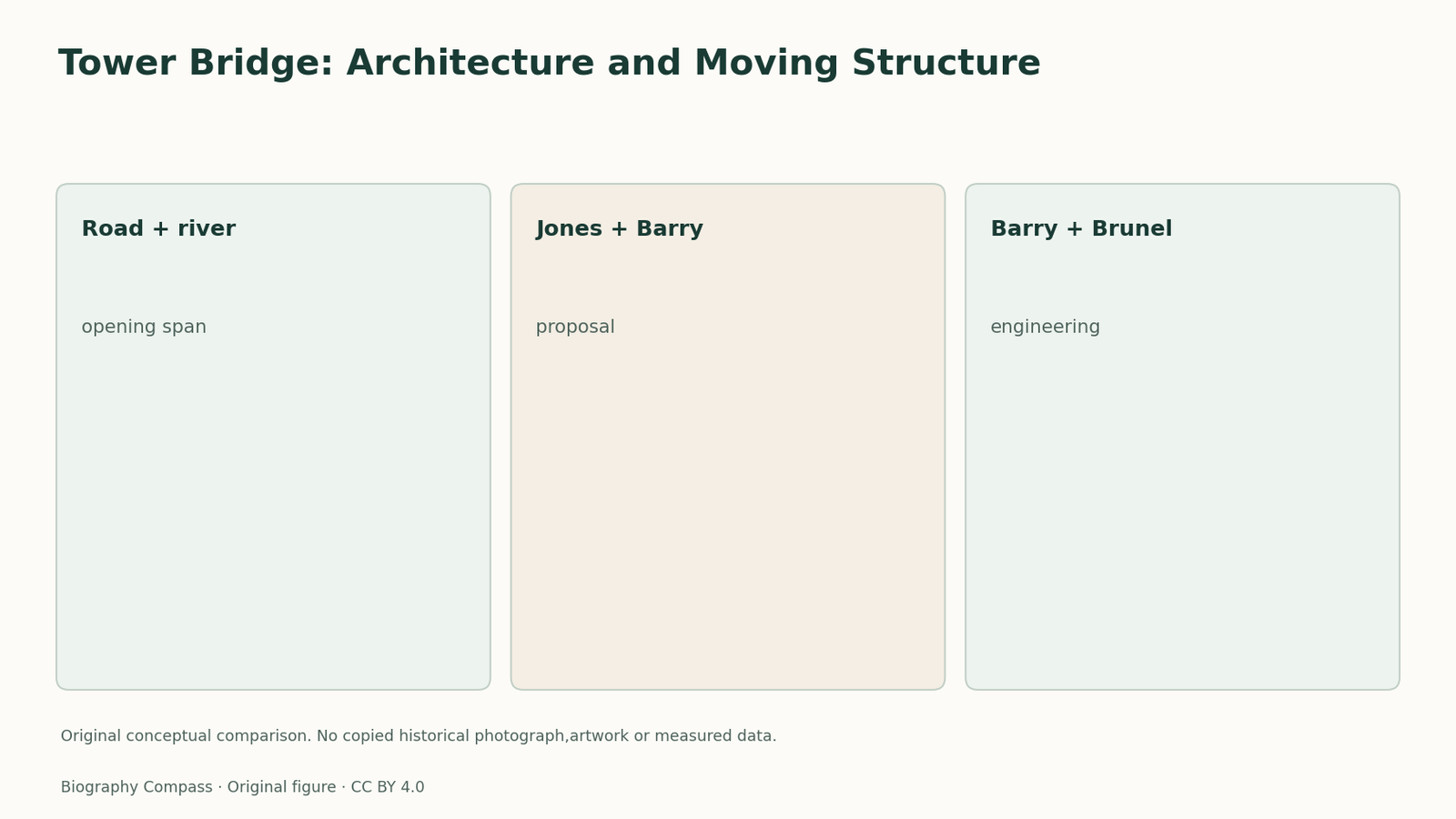
Make a four-role project chart
Write four headings: public requirement, architectural proposal, engineering direction, and operation. Put road-and-river access under the first; Jones and Barry’s accepted proposal under the second; Barry with assistant Brunel under the third. Leave space under operation for the machinery and staff required to lift a working bridge. The checked answer to “does an opening in the deck explain who designed every pump?” is no: function alone does not identify a component’s author. This original chart offers a way to read further technical records. It deliberately stops where the inspected material stops, preserving the distinction between a documented project role and a detailed machinery attribution.
Continue the chronology
Related history guides
St Pancras: Shed, Platforms and Storage
Explore how St Pancras combined its railway approach, elevated platforms, broad roof and storage undercroft, with separate engineering and hotel credits.
Read the timeline1881–1890Forth Bridge: Partnership, Approval and Building
Map Fowler, Baker and the contractors’ roles on the Forth Bridge using design reports, contract dates and construction records, with a worked exercise.
Read the timelineBiography context
Explore United Kingdom through connected lives
Connected biographies
People behind this work
1836–1918
John Wolfe Barry
Civil engineer and engineering standards organiserJohn Wolfe Barry is remembered for engineering Tower Bridge with Horace Jones and Henry Marc Brunel and helping organise British engineering standards.Read biography
1806–1859
Isambard Kingdom Brunel
Consulting civil engineer for railway, bridge, dock and steamship enterprisesIsambard Kingdom Brunel ran an engineering practice serving railway and maritime companies. As the Great Western Railway’s engineer, he helped connect London and Bristol in 1841. His ships and structures combined technical ambition with financial risk and depended on investors, contractors and workers.Read biography
1819–1891
Joseph Bazalgette
Civil engineer and metropolitan drainage designerBazalgette designed main drainage works that carried much of London’s sewage away from central river outlets.Read biographyQuick answers
Common questions
- What were Jones’s and Barry’s Tower Bridge roles?
- Jones and Barry developed the accepted proposal; Barry served as chief engineer and Henry Marc Brunel as assistant engineer.
Primary and institutional sources
How this history was checked
The cited records distinguish contemporary accounts,official catalogues and later institutional or scholarly interpretation. The comparison and worked exercise are original editorial material. This article was reviewed on 7 November 2026.