In this biography
Quick facts
- Born
- 21 March 1954
- Birthplace
- Nakhon Ratchasima Province, Thailand
- Country
- Thailand
- Nationality
- Thai
- Known for
- Leading the 2014 military coup and governing through the NCPO and a post-election coalition
- Office
- 29th Prime Minister, 24 August 2014 – 5 September 2023
- Military role
- Commander-in-chief of the army, 2010–2014
- Coup role
- Leader of the NCPO from May 2014
- 2019 selection
- Chosen 500–244 by a joint parliamentary sitting
Why this life matters
Prayut’s nine years in power connect military intervention, the 2017 Constitution, state-led economic strategy, pandemic government and a contested return to electoral politics.
Timeline
Key moments
Born in northeastern Thailand
Born on 21 March in Nakhon Ratchasima Province and later educated for an army career.
Became army commander
Took command after a career associated with the Queen’s Guard and senior First Army posts.
Led a military coup
The armed forces removed the caretaker government and created the National Council for Peace and Order.
Became the 29th prime minister
Received royal appointment after selection by the junta-appointed National Legislative Assembly.
A new constitution was promulgated
The post-coup charter established the electoral and appointed institutions used for the transition.
Returned after a general election
Received royal endorsement after the elected House and appointed Senate voted jointly for prime minister.
Faced pandemic and protest crises
COVID-19 disrupted tourism and daily life while youth-led demonstrations demanded political and constitutional change.
Constitutional Court allowed him to continue
The Court ruled that the constitutional eight-year calculation began when the 2017 charter took effect.
Transferred power to Srettha
Left office after the 2023 election and the formation of a Pheu Thai-led coalition.
An army career before national power
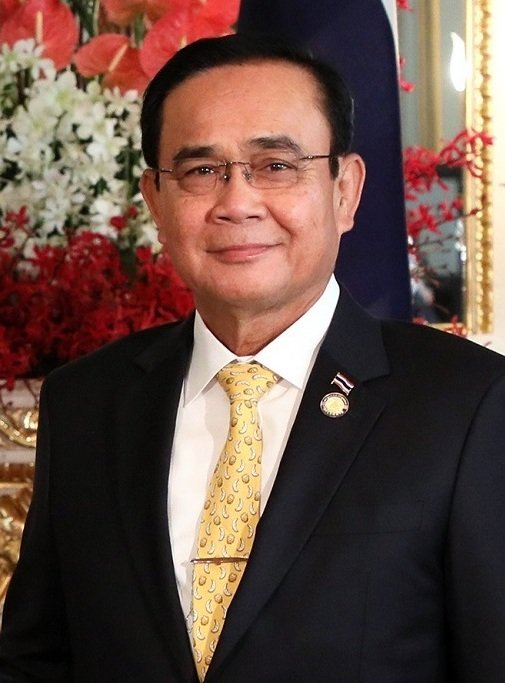
Prayut Chan-o-cha was born on 21 March 1954 in Nakhon Ratchasima Province. He trained at Thailand’s military preparatory school and Chulachomklao Royal Military Academy before building a career in infantry commands associated with the Queen’s Guard. The network supplied several senior officers during a period when the armed forces retained a decisive role in politics.
He became army commander in 2010, shortly after the military had helped suppress large anti-government demonstrations in Bangkok. As commander he presented the army as guardian of national order and the monarchy. That institutional outlook shaped his response when conflict between Yingluck Shinawatra’s government and its opponents paralysed electoral and parliamentary processes in 2013 and 2014.
The 2014 coup and the NCPO
Prayut declared martial law on 20 May 2014 and seized power two days later after talks among political rivals failed. The National Council for Peace and Order suspended most of the constitution, dissolved the Senate and assumed executive and legislative authority. A junta-appointed assembly selected Prayut as prime minister in August, joining his military command with the country’s highest political office.
The NCPO said intervention was necessary to restore stability and pursue reform. It also prohibited political gatherings, summoned politicians and activists, controlled broadcasters and used military courts and broad orders to restrict dissent. United Nations human-rights bodies documented concerns about detention, expression and assembly, making coercive rule inseparable from any assessment of the period’s administrative record.
Constitutional redesign and economic strategy
A referendum approved a new constitution in 2016 and the charter was promulgated in April 2017. Its transitional provisions gave an appointed Senate a vote in selecting the prime minister after the next election. Elections promised soon after the coup were repeatedly delayed, so the constitutional transition kept the NCPO in power for almost five years.
Prayut’s governments promoted Thailand 4.0, digital infrastructure and the Eastern Economic Corridor as routes toward higher-value industry. The World Bank described the corridor as central to a strategy built around transport, advanced manufacturing and services, while also identifying productivity, skills, competition and implementation constraints that could not be solved by investment branding alone.
The 2019 vote and a civilian-labelled government
The March 2019 election produced no House majority. Pheu Thai won the most seats, while the Palang Pracharath Party nominated Prayut and assembled a coalition with the Democrat and Bhumjaithai parties. In a joint sitting, elected representatives and the appointed Senate chose him by 500 votes to 244. Royal endorsement followed on 11 June.
The vote restored an elected lower house but preserved institutional advantages created after the coup. Prayut now led a multiparty cabinet rather than a formal junta, yet opposition parties and civic groups continued to challenge the charter and military influence. Youth-led protests in 2020 widened those demands to include constitutional revision and public discussion of the monarchy.
Pandemic government, term dispute and departure
COVID-19 placed a tourism-dependent economy under exceptional pressure. Thailand initially contained transmission effectively, then faced severe later waves and a contested vaccine rollout. Emergency powers enabled coordination but also intensified debate about accountability, communication and the use of restrictions during political demonstrations.
In 2022 the Constitutional Court temporarily suspended Prayut while considering whether he had reached the constitutional eight-year limit. It ruled that the relevant calculation began with the 2017 Constitution and allowed him to resume work. His new United Thai Nation Party did not lead the 2023 election, and Srettha Thavisin eventually succeeded him. Prayut’s record remains defined by the unusual durability of a coup leader who converted military rule into a coalition premiership without resolving the debate over democratic legitimacy.
Quick answers
Frequently asked questions about Prayut Chan-o-cha
- Who is Prayut Chan-o-cha?
- Prayut Chan-o-cha is the 29th Prime Minister of Thailand, 2014–2023. Prayut’s nine years in power connect military intervention, the 2017 Constitution, state-led economic strategy, pandemic government and a contested return to electoral politics.
- What is Prayut Chan-o-cha best known for?
- Prayut Chan-o-cha is best known for leading the 2014 military coup and governing through the NCPO and a post-election coalition.
- When and where was Prayut Chan-o-cha born?
- Prayut Chan-o-cha was born on 21 March 1954 in Nakhon Ratchasima Province, Thailand.
Sources and further reading
How this biography was checked
Core dates and offices are checked against the sources below. This profile was last reviewed on 3 October 2026.
- Secretariat of the Prime Minister of ThailandDirectory of Prime Ministers of Thailand
- Inter-Parliamentary UnionThailand House of Representatives election, March 2019
- National Assembly of ThailandConstitution of the Kingdom of Thailand, 2017
- Constitutional Court of ThailandConstitutional Court Ruling No. 14/2565 on the eight-year limit
- World Bank GroupThailand Country Private Sector Diagnostic
- Office of the UN High Commissioner for Human RightsUN communications on rights restrictions after the 2014 coup
- ReutersPrayut leaves politics nine years after the coup
- Wikimedia CommonsPortrait and licence record