In this biography
Quick facts
- Born
- 26 May 1887
- Died
- 9 November 1963
- Birthplace
- Bassein, Lower Burma, British India
- Country
- Myanmar
- Nationality
- Burmese
- Known for
- Moving from the independent state’s highest court to its constitutional presidency in 1952
- Legal education
- University of Cambridge
- Chief justice
- 4 January 1948–12 March 1952
- President
- 16 March 1952–13 March 1957
- Memoir
- My Burma · 1958
Why this life matters
Ba U’s career links colonial courts, the creation of a national judiciary and the first peaceful succession in Burma’s presidency.
Timeline
Key moments
Born in the Irrawaddy delta
Born on 26 May in Bassein, now Pathein.
Studied law at Cambridge
Completed legal study in Britain before returning to practise in Rangoon.
Entered the colonial judiciary
Advanced from district judge to the High Court of Judicature at Rangoon.
Became chief justice at independence
Led the Supreme Court created for the new Union of Burma.
Elected second president
Succeeded Sao Shwe Thaik through the parliamentary procedure in the 1947 Constitution.
Retired and published his memoir
Left office after one term, published My Burma and died in Rangoon in 1963.
From colonial law to the national Supreme Court
Ba U was born in Bassein in 1887 and went to Britain to study law at the University of Cambridge. After returning to Burma, he practised in Rangoon and entered the judicial service. He became a district judge in 1921 and a judge of the High Court of Judicature at Rangoon in 1932, building a career that crossed late colonial rule, wartime occupation and the restoration of British administration.
When the Union of Burma became independent on 4 January 1948, Ba U became chief justice of the new Supreme Court. The 1947 Constitution assigned the court an important place in protecting constitutional rights and interpreting the powers of the Union. Scholarship on Burmese judicial independence identifies his 1948–1952 tenure as the opening period of the postcolonial court rather than a simple continuation of the colonial bench.
A constitutional president in a parliamentary system
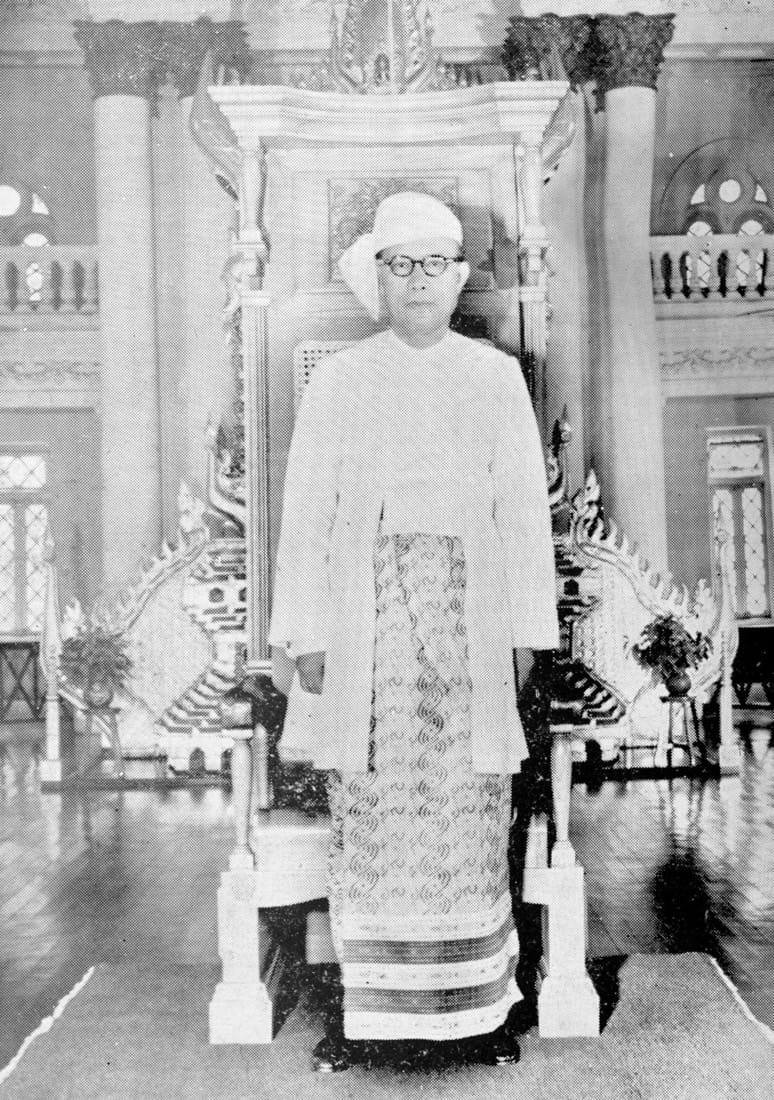
Both chambers of Parliament elected Ba U president in March 1952. He succeeded Sao Shwe Thaik while U Nu remained prime minister, demonstrating the separation between a constitutional head of state and the cabinet responsible for governing. His presidency covered armed insurgency, economic reconstruction and changes in the premiership, including Ba Swe’s year in office, without turning the presidency into an independent executive centre.
The transfer was also institutionally significant: a chief justice left the judiciary and entered the presidency through a parliamentary vote, then completed a five-year term. Ba U exercised formal powers within the conventions of the 1947 Constitution and was succeeded by Win Maung in March 1957. That orderly sequence would end when the military suspended the Constitution five years later.
Memoir, legal memory and historical limits
After leaving office, Ba U published My Burma: The Autobiography of a President in 1958. The book records a life spent inside institutions that changed sovereignty several times, from British colonial courts to the independent republic. It is valuable as a participant account, although contemporary assessments note that it offers limited discussion of some larger political controversies.
Ba U died in Rangoon on 9 November 1963, after Ne Win’s coup had already abolished the presidency he once held. His historical importance lies less in a personal political programme than in the offices he embodied: the first national Supreme Court and a presidency governed by parliamentary succession rather than military command.
Quick answers
Frequently asked questions about Ba U
- Who was Ba U?
- Ba U was a chief justice and second president of the Union of Burma. Ba U’s career links colonial courts, the creation of a national judiciary and the first peaceful succession in Burma’s presidency.
- What is Ba U best known for?
- Ba U is best known for moving from the independent state’s highest court to its constitutional presidency in 1952.
- When and where was Ba U born?
- Ba U was born on 26 May 1887 in Bassein, Lower Burma, British India.
- When did Ba U die?
- Ba U died on 9 November 1963.
Sources and further reading
Explore the evidence
These references support the biography and offer further reading. Official records, first-person accounts and independent reporting provide different perspectives; image records document attribution and licensing.
- 1. Supreme Court of the Union of MyanmarThe Honorable Chief Justices in Different Eras
- 2. Asian-Pacific Law & Policy Journal · University of HawaiʻiJudicial Independence in Burma
- 3. United Nations Digital LibraryConstitution of the Union of Burma (1947)
- 4. Central Arkansas Library SystemMy Burma · catalogue record for Ba U’s autobiography
- 5. Wikimedia Commons1955 portrait and public-domain record