In this biography
Quick facts
- Born
- 5 January 1927
- Died
- 5 October 2015
- Birthplace
- Naga, Camarines Sur, Philippines
- Country
- Philippines
- Nationality
- Filipino
- Known for
- Defending political detainees under Marcos and serving in Congress after democratic restoration
- Profession
- Lawyer and legislator
- Rights organisations
- MABINI and Free Legal Assistance Group
- House service
- Makati representative, 1992–2001
- Senate service
- 2001–2013
Why this life matters
Arroyo linked courtroom resistance under dictatorship to the difficult work of governing, legislating and scrutinising presidents in the post-EDSA constitutional order.
Timeline
Key moments
Entered legal practice
Completed his law degree at the University of the Philippines and built a career as a private lawyer.
Defended martial-law detainees
Helped organise legal aid through MABINI and the Free Legal Assistance Group.
Became executive secretary
Joined President Corazon Aquino’s government after the People Power Revolution.
Elected to the House
Began three terms representing Makati in the restored legislature.
Joined the Estrada impeachment prosecution
Served among the House prosecutors before the trial crisis and EDSA II.
Served two Senate terms
Built a reputation for detailed budget scrutiny and dissent from prevailing political blocs.
A lawyer against authoritarian power
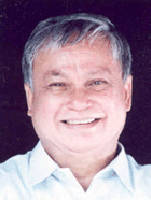
Ceferino “Joker” Arroyo Jr. studied at the University of the Philippines and entered legal practice in the early 1950s. Under martial law, he defended political detainees and helped organise the Movement of Attorneys for Brotherhood, Integrity and Nationalism, or MABINI, as well as the Free Legal Assistance Group.
Legal defence could not by itself end authoritarian rule, but it preserved records, challenged detention and connected individual cases to a broader defence of constitutional rights. This work placed Arroyo among the lawyers who carried opposition from the courts into the post-Marcos government.
From People Power to executive government
After the 1986 transition, President Corazon Aquino appointed Arroyo executive secretary. The office placed a former rights lawyer inside a government simultaneously dismantling authoritarian structures, writing new rules and responding to coup attempts and institutional instability.
He later moved to electoral politics, winning three terms as representative of Makati beginning in 1992. During the impeachment of President Joseph Estrada, Arroyo joined the House prosecution panel whose case became a central part of the crisis that culminated in EDSA II.
Senate scrutiny and political independence
Arroyo served in the Senate from 2001 to 2013. He was particularly associated with scrutiny of appropriations and with votes that sometimes isolated him from both government and opposition majorities.
His career demonstrates that democratic restoration did not erase conflict over executive power. The rights lawyer, presidential aide, prosecutor and legislative dissenter were all parts of a long argument about how institutions should restrain public officials.
Quick answers
Frequently asked questions about Joker Arroyo
- Who was Joker Arroyo?
- Joker Arroyo was a human-rights lawyer, representative and senator. Arroyo linked courtroom resistance under dictatorship to the difficult work of governing, legislating and scrutinising presidents in the post-EDSA constitutional order.
- What is Joker Arroyo best known for?
- Joker Arroyo is best known for defending political detainees under Marcos and serving in Congress after democratic restoration.
- When and where was Joker Arroyo born?
- Joker Arroyo was born on 5 January 1927 in Naga, Camarines Sur, Philippines.
- When did Joker Arroyo die?
- Joker Arroyo died on 5 October 2015.
Sources and further reading
How this biography was checked
Core dates and offices are checked against the sources below. This profile was last reviewed on 9 September 2026.