In this biography
Quick facts
- Born
- 1916
- Died
- 2009
- Birthplace
- Charleston, SC, USA
- Country
- United States
- Nationality
- Not independently established
- Known for
- Discovery of endothelium-dependent relaxation and investigation of EDRF
Why this life matters
A necessary component may have been removed before the measurement began, making preparation history part of the evidence.
Timeline
Key moments
Birth
Born in Charleston, SC, USA.
Nobel recognition
Received the Nobel Prize in Physiology or Medicine.
Natural history and experimental physiology
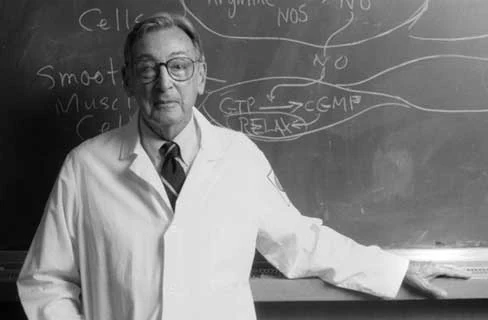
Robert Furchgott was born in Charleston in 1916. His autobiography recalls museum nature classes, collecting shells and watching birds before an academic career in chemistry and physiology. He studied in North Carolina and completed doctoral work at Northwestern. Appointments at Cornell and Washington University preceded his move to the State University of New York in Brooklyn. His research concerned how substances act on vascular smooth muscle, a problem in which preparing the experimental tissue could change the response being studied.
An inconsistency exposes a missing layer
In 1980 Furchgott and John Zawadzki reported that acetylcholine-induced relaxation of isolated blood-vessel preparations required endothelial cells. Their paper linked a puzzling difference between preparations to accidental rubbing of the inner surface during tissue handling. Preserving that surface preserved the relaxation response. The finding gave the vessel lining an active signalling role, rather than treating it as a passive boundary around the muscle. It also showed why an apparent drug inconsistency could arise from the experimental preparation itself.
Sources for this section: [3]
From a factor to nitric oxide
The substance responsible became known as endothelium-derived relaxing factor. Later work connected it with nitric oxide, bringing Furchgott's observations together with those of Ignarro and Murad. The three shared the 1998 medicine prize. Furchgott died in 2009. His contribution is especially useful for readers learning to evaluate experiments: a negative response need not mean that a proposed pathway is absent from the intact organism. A necessary component may have been removed before the measurement began, making preparation history part of the evidence.
Quick answers
Frequently asked questions about Robert F. Furchgott
- What is Robert F. Furchgott known for?
- Discovery of endothelium-dependent relaxation and investigation of EDRF.
Keep exploring
Lives connected to this story
- Louis J. Ignarro
Compare the related experimental question and research career.
- Ferid Murad
Compare the related experimental question and research career.
- Brian Kobilka
Read Kobilka’s structural receptor work as another route to explaining how cellular signals are transmitted.
Sources and further reading
Explore the evidence
These references support the biography and offer further reading. Official records, first-person accounts and independent reporting provide different perspectives; image records document attribution and licensing.
- 1. Nobel Prize OutreachRobert F. Furchgott — Facts
Source scope: Birth/death and award metadata; short official work summary.
- 2. Nobel FoundationRobert F. Furchgott — Biographical
Source scope: Selected historical passages, as recorded in the research evidence ledger; not a full-document reading claim.
- 3. Furchgott and Zawadzki / NatureThe obligatory role of endothelial cells in the relaxation of arterial smooth muscle by acetylcholine
Source scope: Full abstract, web lines230–234, including rubbing, preserved intima and acetylcholine response; author/date record.