In this biography
Quick facts
- Born
- 1936
- Died
- 2023
- Birthplace
- Whiting, IN, USA
- Country
- United States
- Nationality
- Not independently established
- Known for
- Nitric-oxide activation of guanylate cyclase and cyclic-GMP signalling
Why this life matters
The historical achievement was not the general observation that a drug could affect blood vessels, but the experimental construction of a molecular explanation linking nitric oxide, an enzyme and an intracellular signalling molecule.
Timeline
Key moments
Birth
Born in Whiting, IN, USA.
Nobel recognition
Received the Nobel Prize in Physiology or Medicine.
An experimental pharmacologist
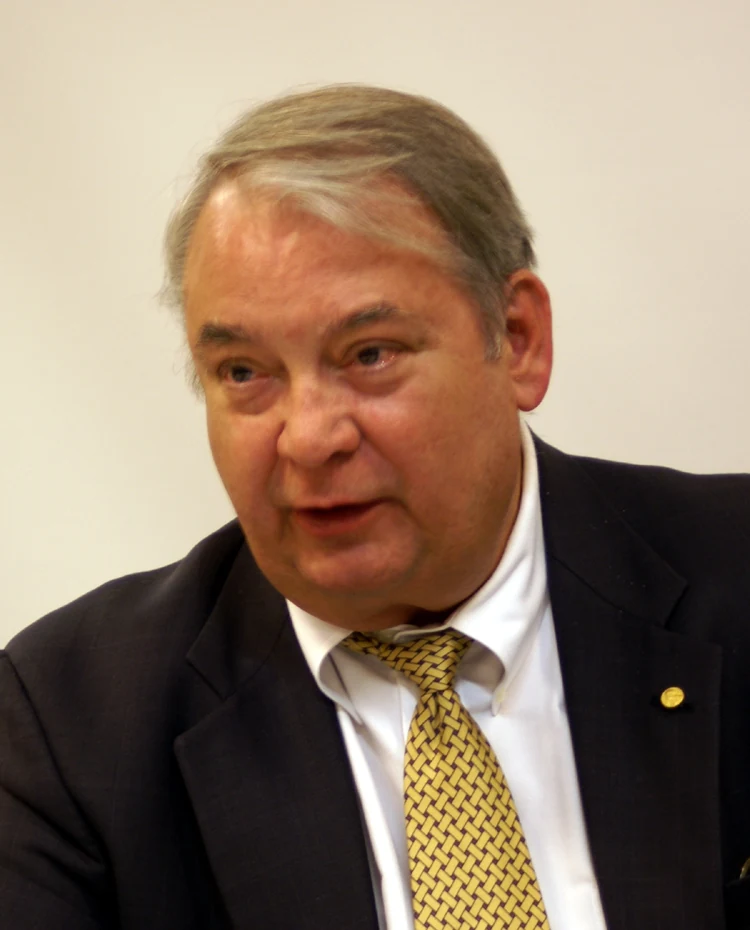
Ferid Murad was born in Whiting, Indiana, in 1936. His parents ran a restaurant, and his education took him through DePauw and doctoral study at Case Western Reserve. His scientific career included the University of Virginia, Stanford and the University of Texas in Houston. The central research problem was how an external chemical influence could be translated into an intracellular biochemical response. That question required connecting a substance applied to a preparation with an enzyme reaction and a change in a cellular messenger.
Putting a gas into a signalling pathway
A 1977 paper by William Arnold, Chandra Mittal, Shigeo Katsuki and Murad investigated nitric oxide's activation of guanylate cyclase in tissue preparations. The enzyme produces cyclic GMP, so its activity supplied a measurable biochemical link. The authors reported effects that varied among preparations. That variation matters: demonstrating a reaction in a defined experiment is more precise than claiming an identical response in every tissue or organism. Murad's work helped make a gas intelligible as a biological signal.
Sources for this section: [3]
Quick answers
Frequently asked questions about Ferid Murad
- What is Ferid Murad known for?
- Nitric-oxide activation of guanylate cyclase and cyclic-GMP signalling.
Keep exploring
Lives connected to this story
- Louis J. Ignarro
Compare the related experimental question and research career.
- Robert F. Furchgott
Compare the related experimental question and research career.
Sources and further reading
Explore the evidence
These references support the biography and offer further reading. Official records, first-person accounts and independent reporting provide different perspectives; image records document attribution and licensing.
- 1. Nobel Prize OutreachFerid Murad — Facts
Source scope: Birth/death and award metadata; short official work summary.
- 2. Nobel FoundationFerid Murad — Biographical
Source scope: Selected historical passages, as recorded in the research evidence ledger; not a full-document reading claim.
- 3. Arnold, Mittal, Katsuki and Murad / PNASNitric oxide activates guanylate cyclase and increases cyclic GMP in tissue preparations
Source scope: Citation and indexed abstract via PubMed/EPA record; enzyme activation, variability and tissue preparations only. No claims about unexamined figure measurements.