
The short answer
What could a receptor–G-protein crystal structure establish about activation without measuring every cell response?
Read the evidence
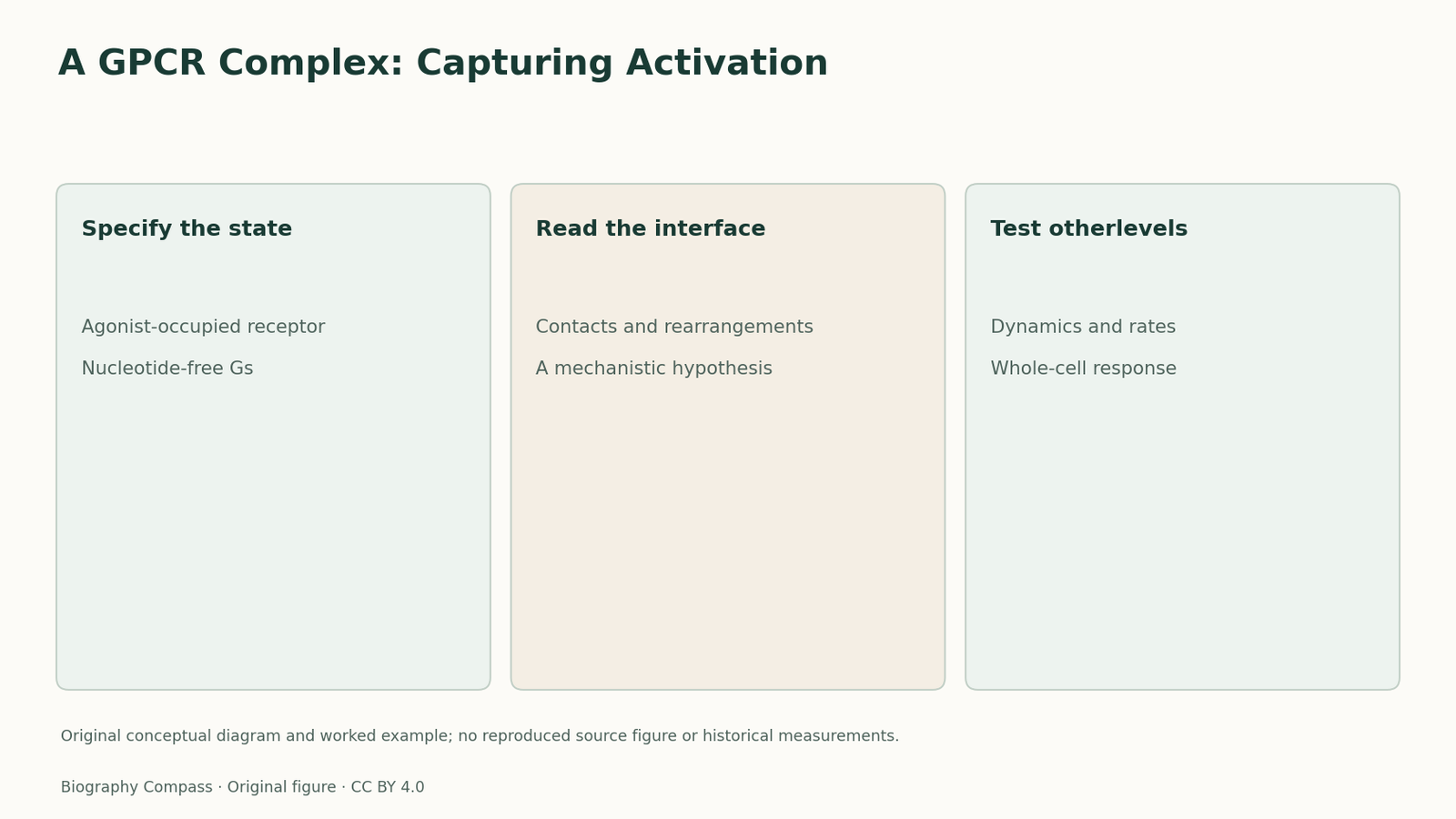
A captured state and the process around it
Theoriginalstructure and functional review operate at related but different levels.
| Record or test | What it establishes | What remains different |
|---|---|---|
| 2011 complex structure | Shows a specific agonist/receptor/Gs assembly. | Is not a complete live-cell time series. |
| Mechanistic interpretation | Relates contacts and rearrangements to signalling models. | Needs functional tests for rates and effects. |
| Whole-cell response | Measures the output of a larger biological system. | Cannot be read directly from one crystal image. |
Name the captured molecular state
The 2011 paper presents a ternary complex containing an agonist-occupied β2-adrenergic receptor and a nucleotide-free Gs heterotrimer. Each part of that description limits what the snapshot represents. It is not simply an isolated receptor, nor a system containing every downstream signalling component. The assembly connects the receptor’s membrane-spanning structure with the protein that receives its activation signal. Identifying the prepared state first makes the later mechanistic interpretation more precise than calling the image a complete picture of cell communication.
Sources for this section: [1]
Interfaces help explain a proposed mechanism
The primary abstract describes contacts between the receptor and Gs and changes that propagate toward the nucleotide-binding pocket. Kobilka’s review places such structural work beside biochemical knowledge of adrenergic signalling. The structure can constrain how the partners fit and which rearrangements are compatible with the captured state. It does not independently determine how frequently every transition occurs in a membrane or how large a cell’s final response will be. Those are functional and dynamic questions requiring different measurements.
One family contains manysystems
GPCRs share important architectural and signalling features, but the β2 receptor is a particular model system. Kobilka’s review discusses how structural information relates to receptor function and pharmacology, not a simple rule that all receptors have identical behaviour. Likewise, an agonist’s presence in a structure does not by itself supply a clinical result for a drug. Reading the source at its actual scale avoids jumping from a molecular interface to an unmeasured claim about treatment effectiveness or all cell types.
An original snapshot-versus-response exercise
Imagine an original evidence sheet with three boxes: the partners are observed in contact; a model proposes how contact affects nucleotide exchange; a cell produces a certain amount of downstream signal. Which box can a structure address most directly? The first. The second can be informed by the structure but needs further testing, and the third requires a functional measurement. Now change the prepared complex so a different nucleotide state is present. A new structure might answer a different question; it should not be assumed identical to the first. These are conceptual research cards, not new receptor coordinates or simulated activation data. They explain why a structural breakthrough can be important without already containing every biological consequence.
Continue the chronology
Related history guides
Receptor Binding: Ligand and Cell Response
Compare Lefkowitz’s 1975 frog and cardiac binding studies, separating specific radioligand sites from downstream signalling and whole-organism effects.
Read the timeline2000–2001RNA Polymerase II: Structure and Transcription
Compare the 2001 ten-subunit polymerase structure with a separate elongation complex, and distinguish structural proposals from functional transcription evidence.
Read the timelineBiography context
Explore United States through connected lives
Connected biographies
Researchers and related approaches
1955–
Brian Kobilka
Physician and structural biologistBrian Kobilka moved from medical training into receptor research with Robert Lefkowitz, then pursued the difficult structural study of GPCRs at Stanford.Read biography
1916–2009
Robert F. Furchgott
Pharmacologist and vascular-physiology researcherIn 1980 Furchgott and John Zawadzki reported that acetylcholine-induced relaxation of isolated blood-vessel preparations required endothelial cells.Read biographyQuick answers
Common questions
- Why does nucleotide-free matter?
- It describes the particular Gs state captured in the complex; the assembly should not be generalised to all stages ofthesignallingcycle.
- Does the crystal structure measure drug efficacy in patients?
- No. It provides molecular structural information, not a clinical test.
Primary and institutional sources
How this history was checked
The 2011 structure abstract identifies the captured complex; Kobilka’s review supplies functional context.The exercise contains no clinical claims. This article was reviewed on 7 November 2026.
- Rasmussen and colleagues / NatureCrystal structure of the β2-adrenergic receptor–Gs protein complex
- Brian K.Kobilka / Trends in Pharmacological SciencesStructural insights into adrenergic receptor function and pharmacology
- Nobel Prize OutreachBrian Kobilka — Facts
- Nobel Prize OutreachBrian Kobilka — Biographical