
The short answer
How did investigators connect EDRF with nitric oxide?
Evidence comparison
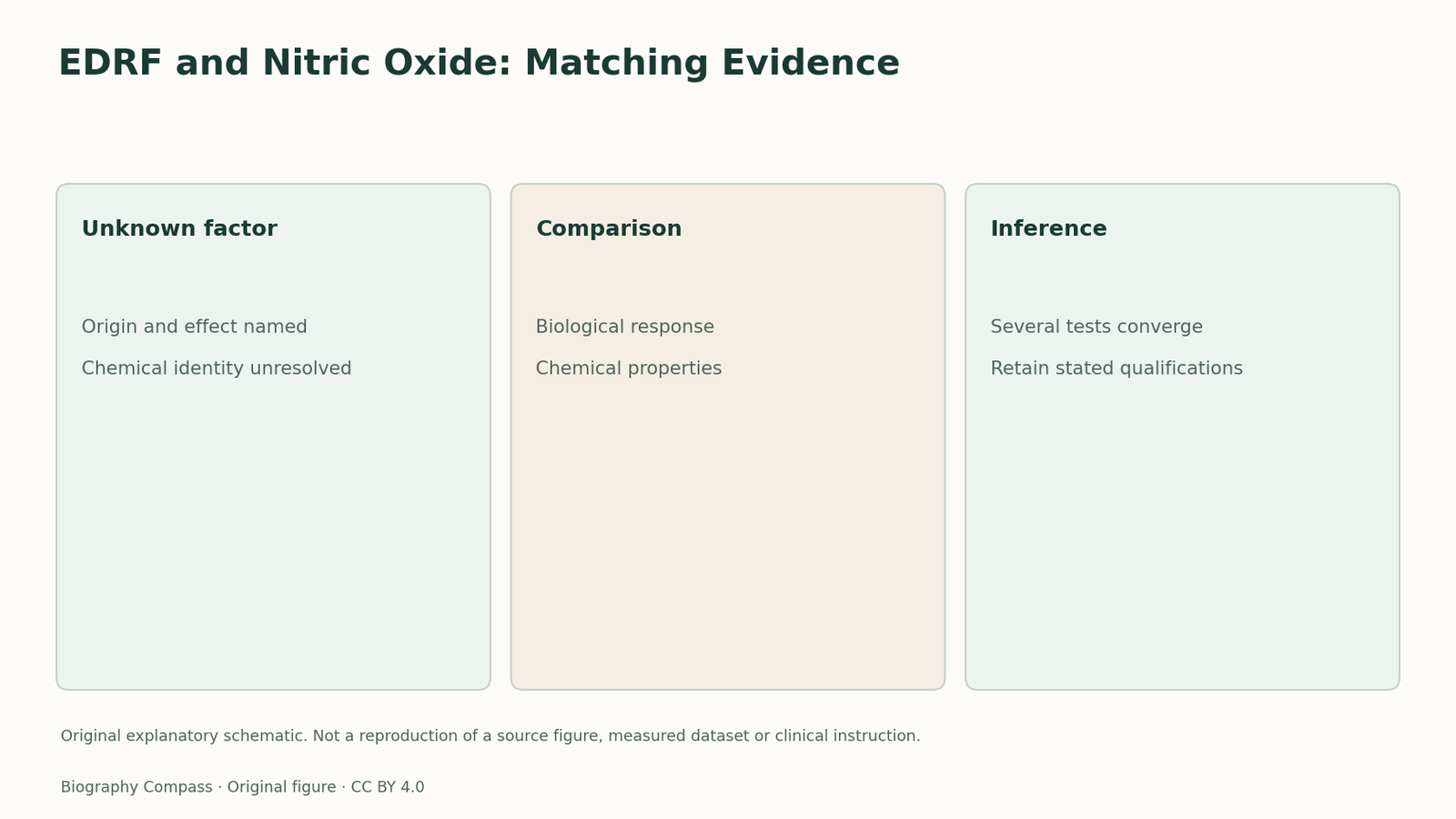
EDRF and Nitric Oxide: Matching Evidence
Compare the observations with the narrower conclusions they support.
| Record or observation | What it supports | What remains separate |
|---|---|---|
| Similar vessel response | Supports a shared functional effect | One effect is insufficient for chemical identity |
| Independent chemical comparisons | Constrain the identity of the released material | Preserve the original paper’s qualified chemical wording |
Start with a named unknown
EDRF meant endothelium-derived relaxing factor: a description of origin and effect, rather than a complete chemical identification. Ignarro's group compared the material released from artery and vein with nitric oxide. Their 1987 paper makes a useful case study in identification because it does not rely on a single shared response. The question is how several properties of an unknown substance can be compared with those of a known candidate.
Compare functional and chemical observations
The study reported similar instability, effects on vessel preparations and cyclic-GMP accumulation. It also described chemical procedures involving haemoglobin and a coupled colour reaction. These are different kinds of comparison. A relaxing effect describes what a preparation does; a chemical reaction helps constrain what the active material might be. The paper's wording includes nitric oxide or a labile nitroso species in its chemical identification discussion, a useful reminder to preserve the scope of the original claim.
Sources for this section: [3]
An identification matrix with one missing row
Create an original matrix with three properties: biological response, sensitivity to an inhibitor and a chemical reaction. Suppose an unknown and a candidate match on the first property, while the other two remain untested. Ask whether identity is established. The answer is no: many substances may share one response. Then mark matching results in all three rows and explain why the combined case is stronger without treating the matrix as an invented reproduction of Ignarro's data.
Sources for this section: [3]
Convergence has limits
Matching tests can make an identification persuasive, but the choice and specificity of the tests matter. This guide explains the logic of the historical comparison. It does not provide a method for diagnosing disease or assume that every substance producing relaxation must be nitric oxide.
Sources for this section: [3]
Continue the chronology
Related history guides
Biography context
Explore United States through connected lives
Connected biographies
Researchers and related questions

1941–
Louis J. Ignarro
Pharmacologist and nitric-oxide researcherIgnarro's group investigated nitric oxide and the unidentified endothelium-derived relaxing factor, usually abbreviated EDRF.Read biography
1936–2023
Ferid Murad
Physician and pharmacology researcherA 1977 paper by William Arnold, Chandra Mittal, Shigeo Katsuki and Murad investigated nitric oxide's activation of guanylate cyclase in tissue preparations.Read biography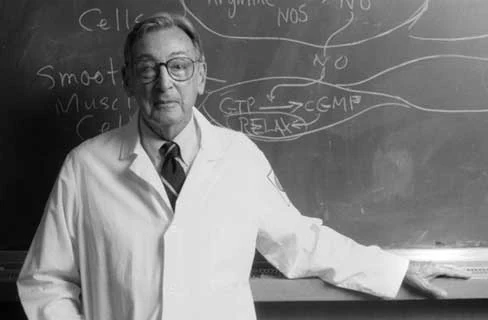
1916–2009
Robert F. Furchgott
Pharmacologist and vascular-physiology researcherIn 1980 Furchgott and John Zawadzki reported that acetylcholine-induced relaxation of isolated blood-vessel preparations required endothelial cells.Read biographyQuick answers
Common questions
- How did investigators connect EDRF with nitric oxide?
- Supports a shared functional effect. One effect is insufficient for chemical identity.
- Are the classroom examples historical measurements?
- No. Invented examples are labelled as classroom models; the source-based discussion identifies the historical evidence separately.
Primary and institutional sources
How this history was checked
Official biographical and award records are read alongside the researcher’s technical account. Source scope and hypothetical examples remain distinct. This article was reviewed on 7 November 2026.