
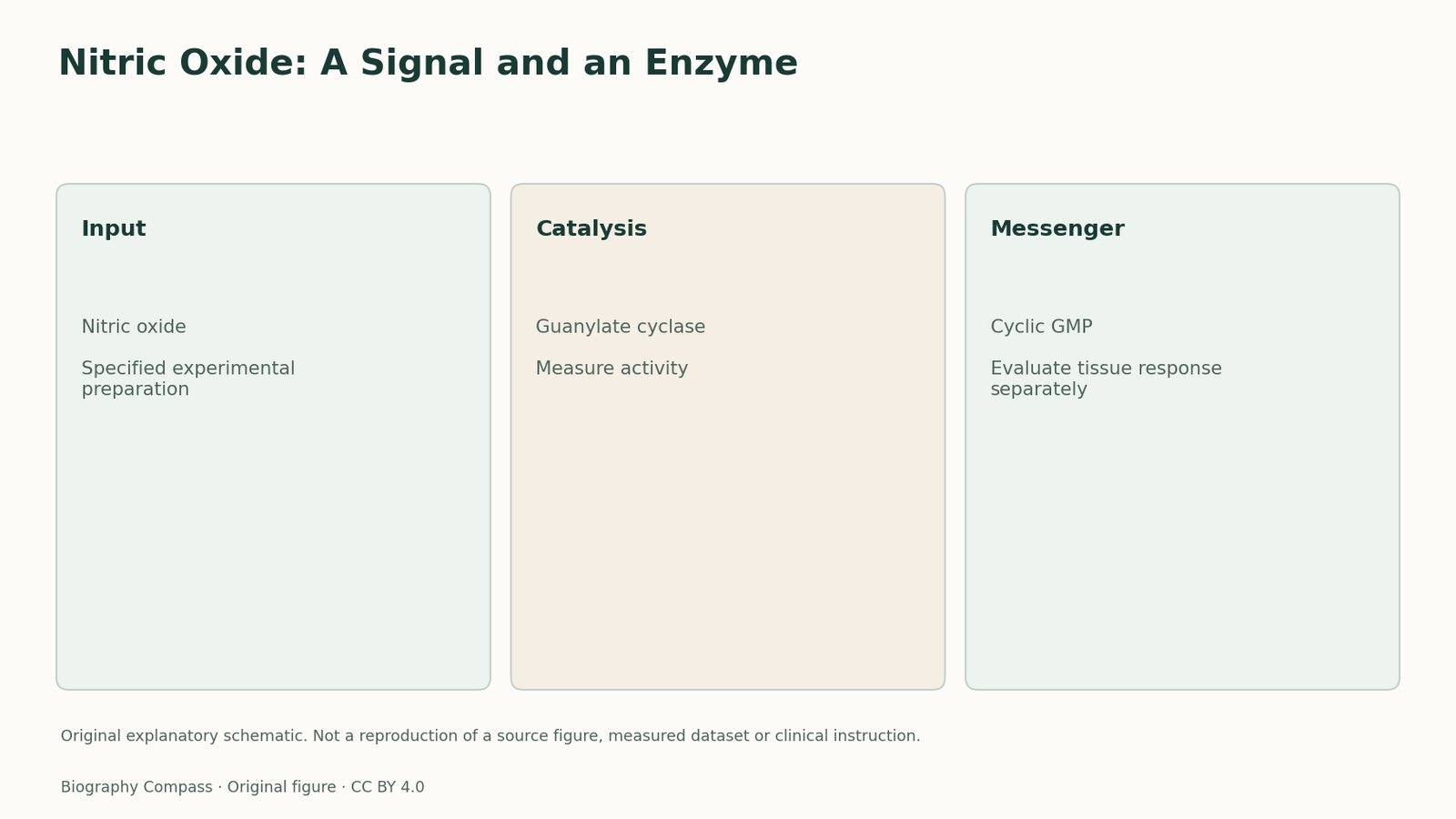
The short answer
How can a short-lived gas activate a signalling enzyme?
Evidence comparison
Nitric Oxide: A Signal and an Enzyme
Compare the observations with the narrower conclusions they support.
| Record or observation | What it supports | What remains separate |
|---|---|---|
| Guanylate-cyclase activity | A biochemical response to nitric oxide | Different from a direct measure of whole-organism benefit |
| Cyclic-GMP level | An intracellular messenger measurement | Does not by itself establish every later tissue effect |
A signal need not be a large molecule
Murad's research helped establish nitric oxide as a signalling molecule. The 1977 study examined its effect on guanylate cyclase and cyclic-GMP levels in tissue preparations. The distinction between the gas and the messenger made by the enzyme is essential. Nitric oxide is an input to this part of the pathway; cyclic GMP is a product whose amount can change as enzyme activity changes. Calling both simply the signal loses a useful experimental distinction.
Compare reaction and tissue response
An increase in enzyme activity and a change in the behaviour of a tissue are related measurements at different scales. The original study reported variable activation across preparations. A reader should therefore identify what was measured before generalising. Observing more cyclic GMP supports a biochemical effect under the assay conditions. It does not, without further evidence, quantify every later step in relaxation or establish the size of a response in an intact person.
Sources for this section: [3]
Keep the intermediate in a paper pathway
Draw three original boxes: nitric oxide, guanylate-cyclase activity and cyclic GMP. Connect them with labelled arrows. Then cover the middle box and ask what the shortened drawing hides. The answer is the catalytic link that makes an increase in the messenger experimentally explainable. Add a separate box for a tissue response, with a question mark on its arrow until evidence for that response is supplied. The exercise does not assign historical quantities or chemical concentrations.
Sources for this section: [3]
The boundary of the explanation
This pathway is a history-of-science model, not a dosing recommendation or a claim that a larger biochemical signal is always beneficial. Its value is to separate the applied substance, the enzyme's measured activity and the physiological outcome so that each can be tested on its own terms.
Sources for this section: [3]
Continue the chronology
Related history guides
Biography context
Explore United States through connected lives
Connected biographies
Researchers and related questions
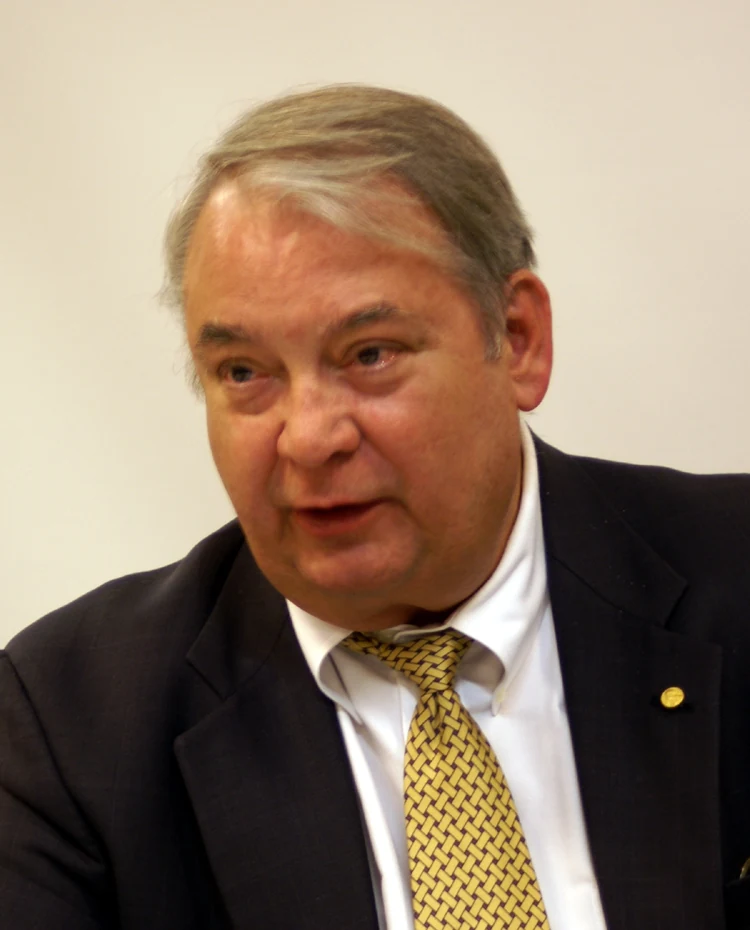
1936–2023
Ferid Murad
Physician and pharmacology researcherA 1977 paper by William Arnold, Chandra Mittal, Shigeo Katsuki and Murad investigated nitric oxide's activation of guanylate cyclase in tissue preparations.Read biography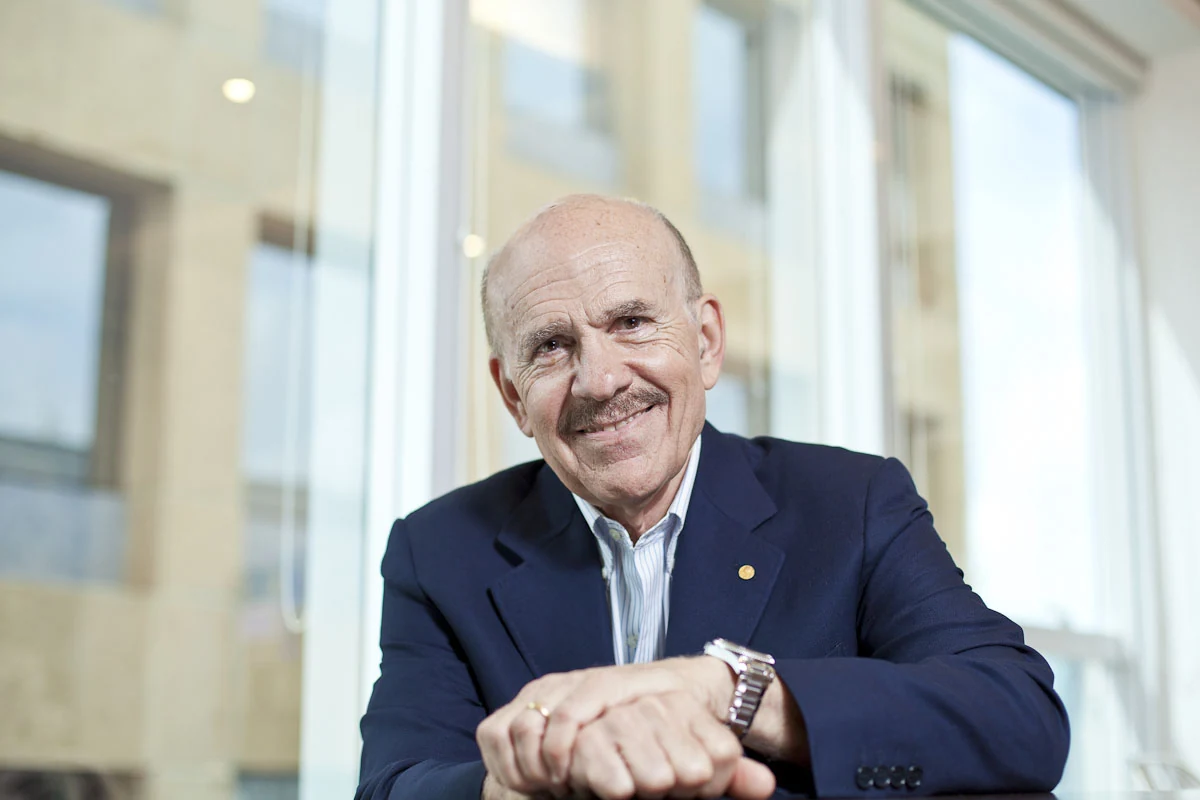
1941–
Louis J. Ignarro
Pharmacologist and nitric-oxide researcherIgnarro's group investigated nitric oxide and the unidentified endothelium-derived relaxing factor, usually abbreviated EDRF.Read biography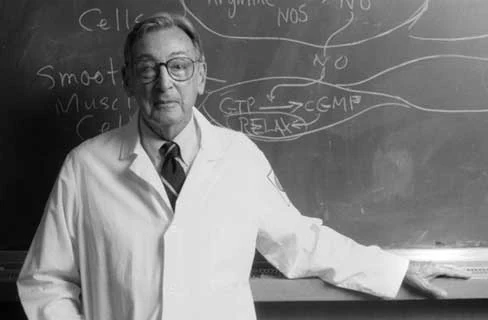
1916–2009
Robert F. Furchgott
Pharmacologist and vascular-physiology researcherIn 1980 Furchgott and John Zawadzki reported that acetylcholine-induced relaxation of isolated blood-vessel preparations required endothelial cells.Read biographyQuick answers
Common questions
- How can a short-lived gas activate a signalling enzyme?
- A biochemical response to nitric oxide. Different from a direct measure of whole-organism benefit.
- Are the classroom examples historical measurements?
- No. Invented examples are labelled as classroom models; the source-based discussion identifies the historical evidence separately.
Primary and institutional sources
How this history was checked
Official biographical and award records are read alongside the researcher’s technical account. Source scope and hypothetical examples remain distinct. This article was reviewed on 7 November 2026.