In this biography
Quick facts
- Born
- 3 December 1838
- Died
- 1912
- Birthplace
- Wisbech, Cambridgeshire, England
- Country
- United Kingdom
- Nationality
- Not independently established
- Known for
- Housing management and the protection of open spaces
Why this life matters
Her housing and conservation work treated access to maintained public space as part of the ordinary conditions of urban life.
Timeline
Key moments
Housing management
Begins work on London properties with Ruskin’s support.
Open spaces
Advocates for spaces city residents can reach and use.
National Trust
Founds a conservation organisation with Hunter and Rawnsley.
Reform as daily management
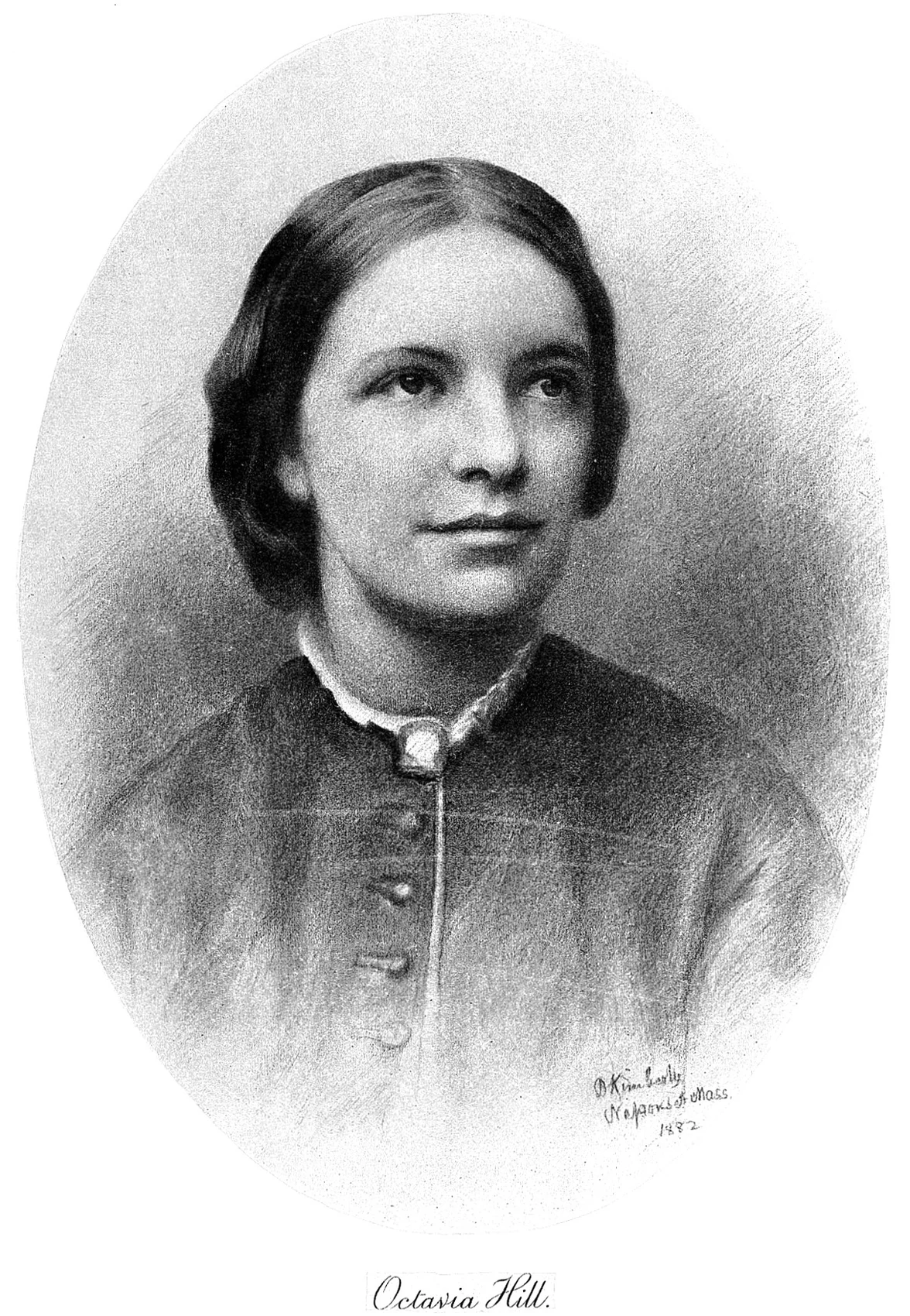
Hill was born in Wisbech to parents involved in social reform. In London she took on the management of homes with financial backing from John Ruskin. Repair, rent collection and the regular work of keeping properties habitable belonged to the same undertaking. Her approach gave managers close knowledge of the buildings and households, although it also put those managers in a position of considerable authority over tenants.
Sources for this section: [1]
Outdoor space and the city
Housing work helped Hill identify another question: what places could city residents reach outside their homes? In her writing she treated a seat, a children’s play space and a larger place for walking as different amenities. She was interested in who did not use distant parks as well as who did. This is a practical account of access that can be investigated by looking at routes, facilities and upkeep.
From local campaigns to an organisation
Efforts to save open land brought her into contact with solicitor Robert Hunter. They were involved in campaigns over London open spaces and joined Hardwicke Rawnsley in founding the National Trust in 1895. Their collaboration gave conservation an organisation that could work over a longer time than a single campaign. This was a collective founding rather than the conversion of one reformer’s scheme into law.
Quick answers
Frequently asked questions about Octavia Hill
- Who founded the National Trust with Hill?
- Robert Hunter and Hardwicke Rawnsley were its other co-founders.
Keep exploring
Lives connected to this story
- Elizabeth Fry
Compare the practical management of a different nineteenth-century institution.
- Rose Scott
Follow another reformer’s interest in civic space and public access.
- Henrietta Barnett
Explore Henrietta Barnett’s career in social reformer and community-planning organiser and the documented study Hampstead Garden Suburb: Land, Rules and Layout.
- Samuel Barnett
Explore Samuel Barnett’s career in clergyman and social reformer and the documented study Toynbee Hall: Residence, Education and Access.
Sources and further reading
Explore the evidence
These references support the biography and offer further reading. Official records, first-person accounts and independent reporting provide different perspectives; image records document attribution and licensing.