

The short answer
A protected square and an accessible square are separate propositions. Hill’s essay asks what people can actually do outdoors and how far they need to travel to do it.
Evidence and interpretation
What each record can establish
Read each record in the context in which it was produced.
| Record | Evidence it supplies | Limit of inference |
|---|---|---|
| Essay observations | Examples of how different spaces are used | A census of all potential users |
| Founding account | The institution’s conservation purpose | Whether a specific visitor can reach a site |
| Two-park exercise | The effect of changing access and use | Historical park attendance |
Chronology
A timeline of the turning points
Essay in collected edition
Hill explains several everyday uses for open spaces.
National Trust
A new body is formed to safeguard natural and historic places.
Different spaces meet different needs
In the collected essay Hill discusses small places to sit, places for children to play, and spaces for walking. Her examples include Leicester Square and the Embankment. A classification by use is more precise than grouping all land under one heading. A place suitable for walking need not make room for supervised play, and a nearby seat may meet a need that a much larger distant park cannot.
Sources for this section: [1]
Take the missing users seriously
Hill contrasts the crowds people notice in large open spaces with the residents who never reach them. This is a prompt to ask what the observer can see. Counting visitors at one gate measures use by the people who arrive. It cannot count everyone excluded by travel time, opening conditions or the absence of a place suited to their activity.
Sources for this section: [1]
Compare a later conservation record
The National Trust’s founding account describes an institution intended to protect natural and historic places. The essay describes reasons a resident might benefit from access. These purposes intersect, but their evidence is different: an institution can acquire a site, while the value of a local amenity is a question about the people and uses around it.
Sources for this section: [2]
Test two invented parks
Give Park A two hectares, a nearby entrance and places to sit, but no games. Give Park B ten hectares, games and a much longer walk. Ask which park suits a person resting after work, a group of children playing and someone taking a long walk. The answer changes with the use. A useful assessment records distance, rules and maintenance rather than ranking the two solely by area.
Continue the chronology
Related history guides
Biography context
Explore United Kingdom through connected lives
Connected biographies
People behind the records
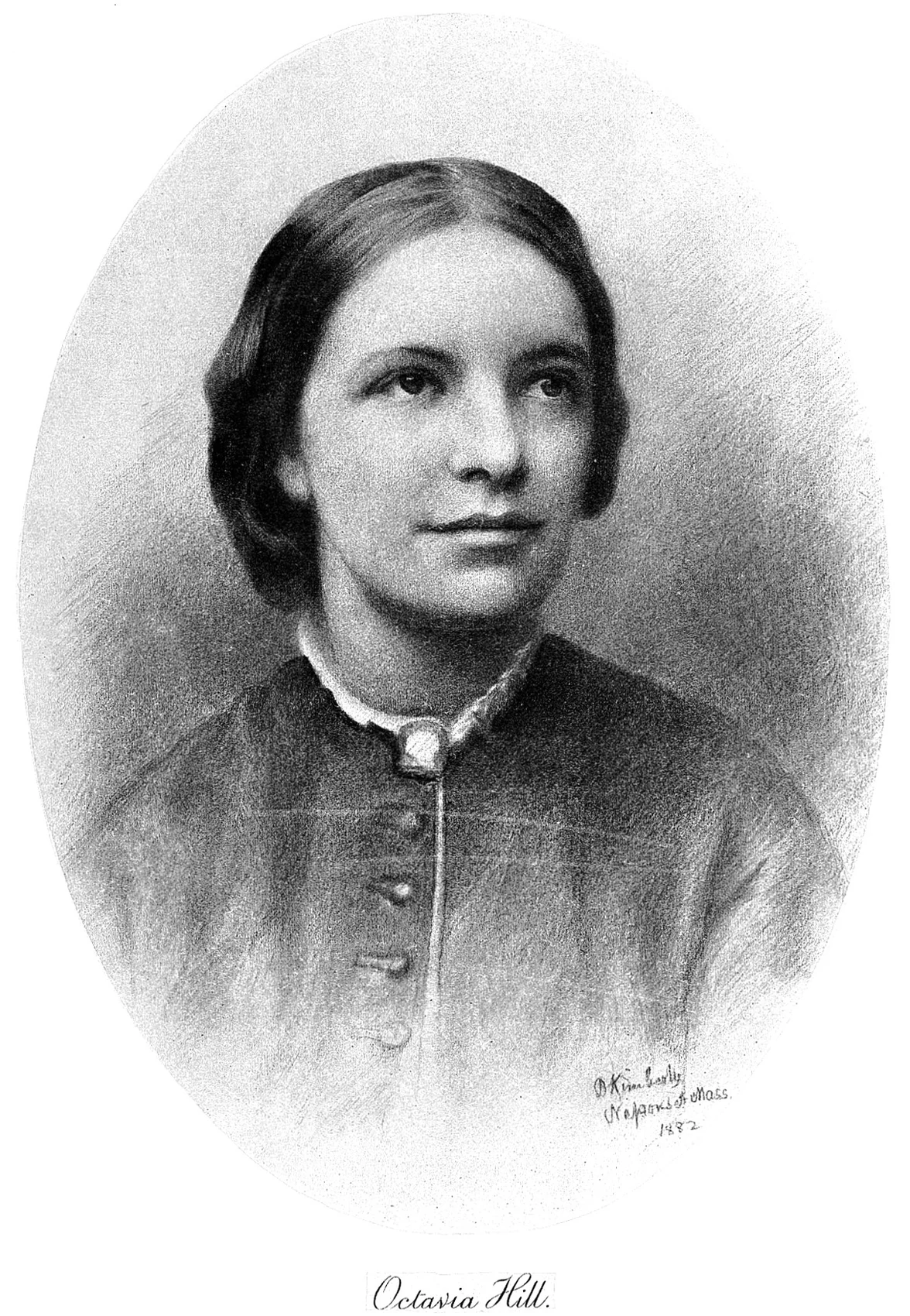
1838–1912
Octavia Hill
Housing reformer and National Trust co-founderHill linked the daily management of homes with a campaign for accessible outdoor space.Read biographyQuick answers
Common questions
- Would a larger park always answer Hill’s concern?
- Her examples distinguish purposes. Proximity and permitted activity may matter more than total area for a particular visitor.
Primary and institutional sources
How this history was checked
The records below support the chronology and the evidence comparison. The reading exercise is original. This article was reviewed on 5 November 2026.