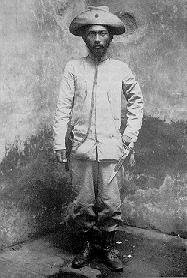

In this biography
Quick facts
- Born
- 22 March 1869
- Died
- 6 February 1964
- Birthplace
- Kawit, Cavite, Philippines
- Country
- Philippines
- Nationality
- Filipino
- Known for
- Leading the independence struggle and the First Philippine Republic
- Office
- President of the First Philippine Republic, 1899–1901
- Movement
- Katipunan and revolutionary government
- Independence declaration
- 12 June 1898
- Capital of the republic
- Malolos, Bulacan
Why this life matters
Aguinaldo stood at the centre of both the revolution against Spain and the war against American rule, making his career inseparable from the disputed birth of the Philippine state.
Timeline
Key moments
Born in Kawit
Born in Cavite on 22 March.
Led revolution in Cavite
Won a series of campaigns after joining the anti-colonial uprising.
Declared independence
Proclaimed Philippine independence in Kawit on 12 June.
First Philippine Republic
Became president after the Malolos Constitution took effect.
Captured by U.S. forces
His capture effectively ended his leadership of organised resistance.
Revolution and contested leadership
Aguinaldo entered local government in Cavite before joining the Katipunan revolt in 1896. Military victories raised his standing, but rivalry inside the revolutionary movement culminated in the execution of Andrés Bonifacio, a lasting controversy in accounts of Aguinaldo’s leadership.
After the Pact of Biak-na-Bato he went into exile in Hong Kong, returning during the Spanish-American War. On 12 June 1898 he declared independence at his home in Kawit.
Republic, war and a long afterlife
The Malolos Congress established a constitutional republic and Aguinaldo became its president in 1899. The transfer of the Philippines from Spain to the United States without Filipino consent led to war with the new colonial power.
U.S. forces captured Aguinaldo in 1901. He later participated intermittently in public life and lived long enough to see independence recognised in 1946. His legacy combines state founding, military leadership and unresolved questions about revolutionary unity.
Quick answers
Frequently asked questions about Emilio Aguinaldo
- Who was Emilio Aguinaldo?
- Emilio Aguinaldo was a revolutionary leader and first president of the Philippines. Aguinaldo stood at the centre of both the revolution against Spain and the war against American rule, making his career inseparable from the disputed birth of the Philippine state.
- What is Emilio Aguinaldo best known for?
- Emilio Aguinaldo is best known for leading the independence struggle and the First Philippine Republic.
- When and where was Emilio Aguinaldo born?
- Emilio Aguinaldo was born on 22 March 1869 in Kawit, Cavite, Philippines.
- When did Emilio Aguinaldo die?
- Emilio Aguinaldo died on 6 February 1964.
Sources and further reading
How this biography was checked
Core dates and offices are checked against the sources below. This profile was last reviewed on 8 September 2026.