Historical collection · Philippines

Republic · War · Guerrilla resistance · Memory

Philippine–American War Figures

Eight lives show how a dispute over sovereignty moved from constitutional government and conventional battle into regional guerrilla resistance—and why the official 1902 ending remains incomplete.

Eight biographies across an uneven national war

This collection connects the First Philippine Republic’s political leadership to commanders in Luzon and Panay, then follows resistance beyond Aguinaldo’s capture and the United States declaration that the conflict had ended. It includes conflict within the Filipino command and Artemio Ricarte’s later, controversial association with Japanese occupation rather than treating every life as an uncomplicated heroic arc.

  1. 01

    The republic made a competing sovereignty claim

    Emilio Aguinaldo and Apolinario Mabini connect the Malolos government, diplomacy and constitutional state-building to the cause of war.

  2. 02

    Command was divided as well as courageous

    Antonio Luna and Gregorio del Pilar show professionalisation, personal loyalty, internal conflict and sacrifice during the conventional campaign.

  3. 03

    Regional leadership changed the geography

    Miguel Malvar’s Batangas campaign and Teresa Magbanua’s command in Panay prevent a Manila-centred account from standing in for the archipelago.

  4. 04

    Refusal took different forms

    Artemio Ricarte chose exile rather than an oath of U.S. allegiance, while Macario Sakay rebuilt armed resistance after the official end date.

  5. 05

    Colonial law shaped historical labels

    The Brigandage Act made it possible to prosecute continuing resistance as banditry, influencing how Sakay and other fighters were remembered.

  6. 06

    Later choices complicate public memory

    Ricarte’s support for Japan during the Second World War shows why anti-colonial biography must examine consequences as well as declared motives.

Eight biographies · 1864–1964

Meet the figures behind republic, war and continuing resistance

Apolinario Mabini seated in a wicker chairPhilippines · Politics

1864—1903

Apolinario Mabini

Political thinker and first prime minister of the PhilippinesThe lawyer and political thinker who became Emilio Aguinaldo’s chief adviser and the first prime minister and foreign secretary of the Philippine Republic.Read biography
Full-length photograph of General Miguel Malvar in uniformPhilippines · Politics

1865—1911

Miguel Malvar

Revolutionary general and resistance commanderA Batangueño revolutionary commander who fought Spain and the United States and carried on resistance after the First Republic lost its central leadership.Read biography
Philippines · Politics

1866—1945

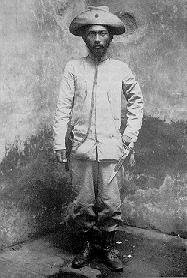
Artemio Ricarte

Revolutionary general and political exileA teacher and revolutionary general known as Vibora who fought Spain and the United States, refused American allegiance and later returned with Japanese forces during the Second World War.Read biography
Cropped group photograph of Macario Sakay seatedPhilippines · Politics

1870—1907

Macario Sakay

Katipunan organiser and president of the Republika ng KatagaluganA Katipunan veteran who organised the Republika ng Katagalugan and resisted American colonial rule until his negotiated surrender and later execution.Read biography

Quick answers

Philippine–American War figures FAQs

Who led the Philippines in the Philippine–American War?
Emilio Aguinaldo was president of the First Philippine Republic. Military leadership was distributed among commanders including Antonio Luna, Gregorio del Pilar, Miguel Malvar, Artemio Ricarte and regional leaders across the islands.
What role did Apolinario Mabini play?
Mabini was Aguinaldo’s principal political adviser and a leading architect of the revolutionary government. He argued for legitimate institutions as well as independence and later refused an oath of U.S. allegiance.
Why is Teresa Magbanua important?
She commanded fighters in Panay against Spanish and American forces. Her career places women’s military leadership and the Visayas within a war often narrated through male commanders in Luzon.
Was Miguel Malvar the last Filipino general to surrender?
The National Historical Commission identifies Malvar as the last Filipino general to surrender to American forces, on 18 April 1902. Macario Sakay and other leaders nevertheless continued organised resistance after that date.
Why did Macario Sakay fight after 1902?
Sakay continued the Katipunan’s independence project through the Republika ng Katagalugan. The colonial government classified his forces as brigands rather than belligerents and executed him in 1907.
Why is Artemio Ricarte’s legacy controversial?
His refusal to accept U.S. sovereignty made him a symbol of resistance, but he later returned with Japanese forces and supported Japan during an occupation marked by coercion and mass violence.

Primary and institutional sources

How the collection was checked

Regional comparisons are checked against official archives, legislation and institutional histories. Individual biographies contain person-level citations.

  1. U.S. Department of State, Office of the HistorianThe Philippine–American War, 1899–1902
  2. National Historical Commission of the PhilippinesPhilippine Republic, 1898–1901 historical marker
  3. The LawPhil ProjectAct No. 518 — Brigandage Act of 1902
  4. National Historical Commission of the PhilippinesMiguel Malvar historical landmark
  5. National Historical Commission of the PhilippinesThe Magbanua family historical marker
  6. Philippine Political Science JournalExile as Protest: Artemio Ricarte