
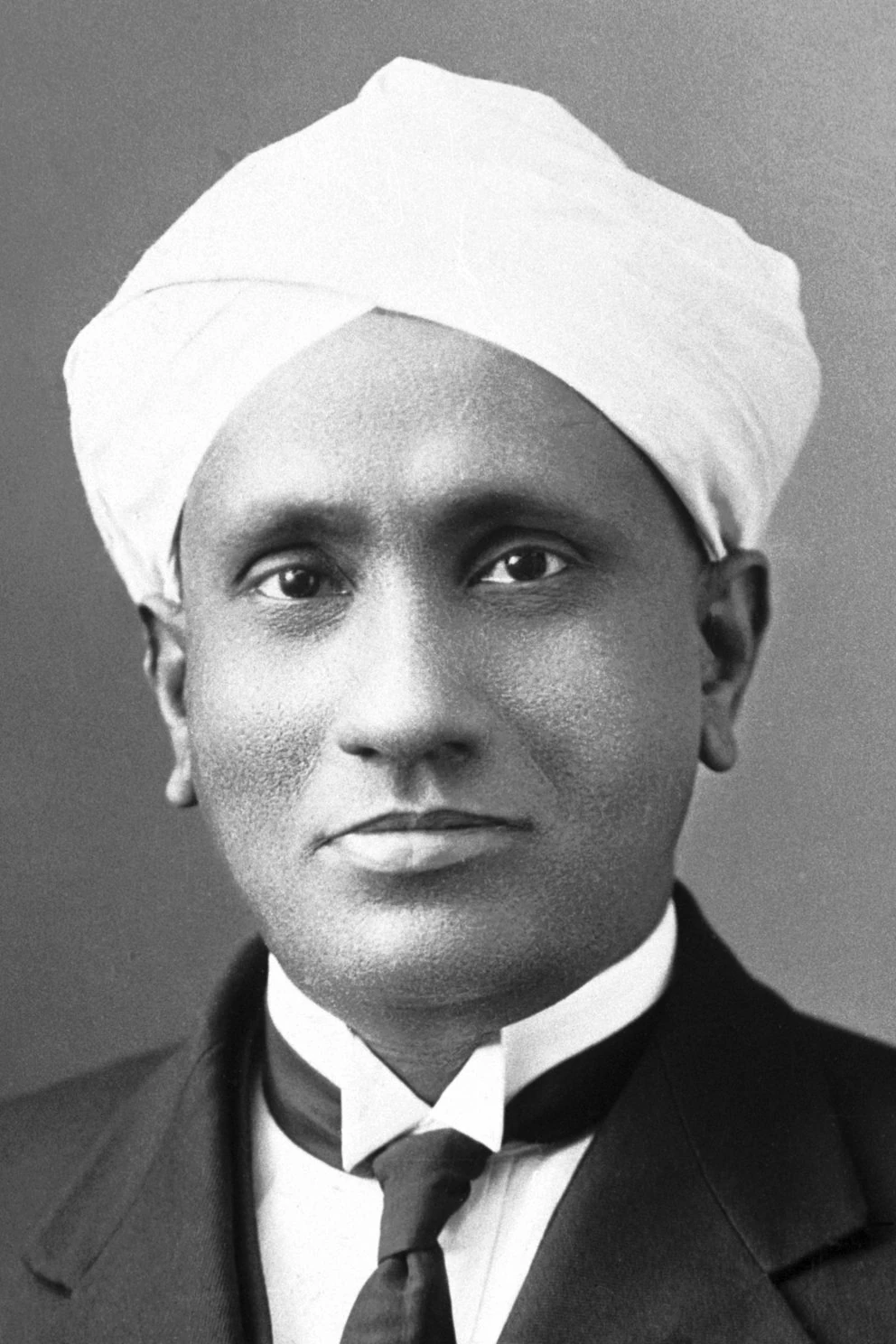
In this biography
Quick facts
- Born
- 7 November 1888
- Died
- 21 November 1970
- Birthplace
- Tiruchirappalli, present-day Tamil Nadu, India
- Country
- India
- Nationality
- Indian
- Known for
- Research on light scattering, the Raman effect and the 1930 Nobel Prize in Physics
- Full name
- Chandrasekhara Venkata Raman
- Research fields
- Optics, light scattering and acoustics
- Nobel Prize
- Physics, 1930
- Collaborative publication
- With K. S. Krishnan, Nature, 1928
- Institution founded
- Raman Research Institute, 1948
Why this life matters
His importance lies in both experimental physics and research organization: interpreting scattered light, training researchers and sustaining institutions for basic science.
Timeline
Key moments
Born in southern India
Born in Tiruchirappalli on 7 November.
Government service and research
Enters the Finance Department while continuing experimental work.
Moves into university physics
Leaves government employment for a professorship at Calcutta University.
Reports modified scattered light
Raman and Krishnan publish their jointly authored Nature report.
Nobel recognition
Receives the Nobel Prize in Physics for his light-scattering work.
Research in Bangalore
Works at IISc; its Physics Department dates its foundation to 1933.
An independent research institute
Establishes the Raman Research Institute and continues research there.
Death
Dies on 21 November; the institute continues beyond its founder.
Early life and an education in physics
Chandrasekhara Venkata Raman was born on 7 November 1888 in Tiruchirappalli, in what is now Tamil Nadu. His education and early scientific work developed in India under British colonial rule. The Royal Society’s biographical catalogue records a first-class bachelor’s degree in 1904 and a master’s degree in physics in 1907. These qualifications preceded his university career: he did not begin professional life with a permanent research appointment.
His scientific interests also extended beyond the light-scattering result that later carried his name. The National Council of Science Museums’ historical account identifies work on sound, musical instruments and several branches of optics. This wider range helps explain a career concerned with how physical systems could be investigated experimentally, rather than one organized around a single prize-winning event.
A government job alongside laboratory work
In 1907 Raman entered the Indian Finance Department. The Nobel biographical account describes how he continued experiments at the Indian Association for the Cultivation of Science in Calcutta alongside his official duties. He later became the association’s honorary secretary. Government employment and access to a research laboratory were distinct parts of this period, not evidence that his official post itself was a physics appointment.
In 1917 he left government service for a physics professorship at Calcutta University. The transition gave research a different place in his working life. It also makes the association’s facilities important to the story: scientific work had already been taking place before the change of employer. The public-service-to-professorship sequence is more informative than presenting his discovery as an isolated flash of inspiration.
The Raman effect and K. S. Krishnan’s contribution
Raman and K. S. Krishnan’s 1928 Nature letter reported light scattered at a frequency different from that of the incoming beam. Its joint authorship is a clear reason to discuss the collaboration when explaining the discovery. The familiar name “Raman effect” should not erase the second author or be mistaken for a complete laboratory staff list.
The American Chemical Society’s historical account describes a progression from observing colors through filters to recording spectra. That movement from an observation toward a measurable pattern is central to understanding the achievement. The Nobel organization awarded Raman the 1930 Physics Prize; its affiliation record places him at Calcutta University. An award identifies its recipient, while a paper identifies its authors: the two records answer different questions.
IISc and a continuing research career
Raman moved to the Indian Institute of Science in Bangalore in 1933. The Physics Department dates its foundation to that year, and the Nobel biographical account places his IISc professorship across 1933–1948. His administrative leadership and his longer period of scientific work there should not be compressed into a single job title or treated as having identical end dates.
Departmental history matters because a laboratory result does not explain how a research organization develops. In this phase Raman’s career involved building a setting for physics as well as pursuing his own investigations. The department’s account is evidence of the institution’s stated origins; it does not, on its own, allocate every later researcher’s contribution to Raman.
Founding the Raman Research Institute
In 1948 he founded the Raman Research Institute after retiring from IISc. Its own history records personal funding and private donations during the founder’s lifetime. It also traces the institute’s land to a gift from the Government of Mysore in 1934. Land acquisition, the start of the institute and its later organizational changes were separate stages.
Raman directed the institute until his death on 21 November 1970. Its subsequent history included a charitable trust and a 1972 restructuring as an aided autonomous institution. The distinction matters to his legacy: founding and supporting a research institute was his work, but the institution’s later governance and research programmes belong to a continuing history beyond him.
Recognition and a legacy beyond the award
Raman received the Bharat Ratna in 1954. India’s National Science Day, observed on 28 February, commemorates the light-scattering discovery. These forms of recognition explain his public visibility, but they are best read alongside his research and institutional career. Neither a national commemoration nor a prize citation replaces the evidence in a scientific publication.
His biography connects several kinds of achievement: experimental observations, collaborative reporting, university research and the creation of a sustained research setting. Keeping those contributions distinct makes his career useful to readers interested in how science is practiced, supported and remembered.
Quick answers
Frequently asked questions about C. V. Raman
- What is C. V. Raman known for?
- He is known for research on light scattering, the effect named after him and the 1930 Nobel Prize in Physics. His career also included acoustics and building research institutions.
- Who worked with Raman on the 1928 discovery?
- K. S. Krishnan coauthored the Nature report. Naming the effect after Raman does not make that publication a single-author work.
- Did Raman found the Indian Institute of Science?
- No. He joined the already existing institute in 1933. Its Physics Department dates its foundation to that year; Raman later founded the Raman Research Institute in 1948.
- When did C. V. Raman live?
- He was born on 7 November 1888 and died on 21 November 1970.
Keep exploring
Lives connected to this story
- Jamsetji Tata
Read about the earlier institution-building effort behind IISc, distinguishing a founder’s initiative from Raman’s later research career.
- Rabindranath Tagore
Explore a different Indian Nobel laureate’s career in literature and education, alongside Raman’s scientific and institutional work.
- K. S. Krishnan
Follow the collaborator’s later career in crystal magnetism and national laboratory leadership.
- Srinivasa Ramanujan
Compare a different Indian research path through independent mathematics, correspondence and institutional support.
- Meghnad Saha
Compare spectroscopy and atomic theory in another scientific career and institutional setting.
- Asima Chatterjee
Compare another Indian experimental scientist’s research school and institutional work.
- G. N. Ramachandran
Follow his student’s transition from optics and crystallography to protein geometry.
- Homi J. Bhabha
Follow the later institution-building career associated with Raman’s Bangalore research setting.
- Vikram Sarabhai
Read about Sarabhai’s cosmic-ray research and subsequent scientific institutions.
Sources and further reading
Explore the evidence
These references support the biography and offer further reading. Official records, first-person accounts and independent reporting provide different perspectives; image records document attribution and licensing.
- 1. National Council of Science MuseumsIndia’s Science and Technology Heritage: Raman entry
- 2. Royal SocietyRaman: biographical catalogue, qualifications and appointments
Indexed catalogue text supports the listed qualifications. No underlying degree certificate or complete biographical memoir was inspected.
- 3. Nobel PrizeC. V. Raman: biographical account
The Nobel biography was available through indexed text; the direct page was unavailable during review. Its retrospective wording is not treated as a current institutional directory.
- 4. Press Information Bureau / New India SamacharC. V. Raman: life dates and career summary
- 5. C. V. Raman and K. S. Krishnan / NatureA New Type of Secondary Radiation (1928)
Reviewed the indexed report text and publisher metadata. No laboratory notebook or complete scanned issue was inspected.
- 6. American Chemical SocietyC. V. Raman and the Raman Effect: historical landmark account
- 7. Nobel PrizePhysics 1930: recipient and research affiliation
- 8. Indian Institute of Science / Physics DepartmentAbout the department: foundation and research history
The indexed departmental history supports the 1933 foundation. A separate general IISc page inconsistently describes the appointment year; no 1934 appointment claim is adopted.
- 9. Raman Research InstituteOverview and institutional history
- 10. Nobel Foundation attribution / Wikimedia CommonsSir CV Raman: source, file history and public-domain notices
The file description records a 1930 portrait and public-domain grounds in Sweden, India and the US. Adopted the supplied photographic file, not a newly generated or enlarged likeness; no worldwide rights guarantee is implied.
