In this biography
Quick facts
- Born
- 22 December 1887
- Died
- 26 April 1920
- Birthplace
- Erode, present-day Tamil Nadu, India
- Country
- India
- Nationality
- Indian
- Known for
- Number theory, partitions, infinite series and work with G. H. Hardy
- Research fields
- Number theory, analysis, series and continued fractions
- Cambridge collaborator
- G. H. Hardy
- Royal Society election
- 2 May 1918
- Trinity fellowship
- 1918
- Posthumous publication
- Collected Papers, 1927
Why this life matters
His results and conjectures continue to generate mathematical work; his collaboration with Hardy also shows how numerical discovery, formal proof and institutional support can interact.
Timeline
Key moments
Born in Erode
Born on 22 December.
Publication before Cambridge
Some Properties of Bernoulli’s Numbers appears in the Journal of the Indian Mathematical Society.
Support for research
Correspondence with Hardy and support from Madras University open a new research path.
Travels to England
Begins the Cambridge phase of his career.
Joint work and fellowships
The partition paper is published; he becomes a Royal Society and Trinity Fellow.
Returns to India
Continues mathematical work despite illness and dies on 26 April 1920.
Collected Papers
Hardy, P. V. Seshu Aiyar and B. M. Wilson edit a posthumous collection.
An unconventional route into mathematical research
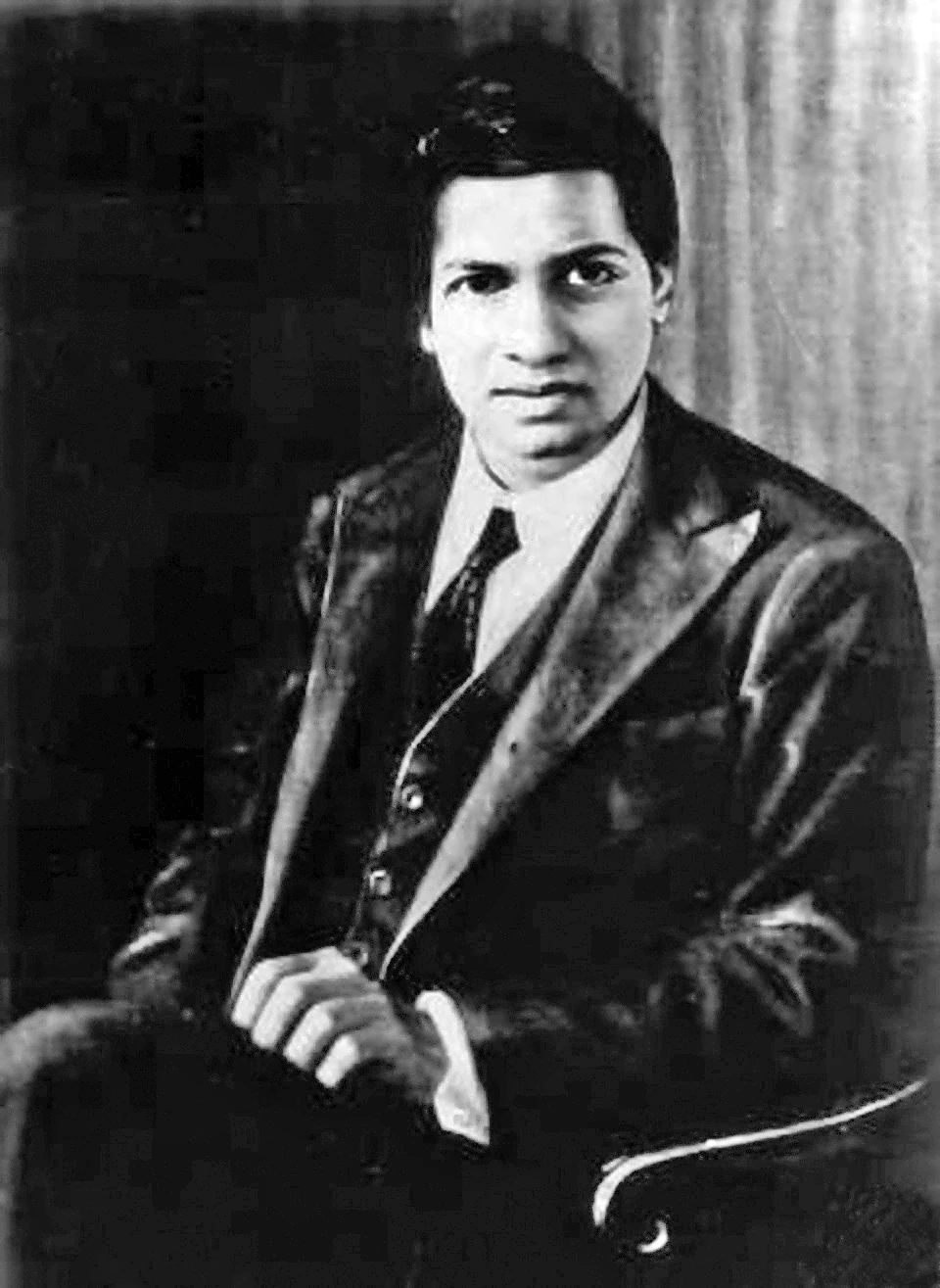
Srinivasa Ramanujan was born in Erode on 22 December 1887. His mathematical interests developed through independent study, but his education did not follow an uninterrupted path through university examinations. Trinity’s account describes the loss of a college scholarship after difficulties with non-mathematical coursework. Strong mathematical ability and success within a broad examination system were different matters in his early life.
He continued to record results and sought people who could recognize their importance. His work circulated through Indian mathematical contacts before he became famous in Cambridge. The Royal Society’s library holds his 1911 paper on Bernoulli numbers, a useful reminder that his published mathematical career had already begun in India.
Correspondence, employment and support for research
Ramanujan supported himself through clerical work while pursuing mathematics. The notebooks and examples he showed to potential supporters helped establish a network around him. K. Srinivasa Rao’s account identifies people including Ramachandra Rao, V. Ramaswamy Iyer and R. Narayana Iyer, as well as the role of Madras University in funding research and later travel.
G. H. Hardy’s response to Ramanujan’s correspondence became decisive, but it was part of that wider network. Ramanujan travelled to England in 1914 with financial support from Madras University. The move made sustained work with other mathematicians possible without making Cambridge the origin of his mathematical interests or his earlier results.
Collaboration with Hardy and the partition problem
At Cambridge, Ramanujan worked with Hardy on problems in analysis and number theory. Their jointly authored paper Asymptotic Formulae in Combinatory Analysis, published in 1918, investigated the growth of the partition function p(n). A partition expresses an integer as a sum of positive integers without treating different orders as different answers. Counting such expressions becomes difficult remarkably quickly.
The paper connects a counting problem to analytic methods and increasingly precise estimates. It is one example of a collaboration in which a compact numerical question leads to substantial mathematical machinery. The linked partitions guide supplies small exact examples and independently checked numerical comparisons; those illustrations are not a replacement for the paper’s proof.
Sources for this section: [5]
Fellowships, illness and a final period of work
The Royal Society dates Ramanujan’s election to 2 May 1918. He also became a Fellow of Trinity that year. These honors recognized an existing body of research rather than converting every statement in his notebooks into a proved theorem. His work included completed publications alongside results that would require later explanation or correction.
Ill health interrupted his Cambridge years. He returned to India in 1919 and died on 26 April 1920, aged thirty-two. He nevertheless continued working: the final period included ideas about mock theta functions sent to Hardy. This biography does not choose a retrospective medical diagnosis from the differing accounts of his illness.
Notebooks and the work of later mathematicians
The 1927 Collected Papers was edited by Hardy, P. V. Seshu Aiyar and B. M. Wilson. It brought published work together after Ramanujan’s death. Trinity’s library separately holds correspondence and manuscript material, including Hardy’s account of their work. A collected edition and a notebook have different purposes: the former organizes publications, while the latter can preserve intermediate or unexplained results.
His legacy therefore includes work done by later mathematicians to interpret, prove and extend what he left. That continuing activity is more informative than a single total of “theorems discovered.” His surviving papers offer both accessible entry points, such as partitions, and difficult research problems whose significance developed long after his lifetime.
Quick answers
Frequently asked questions about Srinivasa Ramanujan
- Was Ramanujan entirely uneducated?
- No. He attended school and college, although his formal studies were disrupted. Much of his advanced mathematical development was independent.
- What did Ramanujan work on with Hardy?
- Their collaborations included number theory and analysis. The 1918 partition paper studied how the number of unordered sums representing an integer grows.
- When did Ramanujan become a Royal Society Fellow?
- The Royal Society’s account gives 2 May 1918. His Trinity fellowship also dates to 1918.
- Were all his notebook results already proved?
- No. The notebooks included statements requiring later work, and some claims were incorrect or already known. Published papers, conjectures and later proofs should be distinguished.
Keep exploring
Lives connected to this story
- C. V. Raman
Compare another Indian research career, including a different educational route and the institutions that supported experimental physics.
- K. S. Krishnan
Continue with an experimental scientist whose career also connected individual research, collaboration and institution building.
- Satyendra Nath Bose
Compare another mathematical scientist’s international correspondence and distinct contribution to physics.
Sources and further reading
Explore the evidence
These references support the biography and offer further reading. Official records, first-person accounts and independent reporting provide different perspectives; image records document attribution and licensing.
- 1. K. Srinivasa Rao / Institute of Mathematical SciencesSrinivasa Ramanujan: life, research support and manuscripts
A named mathematician’s historical account hosted by IMSc. Its February 1918 election wording is not followed; the Royal Society’s own account gives 2 May. No speculative numerical ranking of mathematical talent is repeated.
- 2. Trinity College CambridgeSrinivasa Ramanujan, FRS: memorial biography
- 3. Ellen Embleton / Royal SocietyRevisiting Ramanujan: publications, fellowship and collections
- 4. Trinity College LibraryThe Man Who Knew Infinity: manuscript collections and Hardy’s account
- 5. G. H. Hardy and S. Ramanujan / Proceedings of the London Mathematical SocietyAsymptotic Formulae in Combinatory Analysis (1918): scan hosted by IMSc
Inspected the opening scanned pages, including the leading asymptotic expression on printed page 79. The guide’s exact counts and numerical comparisons were calculated separately, not copied from a modern summary.
- 6. Oberwolfach Photo Collection / Wikimedia CommonsSrinivasa Ramanujan: historical portrait and permission record
The source identifies the subject and an Oberwolfach provenance; its public permission record cites VRT ticket 2008042410024381 and public-domain notices. Adopted the supplied historical scan, not the later cleanup or a generated portrait.