In this biography
Quick facts
- Born
- 3 March 1839
- Died
- 19 May 1904
- Birthplace
- Navsari, present-day Gujarat, India
- Country
- India
- Nationality
- Indian
- Known for
- Textile enterprises, the Taj Mahal Hotel and plans that led to Tata Steel, hydroelectric power and the Indian Institute of Science
- Birth name
- Jamsetji Nusserwanji Tata
- Textile milestone
- Empress Mills opened in Nagpur on 1 January 1877
- Hotel
- Taj Mahal Hotel, Bombay, opened in 1903
- Chronology distinction
- Died in 1904; Tata Iron and Steel Company registered in 1907 and made its first steel in 1912
Why this life matters
His career connects Indian enterprise with colonial trade, industrial technology and institution building. It also shows why a founder’s ambitions, the companies later bearing his name and workers’ experiences require separate historical attention.
Timeline
Key moments
Navsari and education
Born on 3 March in Navsari; studies at Elphinstone in Bombay before joining the family business.
Trade and manufacturing
Works in overseas trade, establishes his own trading venture in 1868 and converts a Bombay oil mill to cotton production.
The Nagpur undertaking
Organizes the Central India Spinning, Weaving and Manufacturing Company; Empress Mills opens in 1877.
Education and research
Creates the JN Tata Endowment and develops a proposed research institution with Burjorji Padshah and others.
Hotel and death
The Taj Mahal Hotel opens in Bombay in 1903. Tata dies at Nauheim, Germany, on 19 May 1904.
Successors realize major plans
Steel-company registration in 1907, IISc’s establishment in 1909 and first steel in 1912 all follow his death.
A Parsi family in a changing colonial economy
Jamsetji Nusserwanji Tata was born in Navsari on 3 March 1839. His family belonged to the Parsi community, with generations associated with the priesthood. His father Nusserwanji moved into commerce in Bombay, now Mumbai. Jamsetji studied at Elphinstone and entered that business after completing his education in 1858. The family’s opportunities developed within a port city shaped by British imperial power, shipping and expanding international markets.
His early work took him to China and Britain. The family’s trading background included the opium economy as well as cotton; a later Yale history describes his advocacy of a shift towards cotton. The American Civil War then disrupted cotton supplies from the southern United States, boosting demand for Indian exports. His commercial education therefore involved both technological observation and the opportunities and instability of imperial trade.
Textiles turned trading experience into factories
In 1868 Tata established a trading concern of his own. The following year he acquired an unsuccessful oil mill in Bombay, converted it into the Alexandra cotton mill and subsequently sold it. Visits to Lancashire helped him study machinery and manufacturing. His achievement lay in adapting and organizing production in India, with Indian and overseas expertise, rather than inventing textile machinery from nothing.
The Central India Spinning, Weaving and Manufacturing Company followed in 1874. Its Empress Mills opened at Nagpur on 1 January 1877. Cotton supplies, fuel, water and railway access made an inland location commercially attractive. Later textile interests included Swadeshi Mills. Such ventures required decisions about raw materials, freight and skills alongside capital; a mill’s name alone does not explain how it produced and sold cloth.
Worker welfare belongs within a wider labour history
Tata Trusts records medical assistance, crèches, education and provident or pension arrangements among initiatives associated with his mills. These are specific institutional claims, not proof that every worker enjoyed security or equal bargaining power. The contemporary biographical record also links improvements in workers’ conditions to efforts to improve production and develop skilled labour. Commercial and social purposes could operate together.
His plans for a steel township included open space and provision for different religious communities. Yet the later steel town was also a place where the company controlled employment, housing and services. Historical research finds unequal authority between management and migrant workers. Those later conditions cannot be assigned to decisions Tata personally made after 1904, but they qualify any claim that his ideals automatically determined every successor’s practice.
A hotel opened while larger industrial plans remained unfinished
The Taj Mahal Hotel opened on Bombay’s waterfront in 1903, during his lifetime. Its ambitious accommodation and modern facilities made it a conspicuous commercial project. Stories that reduce its origin to a single incident of racial exclusion are presented as legend even in Tata’s heritage account; the opening itself is better established than that familiar explanation of his motive.
Steelmaking and hydroelectric generation were longer projects. Tata investigated mineral resources and sought expert advice for a major steel works. He also envisaged using rainfall in the Western Ghats to supply industrial power to Bombay. Both plans demanded engineering, finance and negotiations that remained incomplete when he died. They are part of his biography as initiatives, not factories he personally operated in their later form.
Scientific education required partners and a durable endowment
The JN Tata Endowment, created in 1892, supported higher study overseas. Tata’s larger proposal for scientific research involved an endowment of property and the organizational work of Burjorji Padshah. A provisional committee developed the scheme in 1898. The project evolved through consultation rather than emerging as a completed institution from a single donation.
The Indian Institute of Science’s history credits Mysore’s rulers and the colonial government alongside Tata. It came into existence through a vesting order on 27 May 1909, five years after his death, and admitted its first students in 1911. This distinction gives his contribution its proper scale: he helped create the resources and purpose for an institution whose establishment required others to carry the scheme forward.
Death, successors and the meaning of founder
Tata died at Nauheim in Germany on 19 May 1904 and was buried at Brookwood in England. His sons Dorabji and Ratan and associates continued the enterprises. Tata Iron and Steel Company was registered on 26 August 1907; its first steel followed in February 1912. Naming him its originating visionary is compatible with recognizing that successors, engineers and workers built and operated the company.
He should not be confused with Dorabji, with the later chairman JRD Tata, or with the much later Ratan Tata. The group’s subsequent expansion was not one person’s uninterrupted career. Jamsetji’s lasting significance lies in the connection he sought between Indian industrial capacity, trained people and institutions, while the results remain open to assessment through their economic and social history.
Quick answers
Frequently asked questions about Jamsetji Tata
- Did Jamsetji Tata live to see Tata Steel begin production?
- No. He died in May 1904. Tata Iron and Steel Company was registered in August 1907, and the first steel was made in February 1912.
- Was Jamsetji Tata the same person as Ratan Tata?
- No. Jamsetji lived from 1839 to 1904. His son Ratan and the much later group chairman Ratan Tata were different people.
- Did he establish IISc alone?
- He proposed and endowed a research institution, but its establishment in 1909 also depended on Mysore’s rulers, the colonial government, Padshah and other participants.
- Why was Empress Mills built in Nagpur?
- The location offered access to cotton, fuel, water and rail transport. The mill opened in 1877, after the company had been organized in 1874.
Keep exploring
Lives connected to this story
- N. R. Narayana Murthy
Compare a later Indian software-services enterprise with Tata’s trading and manufacturing setting; the two founders were not collaborators.
- James Dyson
Consider another business history in which engineering expertise and commercialization required teams and institutions.
- C. V. Raman
Follow a later IISc physicist’s research career and the separate founding of the Raman Research Institute.
Sources and further reading
Explore the evidence
These references support the biography and offer further reading. Official records, first-person accounts and independent reporting provide different perspectives; image records document attribution and licensing.
- 1. TataJamsetji Tata: corporate heritage biography
Interested corporate account used for the sequence of ventures, not its claims of unique virtue or industrial priority. Its hotel-origin story is explicitly labelled legend; sweeping electricity and welfare “firsts” are not repeated.
- 2. Tata TrustsOur history, 1839–1905: textiles, welfare and endowment
- 3. Yale University Press / Peter Heather and John RapleyThe Story of the Tata Family: published historical excerpt, 2024
Read the published excerpt on the family’s colonial trade, cotton and manufacturing. It provides context for the opium connection without assigning an unsupported personal fortune total or moral verdict.
- 4. Dictionary of National Biography / WikisourceJamsetji Nasarwanji Tata, 1912 supplement: historical biography
Read the 1912 biography, including death and succession. Its dated predictions, honorific language and present-tense production estimates are not treated as current evidence.
- 5. Indian Institute of ScienceHistory: endowment, Mysore support and the 1909 vesting order
- 6. Indian Institute of ScienceOrigin: Padshah, the provisional committee and the 1898 scheme
- 7. Tata SteelA hundred years and still counting, 2007: registration and production
- 8. Business StandardTata Steel’s formative years, 27 August 2007
- 9. Business History / Alan McKinlay, Swapnesh Masrani and Eric PezetFoucault, governing and knowledge: Everyday diplomacy in Tata Steel, 1907–1925
Read the abstract and selected passages on American technical authority, Padshah and migrant labour, particularly PDF pages 10–11. The study concerns 1907–1925, after Jamsetji’s death; later actions are not attributed to him.
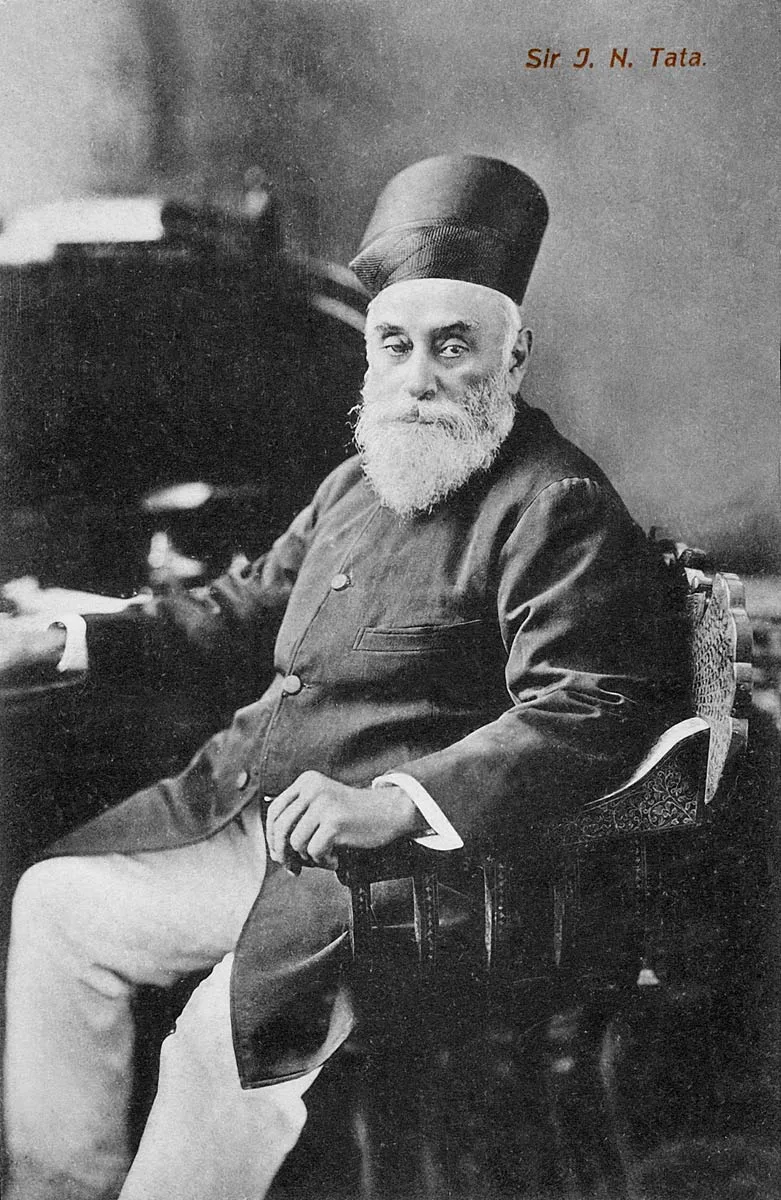
- 10. Paper Jewels / Wikimedia CommonsSir J. N. Tata: complete 1910 postcard and file history
- 11. Paper JewelsSir J. N. Tata: source postcard record
- 12. Paper JewelsImage rights: express permission for commercial reuse with credit
Read upstream express commercial-use permission; the Commons file also specifies CC BY 4.0. Original photographer/publisher remains unknown. The entire postcard is retained, including its unverified “Sir” caption.
- 13. Creative CommonsAttribution 4.0 International licence