In this biography
Quick facts
- Born
- 7 May 1861
- Died
- 7 August 1941
- Birthplace
- Jorasanko, Calcutta, Bengal Presidency, British India (now Kolkata, India)
- Country
- India
- Nationality
- Indian
- Known for
- Gitanjali, Rabindra Sangeet, fiction, Visva-Bharati and the songs adopted as India’s and Bangladesh’s national anthems
- Literary language
- Primarily Bengali; also wrote and translated into English
- English Gitanjali
- 103 prose poems, first published in 1912
- Nobel recognition
- Nobel Prize in Literature, 1913
- Educational institutions
- Santiniketan school, 1901; Visva-Bharati, 1921
Why this life matters
His 1913 Nobel recognition brought international attention to one part of a much wider Bengali career in poetry, songs, fiction, education and visual art.
Timeline
Key moments
Born at Jorasanko
Born on 7 May into the Tagore family in colonial Calcutta, now Kolkata.
Study in Britain
Travelled to Britain for education and returned without completing a formal course.
School at Santiniketan
Established an experimental school that connected learning with nature and cultural inquiry.
Two Gitanjalis
The Bengali collection appeared in 1910; the differently selected English Song Offerings followed in 1912.
Nobel Prize in Literature
The Swedish Academy recognised his poetry, particularly its expression in his own English words.
Knighthood and public renunciation
Accepted a British knighthood in 1915 and publicly renounced it in 1919 following violence in Punjab.
Visva-Bharati and Sriniketan
Visva-Bharati was inaugurated in 1921; rural reconstruction at Sriniketan followed in 1922.
Painting and final years
His paintings reached international exhibitions. He died in Calcutta on 7 August 1941.
A Bengali childhood in colonial Calcutta
Rabindranath Tagore was born on 7 May 1861 at Jorasanko in Calcutta, now Kolkata. His parents were Debendranath Tagore and Sarada Devi. The family participated in Bengal’s literary, artistic and religious debates; Debendranath was a leading figure in the Brahmo Samaj. Tagore’s Bengali identity is essential to understanding his writing. India is this archive’s modern country association, while his birthplace belonged to British India.
His education combined schooling with learning at home. He began publishing while young and travelled to Britain in 1878, returning in 1880 without completing a formal course. Music, theatre and literary discussion formed part of the family environment. He married Mrinalini Devi in 1883. These beginnings place him within a particular Bengali household and colonial society rather than an abstract image of an isolated spiritual sage.
Poetry, songs and the lives inside fiction
Tagore wrote across forms: lyric poetry, drama, novels, short stories, essays, letters and travel accounts. Collections including Manasi, Sonar Tari and the Bengali Gitanjali belong to a long poetic career. His songs, collectively associated with Rabindra Sangeet, combine words and melody; reducing them to printed poems misses an important part of their continuing life in Bengali culture.
Fiction offered other ways to examine relationships and society. Gora addresses religious belonging and nationalism; The Home and the World places political excitement inside a troubled domestic setting. His short stories also made ordinary encounters and unequal social positions central subjects. Songs he composed were later adopted as the national anthems of India and Bangladesh. These later uses should not erase the distinct historical circumstances in which the songs were written.
An educator who built institutions
Managing family estates in Bengal brought Tagore into contact with rural life, alongside the privileges of landownership. His educational work took institutional form at Santiniketan, where he established a school in 1901. It sought a relationship between learning, the natural environment and creative activity. The project was an experiment with practical demands, not only a philosophy expressed in poems.
Visva-Bharati, inaugurated in 1921, developed an international setting for scholarship and the arts. Sriniketan followed in 1922 as a centre for rural reconstruction. Travel, lectures, friendships and fundraising supported these ambitions. The university describes cultural exchange and self-reliance as connected aims. Its present status as a central university dates from 1951, after Tagore’s death, and should not be projected backwards onto the institution he originally created.
Gitanjali and the opportunities of translation
The Bengali Gitanjali appeared in 1910. The English Gitanjali: Song Offerings, published by London’s India Society in 1912, was a different selection of 103 prose poems drawn from several Bengali collections. Tagore made the English versions himself. William Rothenstein helped introduce them to literary readers, and W. B. Yeats supplied an introduction. A Macmillan edition followed in 1913.
The Nobel Prize in Literature that year recognised Tagore’s verse and its expression in his own English words. It was an award to a writer, not an international ranking of nations or a prize category restricted to one book. The English collection opened a route to new audiences while presenting only a small portion of his work. Amartya Sen later criticised the narrow Western picture of Tagore as an exclusively mystical poet.
Nationalism, freedom and an imperial honour
Tagore opposed colonial domination while questioning forms of patriotism that made obedience or hostility to outsiders a virtue. His friendship and disagreements with Gandhi belong within that argument about freedom. Sen interprets Tagore’s commitments through intellectual independence: the ability to learn across borders and resist both imperial power and unreasoned communal loyalties.
Knighted in 1915, Tagore publicly renounced the honour in 1919 after British violence in Punjab, including the Jallianwala Bagh massacre. His letter linked personal distinction to the humiliation suffered by fellow Indians. The administrative record adds a qualification: in July 1919 the British government told Parliament that the title had not been formally revoked. His clear public rejection and the government’s formal handling of it are related but different facts.
Late painting and a career larger than one emblem
Painting became a major activity in Tagore’s sixties. The V&A traces some early images to manuscript doodles and describes invented creatures, expressive faces, theatrical groups and landscapes. His visual work developed an individual language rather than merely illustrating his poems. Exhibitions abroad added another dimension to his international presence.
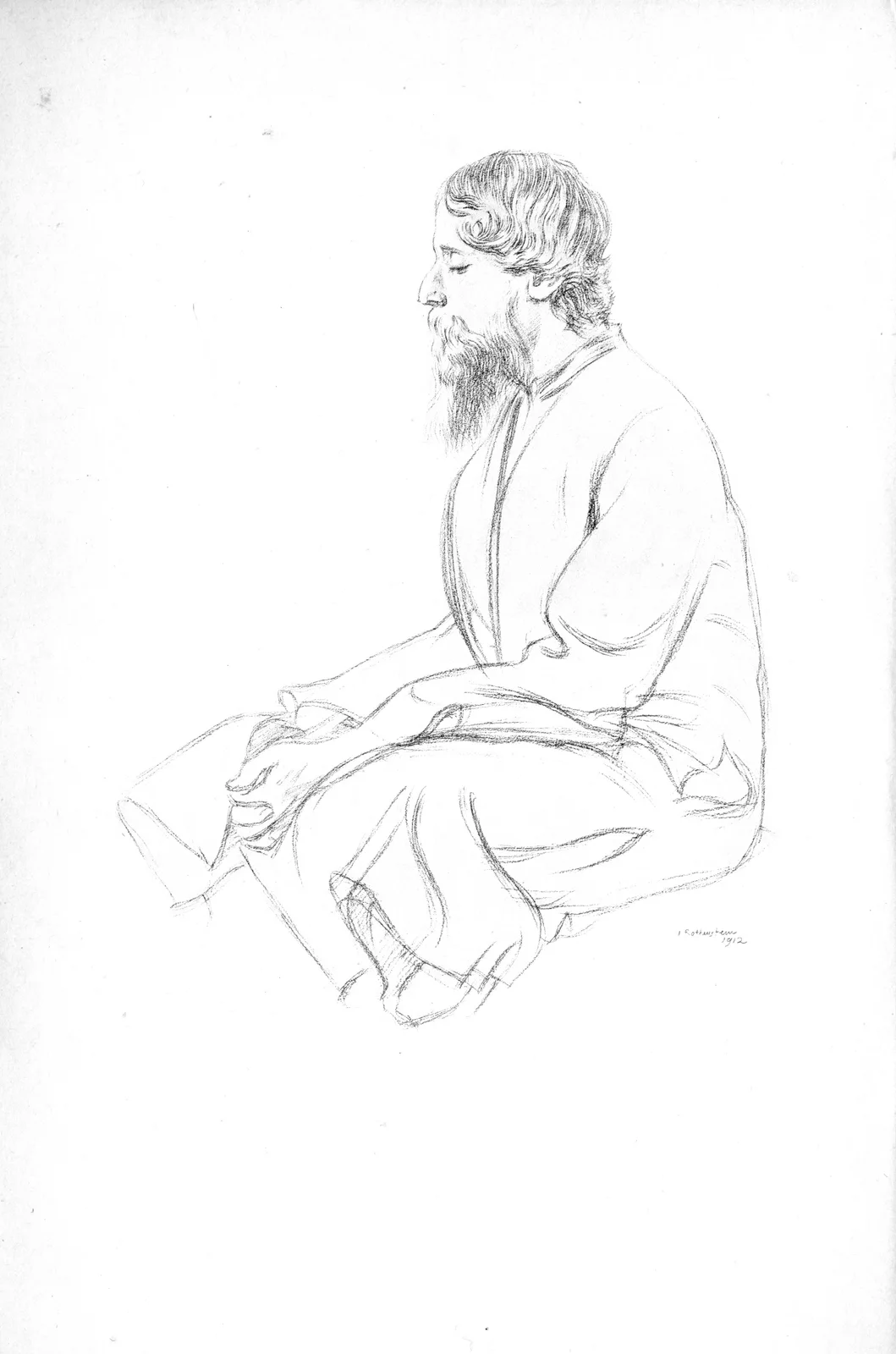
He died in Calcutta on 7 August 1941, before Indian independence and partition. His writings and songs now circulate across national boundaries that changed after his lifetime. The 1912 Rothenstein drawing reproduced here belongs to this period of cultural exchange; it does not stand for all Tagore’s changing public identities. Reading poetry beside fiction, education and painting gives a more useful account of his achievement than treating the Nobel medal as his whole biography.
Quick answers
Frequently asked questions about Rabindranath Tagore
- Are Rabindranath Tagore and Rabindranath Thakur the same person?
- Yes. Thakur is a transliteration of the Bengali family name; Tagore is its established English form.
- Did Tagore write only poetry?
- No. He also composed songs, wrote fiction, plays and essays, developed educational institutions and became a prolific painter.
- Is the English Gitanjali a complete translation of the 1910 Bengali book?
- No. The 1912 English collection contains 103 prose poems selected from several Bengali collections and translated by Tagore himself.
- Why did Tagore renounce his knighthood?
- He publicly rejected the honour in 1919 in protest against British violence in Punjab. Parliament’s contemporary record says the title had not been formally revoked by July 1919.
Keep exploring
Lives connected to this story
- Satyajit Ray
Follow the later filmmaker who studied at Santiniketan and adapted Tagore’s fiction, including Charulata and The Home and the World.
Sources and further reading
Explore the evidence
These references support the biography and offer further reading. Official records, first-person accounts and independent reporting provide different perspectives; image records document attribution and licensing.
- 1. National Gallery of Modern Art, IndiaRabindranath Tagore: chronology and virtual exhibition
- 2. Visva-BharatiGurudev Rabindranath Tagore, founder of Visva-Bharati
- 3. Nobel PrizeRabindranath Tagore: biographical (indexed official text)
Official indexed biographical text was available; direct page requests returned 403. Used only for the visible passages on family, education, estates, genres and the honour. No complete live-page inspection is claimed.
- 4. Nobel PrizeThe Nobel Prize in Literature 1913: citation (indexed official text)
Official indexed prize citation distinguishes recognition of the writer’s verse from the shorthand claim that a single book won a separate book prize. Direct Nobel requests were blocked.
- 5. Poetry FoundationRabindranath Tagore (indexed institutional essay)
Read indexed institutional essay passages on songs, fiction and range. Direct access returned 403; no complete essay or underlying Bengali corpus was inspected.
- 6. Victoria and Albert MuseumRabindranath Tagore: Poet and Painter
- 7. Amartya Sen / Nobel PrizeTagore and his India (indexed essay)
- 8. InivaTagore Archive: the letter renouncing his knighthood
- 9. UK ParliamentSir Rabindranath Tagore, 31 July 1919
Read the short 31 July 1919 exchange in full. Public renunciation is distinguished from formal revocation of the title.
- 10. Rabindranath Tagore / Project GutenbergGitanjali: author’s English versions and Yeats introduction
- 11. Pabitra Sarkar / Society for Natural Language Technology ResearchThe Two Gitanjalis (indexed introductory essay)
- 12. Morgan Library and MuseumGitanjali, London: Macmillan, 1913, PML 134671
- 13. SatyajitRay.orgAt Shantiniketan: Tagore’s death and Ray’s education
- 14. Wikimedia CommonsGitanjali Tagore by Rothenstein: image record
- 15. Wikimedia CommonsRothenstein frontispiece record, revision 774727163
Used the archived 14 December 2019 2870×4335 full-page scan, not the later 800×960 cropped replacement. Publication in 1913 establishes public-domain status in the United States because it predates 1931, without asserting original US publication. Rothenstein’s named authorship and 1945 death supply a separate creator-term basis. Entire supplied frame retained.
- 16. National Portrait GalleryRabindranath Tagore: William Rothenstein’s dates and friendship