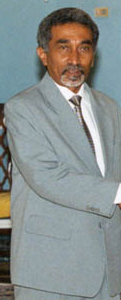
In this biography
Quick facts
- Born
- 20 June 1946
- Birthplace
- Manatuto, Portuguese Timor
- Country
- Timor-Leste
- Nationality
- Timorese
- Known for
- Leading the Timorese resistance and becoming the country’s first elected president
- Birth name
- José Alexandre Gusmão
- President
- 20 May 2002–May 2007
- Prime minister
- 2007–2015; returned on 1 July 2023
- Maritime diplomacy
- Timor-Leste’s chief negotiator in the Australia boundary conciliation
Why this life matters
Gusmão connects armed resistance, clandestine organisation, the 1999 self-determination vote and the difficult institutional politics of the post-independence state.
Timeline
Key moments
Born in Manatuto
Born on 20 June during Portuguese colonial rule.
Resistance command
Elected resistance leader and FALINTIL commander-in-chief.
Arrested in Dili
Indonesian military authorities captured him on 20 November.
Trial and commutation
Sentenced to life imprisonment on 21 May; the sentence was reduced to twenty years in August.
Released
Released on 7 September, after the 30 August self-determination ballot.
Election and inauguration
Won the 14 April presidential vote and was sworn in on 20 May.
First period as prime minister
Led governments before the February 2015 transition to Rui Maria de Araújo.
Maritime-boundary negotiations
Led Timor-Leste’s team; the treaty was signed on 6 March 2018 and entered into force on 30 August 2019.
Returned to government leadership
Sworn in on 1 July after CNRT formed a coalition with the Democratic Party.
From colonial Timor to resistance leadership
Xanana Gusmão was born in Manatuto on 20 June 1946. Before becoming a resistance commander, he worked in public administration, served in the Portuguese military and joined the newspaper A Voz de Timor. His political involvement developed as Portuguese colonial rule approached its end and rival Timorese movements competed over the territory’s future.
After Indonesia’s 1975 invasion and the resistance’s heavy losses, Gusmão helped reorganise the struggle. In 1981 he became resistance leader and commander-in-chief of FALINTIL. His strategy combined armed resistance with clandestine organisation and a broader national coalition. The government biography presents these developments as a policy of national unity, rather than an exclusively military campaign.
Sources for this section: [1]
Arrest, trial and political work from prison
Indonesian military authorities arrested Gusmão in Dili on 20 November 1992. Amnesty International’s urgent action, issued three days later, reported incommunicado detention and concerns about mistreatment. Its subsequent trial report records a life sentence on 21 May 1993 and criticises restrictions on legal assistance, the preparation of his defence and the interruption of his final statement.
The life sentence was commuted to twenty years in August 1993. Imprisonment therefore did not end his political importance: he remained a recognised resistance representative while held in Indonesia. He was released on 7 September 1999, after the UN-backed ballot on self-determination. The trial, commutation and release were separate events, not one continuous twenty-year period actually served in prison.
The 2002 presidential election and restored independence
On 14 April 2002, voters chose Gusmão over Francisco Xavier do Amaral in the territory’s first presidential election. UNTAET’s election fact sheet records 82.7 per cent of valid votes for Gusmão and 17.3 per cent for Amaral. This presidential ballot came after the 1999 consultation and the 2001 Constituent Assembly election; the three votes had different purposes.
Gusmão was sworn in on 20 May 2002 as independence was restored and UN transitional administration ended. The UN account describes both the transfer of authority and his inauguration. Calling him the first elected president of the restored independent state preserves that distinction without erasing Amaral’s presidency following the separate 1975 declaration of independence.
Negotiating a permanent maritime boundary with Australia
Gusmão later led Timor-Leste’s negotiating team in the maritime-boundary process with Australia. The proceedings began in April 2016 under the UN Convention on the Law of the Sea. A conciliation commission, supported by the Permanent Court of Arbitration, helped the two governments negotiate rather than imposing a binding arbitral boundary award.
The countries signed their treaty on 6 March 2018, and it entered into force on 30 August 2019. Alongside permanent boundaries, it established arrangements concerning the Greater Sunrise gas fields. Agreement on a boundary and a resource-sharing framework was a diplomatic achievement, but it was not proof that every commercial decision about developing the gas had already been settled or implemented.
Presidency, premiership and the 2023 coalition
His presidency ended in 2007. He then served as prime minister from 2007 to 2015 before taking other government responsibilities. The independence-era resistance council called CNRT and the electoral party established in 2007 share an acronym, but they are not the same organisation. His movement from resistance to elected office involved both institutional and party changes.
Gusmão returned as prime minister on 1 July 2023. CNRT had won 31 of Parliament’s 65 seats and formed a coalition with the Democratic Party, which held six. CNRT therefore needed its partner for a parliamentary majority. Government and Australian diplomatic records checked on 17 October 2026 continue to identify him as prime minister, a different office from the presidency held by José Ramos-Horta.
Quick answers
Frequently asked questions about Xanana Gusmão
- What is Xanana Gusmão’s real name?
- His birth name is José Alexandre Gusmão. Kay Rala Xanana Gusmão is the name used in his public and resistance career.
- When was Xanana Gusmão president?
- He won the 14 April 2002 presidential election, was sworn in on 20 May 2002 and served until May 2007.
- When did he become prime minister again?
- He returned on 1 July 2023 after CNRT formed a parliamentary coalition with the Democratic Party. His earlier period as prime minister was 2007–2015.
- What was his role in the 2018 maritime treaty?
- He led Timor-Leste’s negotiating team in the Australia boundary conciliation. The treaty was signed on 6 March 2018 and entered into force on 30 August 2019.
Keep exploring
Lives connected to this story
- Ágio Pereira
Distinguish Pereira’s conciliation agency, treaty signature and cabinet coordination from Gusmão’s negotiating and prime-ministerial roles.
- José Ramos-Horta
Follow the resistance’s diplomatic campaign and a separate career as president and prime minister.
- Mari Alkatiri
Compare the first post-independence government with Gusmão’s later premiership.
- Francisco Xavier do Amaral
Understand the 1975 presidency and Gusmão’s opponent in the 2002 election.
Sources and further reading
Explore the evidence
These references support the biography and offer further reading. Official records, first-person accounts and independent reporting provide different perspectives; image records document attribution and licensing.
- 1. Government of Timor-LesteBiographical Notes on Xanana Gusmão
The government’s September 2026 biography supplies early career and office chronology. Its favourable judgments about leadership are institutional assessments, not independent performance findings.
- 2. United NationsTimor-Leste Becomes the 191st United Nations Member State
- 3. Wikimedia CommonsPortrait and licence record
- 4. Amnesty International23 November 1992 urgent action: arrest in Dili on 20 November
- 5. Amnesty International1993 report on the trial and life sentence
The trial date and procedural criticism are attributed to Amnesty International’s contemporaneous report.
- 6. Amnesty International1997 briefing: arrest, trial and August 1993 commutation
- 7. UNTAET Press OfficeApril 2002 presidential election: dates and certified voting shares
- 8. United NationsSecretary-General’s activities in East Timor, 19–20 May 2002
- 9. Permanent Court of ArbitrationTimor-Leste–Australia conciliation: proceedings and treaty documents
The PCA administered a conciliation. The treaty was negotiated by the states; signing and entry into force have different dates.
- 10. Australian Minister for Foreign Affairs6 March 2018 joint release on the negotiated maritime-boundary treaty
- 11. Timor-Leste Land and Maritime Boundary OfficeKey dates: signature and 30 August 2019 entry into force
- 12. Australian Department of Foreign Affairs and TradeTimor-Leste country brief: 2023 election, coalition and political system
The 31 CNRT and six PD seats distinguish a coalition majority from an outright CNRT majority.