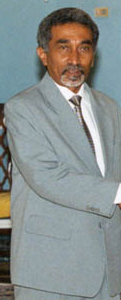
In this biography
Quick facts
- Born
- 1937
- Died
- 6 March 2012
- Birthplace
- Turiscai, Manufahi, Portuguese Timor
- Country
- Timor-Leste
- Nationality
- Timorese
- Known for
- Proclaiming Timor-Leste’s independence on 28 November 1975
- Birth year
- 1937 in the government’s obituary
- 1974 movement
- ASDT co-founder; the organisation became FRETILIN that September
- Proclamation
- 28 November 1975; first president of the proclaimed republic
- Return
- Returned to Timor-Leste in 2000 after years in Indonesia
- Formal recognition
- Former-president status recognised by Parliament in July 2007
Why this life matters
Amaral personifies both the sovereign claim made before the Indonesian invasion and the deep internal divisions that complicated the resistance movement.
Timeline
Key moments
Born in Turiscai
The government obituary identifies Turiscai, Manufahi and the year 1937.
ASDT and FRETILIN
Co-founded ASDT on 20 May; it became FRETILIN on 11 September.
Proclaimed independence
Spoke for the FRETILIN Central Committee on 28 November; Indonesia invaded on 7 December.
Two separate detentions
FRETILIN detained him in 1977; Indonesian forces captured him in 1978.
Return and parliamentary service
Returned in 2000, entered the constituent process and contested the 2002 presidential election.
Recognition of former-president status
Parliament approved Resolution 10/2007 on 17 July.
Death before the presidential poll
Died in Dili on 6 March, before the scheduled 17 March election; the government declared three days of mourning.
Turiscai and the emergence of an independence organisation
Francisco Xavier do Amaral came from Turiscai in Manufahi, then part of Portuguese Timor. The Timorese government’s obituary gives his birth year as 1937. His political importance grew during the rapid changes of 1974, when Portuguese decolonisation opened space for competing organisations to argue over the territory’s future.
The National Parliament’s 2012 memorial identifies him as a co-founder of the Timorese Social Democratic Association, ASDT, on 20 May 1974. That organisation became FRETILIN on 11 September. These dates describe the formation and transformation of an independence movement, not the creation of an already sovereign state or the uninterrupted operation of a post-independence political party.
The proclamation of 28 November 1975
On 28 November 1975, Amaral proclaimed the independence of the Democratic Republic of Timor-Leste on behalf of FRETILIN’s Central Committee. He became its first president. The government’s account distinguishes this act from the Indonesian invasion on 7 December, which forced the independence leadership into a very different struggle for survival.
His title belongs to the republic proclaimed in 1975. It should not be confused with the presidency following the restoration of independence in 2002, held by Xanana Gusmão. Parliament later explicitly recognised Amaral’s earlier status. The two presidencies belong to different stages of the same national history, rather than competing claims that one of the men never held office.
A leadership rupture followed by captivity in Indonesia
The resistance was divided over how civilians and fighters could survive Indonesian military pressure. The conflict-history chapter of the Chega commission report describes disagreements involving Amaral, his removal and detention by FRETILIN in September 1977. Allegations used by his opponents are evidence of the internal conflict, not findings this biography adopts as proven criminal guilt.
His later detention by Indonesian forces was a separate event. Parliament’s memorial dates that capture to 1978 and records his return to Timor-Leste in 2000 after a long period in Indonesia. Keeping the two detentions distinct avoids attributing every part of his captivity to the same organisation. It also restores the difficult interruption between his role as proclaimer and his eventual return to public political life.
Constituent politics, elections and formal recognition
After returning, Amaral participated in the constituent process and became a parliamentarian. He contested presidential elections in 2002 and 2007. Resolution 6/2002, approved on 25 June, lists him as one of the National Parliament’s vice-presidents. That parliamentary position was distinct from being president or vice-president of the republic.
On 17 July 2007, Parliament approved Resolution 10/2007 recognising his status as a former president and the rights and honours attached to it. The resolution cites the 1975 proclamation and his subsequent swearing-in. It was retrospective recognition of an earlier role, not a new election to the presidency or a change to the outcome of the presidential contest held that year.
Death in 2012 and the public meaning of remembrance
Amaral died at Guido Valadares National Hospital in Dili on 6 March 2012. He had been a candidate for the presidential election scheduled for 17 March, so his final candidacy did not become a completed third electoral contest. The government declared three days of national mourning and arranged public observances involving Parliament and the presidential palace.
The funeral on 8 March proceeded from Dili Cathedral to the Garden of Heroes in Metinaro. Official tributes celebrated the proclaimer and independence leader, while the historical record also contains division, detention and exclusion. Reading those strands together gives a fuller account than treating his life as an uninterrupted ascent from the 1975 declaration to the restored state.
Quick answers
Frequently asked questions about Francisco Xavier do Amaral
- Who was Timor-Leste’s first president?
- Francisco Xavier do Amaral became president of the republic proclaimed in November 1975. Xanana Gusmão held the presidency after independence was restored in 2002.
- Did FRETILIN and Indonesian forces detain him at the same time?
- No. The reviewed records distinguish FRETILIN’s detention in 1977 from his capture by Indonesian forces in 1978 and the long period in Indonesia that followed.
- What did Parliament recognise in 2007?
- Resolution 10/2007 recognised his status as a former president, based on the 1975 proclamation and swearing-in. It did not elect him president in 2007.
- Did he contest the March 2012 election?
- He was a candidate, but died on 6 March before the scheduled 17 March poll. His completed presidential campaigns were in 2002 and 2007.
Keep exploring
Lives connected to this story
- Nicolau Lobato
Follow the resistance leader whose career intersects with the 1975 government and the later internal rupture.
- Xanana Gusmão
Distinguish the restored state’s 2002 presidency from Amaral’s 1975 office.
- José Ramos-Horta
Read another independence figure’s diplomatic and post-restoration political career.
Sources and further reading
Explore the evidence
These references support the biography and offer further reading. Official records, first-person accounts and independent reporting provide different perspectives; image records document attribution and licensing.
- 1. Government of Timor-LesteA Loss for the Country and the People of Timor-Leste
The official obituary supplies the birth year but not a verified day and month. Its compressed account of replacement and captivity is expanded with the separate parliamentary record and conflict-history chapter.
- 2. Government of Timor-LesteNational Mourning for Francisco Xavier do Amaral
- 3. Centro Nacional Chega!Chega! Final Report
- 4. Wikimedia CommonsPortrait and licence record
- 5. Timor-Leste Ministry of Justice / Jornal da RepúblicaParliamentary memorial 19/2012: party origins, captivity and return in 2000
The Portuguese-language memorial records a return in 2000, not 1999, and distinguishes the 1977 detention from capture in 1978. Official praise is commemorative testimony.
- 6. Timor-Leste Ministry of Justice / Jornal da RepúblicaResolution 10/2007: recognition of former-president status
The resolution recognises a former office; it does not confer a new presidential mandate in 2007.
- 7. Timor-Leste Ministry of Justice / Jornal da RepúblicaResolution 6/2002: election of Parliament’s vice-presidents
- 8. CAVR / Centro Nacional ChegaChega, conflict-history chapter, paragraphs 300–301: the September 1977 rupture
The indexed Indonesian-language chapter’s paragraphs 300–301 were consulted for the leadership rupture; the entire Chega report was not read. Opponents’ allegations are not adopted as established guilt.