
The short answer
Follow the negotiations that established Australia–Timor-Leste maritime boundaries, the conditional Greater Sunrise revenue arrangements, and the separate steps of signature and entry into force.
Annex B, Article 2
The two Greater Sunrise upstream-revenue alternatives
Pipeline destination determines which treaty ratio applies. These are government revenue shares, not commercial shareholdings.
| Development by pipeline to | Timor-Leste share | Australia share |
|---|---|---|
| Timor-Leste | 70% | 30% |
| Australia | 80% | 20% |
Chronology
A timeline of the turning points
Compulsory conciliation initiated
Timor-Leste began proceedings under UNCLOS, administered by the PCA.
Commission confirms competence
A procedural decision allowed the conciliation to proceed; it was not a final boundary award.
Agreement in principle
The parties reached a comprehensive package on the maritime-boundary settlement.
Draft treaty text agreed
The agreement in principle was developed into a complete draft.
Signature in New York
Julie Bishop and Hermenegildo Pereira signed for their respective states.
Timorese ratification
Timor-Leste’s Parliament ratified the treaty and approved implementing measures.
Entry into force
Prime Ministers Taur Matan Ruak and Scott Morrison exchanged notes in Dili.
What did the 2018 Timor Sea treaty do?
The 2018 Timor Sea Maritime Boundary Treaty established permanent maritime boundaries between Australia and Timor-Leste and arrangements for sharing and managing offshore petroleum resources. Its formal title is Treaty Between Australia and the Democratic Republic of Timor-Leste Establishing Their Maritime Boundaries in the Timor Sea. The states signed it in New York on 6 March 2018.
The agreement addressed a long-running dispute between neighbouring states after Timor-Leste’s independence. Earlier resource arrangements had allowed petroleum activity without finally settling every boundary question. The new treaty joined delimitation with transitional arrangements for existing operations and a special regime for Greater Sunrise. It was an international agreement between the two governments, not a contract transferring the whole Timor Sea to one company.
Conciliation, Xanana Gusmão and the actual signatories
Timor-Leste initiated compulsory conciliation under the UN Convention on the Law of the Sea on 11 April 2016. The Permanent Court of Arbitration administered the process. A five-member commission helped the parties work toward agreement; the resulting boundary was negotiated by the states rather than imposed through a final arbitral award drawing a border.
Xanana Gusmão led Timor-Leste’s negotiating effort. The parties reached agreement in principle in August 2017 and completed the draft text later that year. At the 6 March 2018 ceremony, however, the signatories were Australia’s Foreign Minister Julie Bishop and Timor-Leste’s Hermenegildo Pereira, also known as Ágio Pereira. The UN Secretary-General witnessed the signing. Chief negotiator, treaty signatory and witnessing official were distinct roles.
Boundaries, seabed rights and the separate Indonesian question
The boundary description includes a southern boundary and eastern and western lateral segments. DFAT’s technical fact sheet distinguishes the southern seabed-and-water-column boundary from lateral seabed boundaries. It also explains that the southern alignment is not everywhere an identical straight median line: one segment lies slightly above it, while another follows it.
The treaty provides for specified lateral adjustments in connection with a future Indonesia–Timor-Leste delimitation, subject to conditions concerning relevant resources. That qualification does not make the whole agreement temporary. It does mean that a bilateral settlement with Australia should not be presented as a simultaneous settlement of every Timorese boundary with Indonesia. A political map, rights over the seabed and arrangements for a shared petroleum field answer related but different questions.
Sources for this section: [4]
Why signing in 2018 was followed by entry into force in 2019
Signature did not immediately put the treaty into operation. Both countries had domestic implementation steps to complete. Timor-Leste’s boundary office records parliamentary ratification on 23 July 2019. Australia’s foreign minister announced passage of implementing legislation later that month, including work on transitional arrangements with offshore petroleum operators.
On 30 August 2019, Prime Ministers Taur Matan Ruak and Scott Morrison exchanged notes in Dili to bring the treaty into force. Those are different officeholders and a different event from the 2018 signing in New York. Keeping the two dates separate explains why the agreement is called the 2018 treaty even though its operative entry-into-force milestone falls in 2019.
A negotiated framework, not an automatic gas-development decision
The treaty created a framework for joint development and management of Greater Sunrise. The Australian government’s signing statement also identified the need for support from the private-sector venture companies and the economic viability of a development. A boundary agreement could reduce legal uncertainty without itself supplying every commercial approval, construction contract or financing decision.
Its historical significance is therefore both diplomatic and institutional. Timor-Leste used a new conciliation route to negotiate maritime rights with a much larger neighbour, while both states accepted arrangements linking boundaries, existing petroleum operations and a shared resource. The connected biographies explain the people involved. The treaty text explains the agreement itself; neither should be substituted for a current operational report on gas production or an investment forecast.
Continue the chronology
Related history guides
Connected biographies
Negotiation, earlier petroleum arrangements and implementation

1946—
Xanana Gusmão
Resistance leader, president and prime ministerA resistance commander, political prisoner and state-builder who became Timor-Leste’s first elected president and later returned to government as prime minister.Read biography
1949—
Mari Alkatiri
FRETILIN leader and former prime ministerA founding FRETILIN figure and exile diplomat who led the first constitutional government after independence and returned briefly as prime minister in 2017.Read biography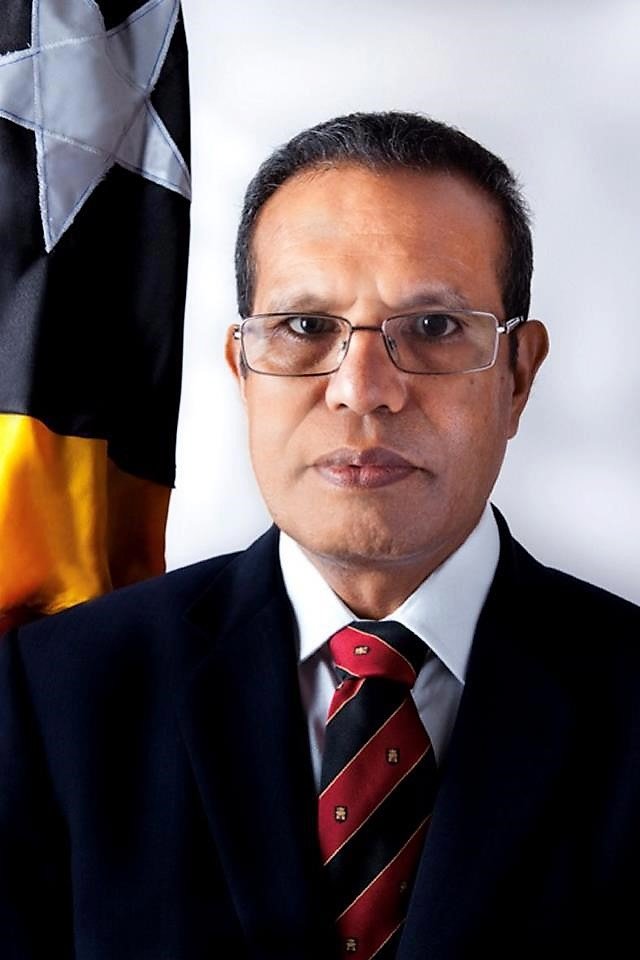
1956—
Taur Matan Ruak
Resistance commander, president and former prime ministerA former FALINTIL commander who led Timor-Leste’s defence force, served as president from 2012 to 2017 and headed the government from 2018 to 2023.Read biography1956–
Ágio Pereira
Timorese minister, government spokesperson and treaty signatoryÁgio Pereira is a Timorese minister and government spokesperson whose career links independence-era advocacy, presidential service, cabinet coordination and the maritime-boundary agreement signed with Australia in 2018.Read biographyQuick answers
Common questions
- When was the Timor Sea Maritime Boundary Treaty signed?
- Australia and Timor-Leste signed it in New York on 6 March 2018. It entered into force on 30 August 2019 after domestic implementation and an exchange of notes in Dili.
- Did Xanana Gusmão personally sign the treaty?
- He led Timor-Leste’s negotiating effort. The 2018 signatories were Julie Bishop for Australia and Hermenegildo, or Ágio, Pereira for Timor-Leste.
- What are the Greater Sunrise revenue shares?
- Annex B gives Timor-Leste 70% and Australia 30% for a pipeline to Timor-Leste, or Timor-Leste 80% and Australia 20% for a pipeline to Australia. These are conditional upstream-revenue shares.
- Did the PCA impose the maritime boundary?
- No. The PCA administered a conciliation process under UNCLOS. The states negotiated the treaty; the boundary was not imposed by a final arbitral award.
Primary and institutional sources
How this history was checked
The treaty text supplies the Greater Sunrise alternatives. PCA records distinguish conciliation from an arbitral boundary award. Timor-Leste’s boundary office and Australian implementation records separate the signature and entry-into-force dates. Government descriptions of the agreement’s benefits are attributed positions, not independent proof of commercial returns. This is a history of the 2016–2019 settlement, not a statement about the current development status of Greater Sunrise. This article was reviewed on 17 October 2026.
- Permanent Court of ArbitrationCase 2016-10: conciliation chronology, representatives and documents
- Timor-Leste Land and Maritime Boundary OfficeKey dates: negotiations, ratification and 30 August 2019 exchange of notes
- Australia and Timor-Leste, hosted by DFATMaritime Boundary Treaty, especially Annex B, Article 2
- Australian Department of Foreign Affairs and TradeTechnical fact sheet: boundaries, conditional adjustments and resource arrangements
- Australian Department of Foreign Affairs and TradeMarch 2018 headline fact sheet: date, location and actual signatories
- Australian Department of Foreign Affairs and TradeMaritime arrangements: signature and entry into force
- Australian Minister for Foreign AffairsJuly 2019: implementing legislation and transitional arrangements
- Australian Minister for Foreign AffairsMarch 2018 signing statement: shared resources and commercial conditions
- Wikimedia CommonsExisting 2011 Gusmão portrait: Agência Brasil provenance and CC BY 3.0 licence