
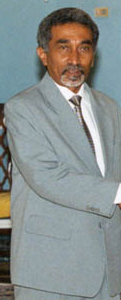
In this biography
Quick facts
- Born
- 26 November 1949
- Birthplace
- Dili, Portuguese Timor
- Country
- Timor-Leste
- Nationality
- Timorese
- Known for
- Leading Timor-Leste’s first government after restored independence
- Full name
- Mari bin Amude Alkatiri
- Prime minister
- 2002–2006 and 2017–2018
- Political party
- FRETILIN
- Exile base
- Mozambique
Why this life matters
Alkatiri shaped early fiscal and petroleum institutions while becoming one of the central figures in Timor-Leste’s debates over party power, security and executive authority.
Timeline
Key moments
Born in Dili
Born on 26 November into Timor’s small Muslim community.
Helped found FRETILIN
Joined the party’s leadership as Portuguese rule moved toward decolonisation.
Represented the movement abroad
An overseas diplomatic mission became prolonged exile after the invasion; Mozambique became his principal base.
Became prime minister
Led the first constitutional government of restored independence as the UN transition ended on 20 May.
Petroleum Fund established by law
Law No. 9/2005 created a framework for petroleum revenue, investment and transfers to the state budget.
Resigned during the crisis
Resigned on 26 June. The later UN inquiry did not recommend immediate prosecution on the material before it, but did recommend further investigation.
Returned to government
Led a FRETILIN–Democratic Party minority administration; parliamentary deadlock led to an early election and a change of government.
Dili, FRETILIN and diplomatic exile
Mari Alkatiri was born in Dili on 26 November 1949. He trained in surveying in Luanda and helped found the Timorese Social Democratic Association, ASDT, in 1974. That movement became FRETILIN as Portuguese decolonisation opened a struggle over Timor’s political future. His organisational role preceded the independent republic’s later cabinet offices.
An overseas mission around the 1975 independence declaration became prolonged exile when Indonesia invaded. Based mainly in Maputo, Mozambique, he represented FRETILIN internationally and studied law at Eduardo Mondlane University. The secondary biography records later legal consultancy in Maputo and constitutional-law consultancy for Mozambique’s parliament, experience distinct from the armed resistance inside occupied Timor.
The first constitutional government after restored independence
After the Indonesian occupation ended, Alkatiri returned during the UN-administered transition. FRETILIN’s strong result in the 2001 Constituent Assembly election gave the party the central position in forming the new state’s government. The UN transition ended with restored independence on 20 May 2002, and Alkatiri led the first constitutional government as prime minister.
This was not Timor-Leste’s first-ever claim to independence or its first historical prime minister: Nicolau Lobato had held that office in the short-lived republic proclaimed in 1975. Alkatiri’s 2002–2006 administration instead faced the practical tasks of the restored state—staffing ministries, preparing budgets and negotiating petroleum arrangements—within a constitution that divided authority among government, parliament and president.
Petroleum revenue and the 2005 fund
The Petroleum Fund, established by Law No. 9/2005 during Alkatiri’s first administration, created a durable framework for managing income from a finite resource. The original law channelled petroleum receipts into the fund, regulated transfers to the state budget and assigned operational management to the banking authority acting as the central bank.
Parliamentary appropriations, reporting and auditing were central to that design. The law sought to connect current expenditure with reserves for future generations rather than treat petroleum receipts as unrestricted ministerial cash. It was an institutional achievement involving parliament and financial authorities, not Alkatiri’s personal fund. The statutory safeguards explain the reform’s purpose without demonstrating that every later spending decision met that purpose.
Sources for this section: [5]
The 2006 security crisis and the inquiry’s actual finding
Disputes within the defence force escalated in 2006 into clashes, displacement and a breakdown of public order. Alkatiri resigned on 26 June amid pressure over the government’s handling of the crisis and allegations concerning weapons distributed to civilians. Political responsibility for a failing administration and criminal responsibility for a particular act required different kinds of assessment.
Paragraph 133 of the UN inquiry said the material before it did not support recommending his prosecution for illegal movement, possession or use of weapons. It nevertheless identified information suggesting he knew of the illegal arming of civilians and recommended further investigation. The archived 2007 U.S. human-rights report subsequently recorded insufficient evidence to bring charges. Neither finding should be rewritten as a conviction or as an unqualified judicial acquittal.
The minority government of 2017–2018
Alkatiri returned as prime minister in September 2017, leading the Seventh Constitutional Government with FRETILIN and the Democratic Party. The coalition held 30 of parliament’s 65 seats, so leading the largest party did not give his administration a working majority. Opposition resistance prevented passage of its programme and budget.
President Francisco Guterres dissolved parliament in January 2018, and the May election changed the governing balance. Alkatiri’s second premiership ended in 2018. The contrast with his first administration shows the changing constraints on FRETILIN: founding-party authority could build an initial government, but a later parliament required support beyond the party’s own seats.
Quick answers
Frequently asked questions about Mari Alkatiri
- When was Mari Alkatiri prime minister of Timor-Leste?
- He served in 2002–2006 and again in 2017–2018. His first administration was the first constitutional government after restored independence, not the short-lived government proclaimed in 1975.
- Why did Alkatiri live in Mozambique?
- An overseas diplomatic mission became exile after Indonesia’s 1975 invasion. He based much of FRETILIN’s external activity in Maputo and studied law at Eduardo Mondlane University.
- What did the 2006 UN inquiry say about Alkatiri?
- It did not find material sufficient to recommend his prosecution for the specified weapons offences, but it did recommend further investigation into possible knowledge of civilians being armed. It was not an unqualified judicial acquittal.
- What was Alkatiri’s role in the Petroleum Fund?
- Law No. 9/2005 established the public fund during his administration, with roles for parliament, the government and banking authorities. Its purpose was to manage petroleum revenue and budget transfers for present and future generations, rather than operate as a personal fund.
Keep exploring
Lives connected to this story
- Rui Maria de Araújo
Read about Rui Maria de Araújo, the physician and prime minister whom Alkatiri succeeded in September 2017.
- Nicolau Lobato
The 1975 republic’s prime minister, distinct from Alkatiri’s first constitutional government in 2002.
- José Ramos-Horta
Another independence-era diplomat who entered national leadership after the 2006 crisis.
- Xanana Gusmão
Compare the president’s role and the tensions between resistance legitimacy, party government and executive authority.
Sources and further reading
Explore the evidence
These references support the biography and offer further reading. Official records, first-person accounts and independent reporting provide different perspectives; image records document attribution and licensing.
- 1. Jornal da RepúblicaFRETILIN Party Registration and Leadership Record
- 2. United NationsCouncil Endorses Independence on 20 May 2002
- 3. United NationsUN Commission Findings on the 2006 Crisis
- 4. Government of Timor-LesteMari Alkatiri — government biographical summary, April 2018
Selected readable passages of the government’s 2018 Portuguese biographical summary establish birth, Luanda training and the ASDT/FRETILIN founding sequence. It is an official career summary, not an independent evaluation.
- 5. Jornal da RepúblicaLaw No. 9/2005 — Petroleum Fund Law
The original Portuguese law was consulted for the fund’s institutional design. Its provisions are historical context, not an assertion that the original investment rules remain unchanged.
- 6. United NationsUN Independent Special Commission of Inquiry — paragraph 133
Indexed paragraph 133 was checked; full PDF retrieval was unavailable. Both the limit on recommending prosecution and the recommendation for further investigation are retained.
- 7. U.S. Department of StateTimor-Leste human-rights report, 2007 — weapons investigations
The archived institutional report records insufficient evidence to bring charges by 2007. This is a dated account, not a newly checked court judgment or a claim about all possible later proceedings.
- 8. Government of Timor-LesteSeventh Government’s first meeting, 19 September 2017
- 9. WikipediaMari Alkatiri — exile and career chronology
The secondary biography supplies the Mozambique legal-study and consultancy account and resignation date. These details were not checked against university or personnel archives.
- 10. Wikipedia2018 Timorese parliamentary election — minority-government background
The secondary election chronology supplies the minority’s seat count and later deadlock. The original election canvass and parliamentary division records were not read.
- 11. Wikimedia CommonsPortrait and licence record


