
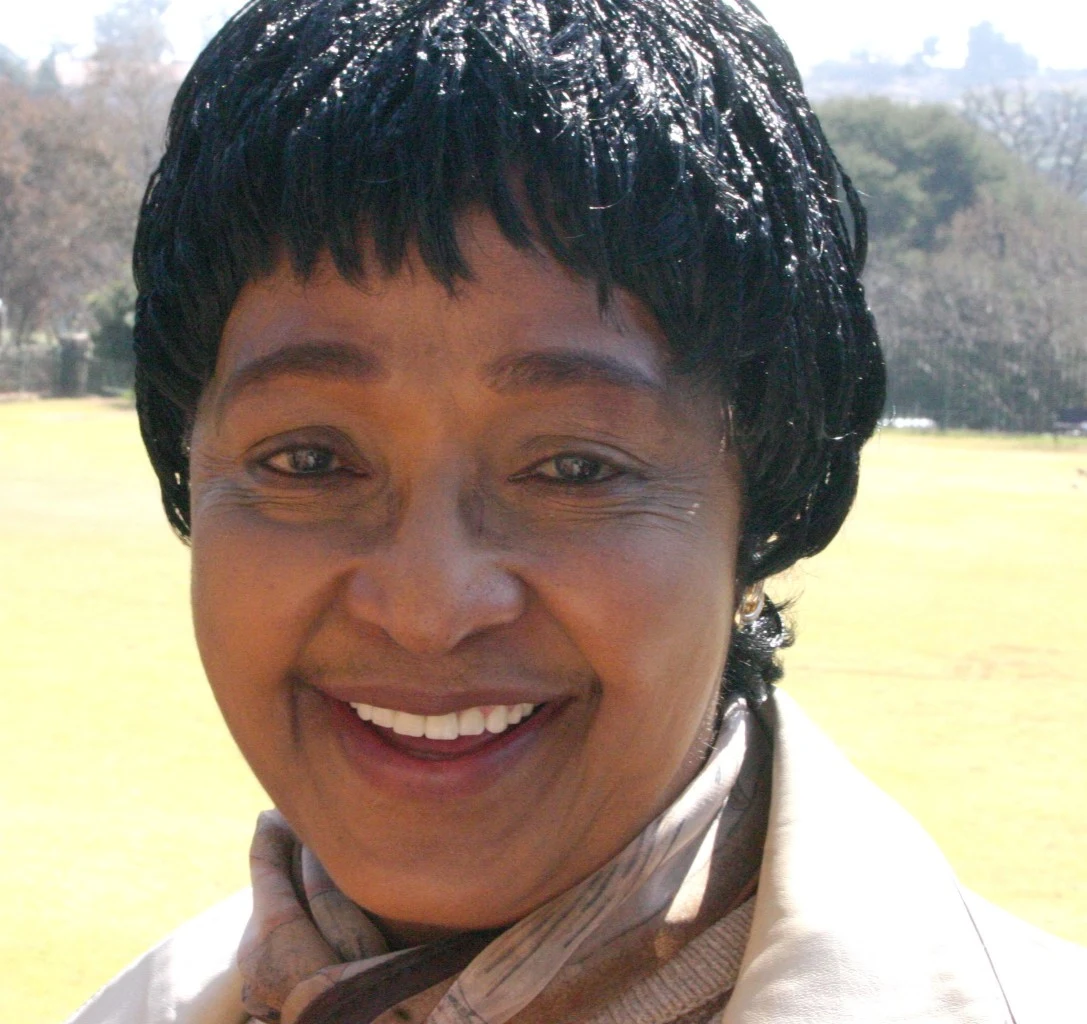
In this biography
Quick facts
- Born
- 26 September 1936
- Died
- 2 April 2018
- Birthplace
- Mbongweni, Bizana, present-day Eastern Cape, South Africa
- Country
- South Africa
- Nationality
- Not independently established
- Known for
- Resistance under detention and banishment, community work and a contested record of public leadership
- Birth name
- Nomzamo Winifred Zanyiwe Madikizela
- Professional training
- Social work, Jan Hofmeyr School, Johannesburg
- Forced residence
- Brandfort, 1977–1985
- Public service
- MP and deputy minister after the 1994 election
- 1993 appeal
- Kidnapping upheld; assault-accessory conviction overturned
- 2004 appeal
- Fraud upheld; theft convictions overturned; suspended sentence
Why this life matters
Her life exposes both the violence of apartheid repression and the need to scrutinise authority exercised within a liberation movement. Recognition of suffering cannot erase victims of later abuses, and commission findings must not be rewritten as criminal verdicts.
Timeline
Key moments
Education and social work
An Eastern Cape childhood leads to professional training in Johannesburg.
Activism and repression
Marriage and political work are followed by bans and repeated detention.
Brandfort banishment
Forced residence disrupts her household and political contacts.
Trial and appeal
Kidnapping convictions survive appeal; assault-accessory convictions do not.
Office and accountability
Public service overlaps with the TRC process and a separate financial prosecution.
Honour and death
The Order of Luthuli precedes her death on 2 April 2018.
Detention and surveillance affected family and political life
Banning orders and police raids repeatedly disrupted her work and household. In 1969 she was detained and spent a prolonged period in solitary confinement. The Nelson Mandela Foundation’s remembrance explicitly recognises torture and the damage it caused. Its account drew on work with her prison archive, but this article does not claim to have read that complete archive.
These experiences help explain the conditions of her activism without determining every later judgment about it. Keeping Nelson Mandela’s imprisonment publicly visible was one responsibility; maintaining her own underground and community connections was another.
Banishment relocated repression rather than ending political contact
In May 1977 she and her younger daughter Zindzi were forced to Brandfort. Residence restrictions combined with controls on meetings and communication. The companion guide examines how these rules affected ordinary visits, household arrangements and access to support.
Community work continued, and a former neighbour later recalled her encouragement to local residents. Such testimony explains part of her enduring support; it cannot stand for every resident’s experience. It also shows why removal from Soweto did not automatically extinguish her political relationships or capacity to influence others.
The kidnapping case had a specific appeal outcome
In 1991 a court convicted her of kidnapping four youths and being an accessory after the fact to their assault. In June 1993 the appeal court upheld kidnapping but overturned the assault-accessory conviction, substituting a fine and suspended sentence for imprisonment.
UPI’s contemporary report distinguishes those outcomes. The TRC’s later account confirms the surviving kidnapping conviction. Neither record supports calling her conviction one for Stompie Seipei’s murder: Jerry Richardson was convicted of that killing. A sentence reduced on appeal was not an acquittal on every charge.
The commission’s findings went beyond the criminal verdict
The TRC found her politically and morally accountable for gross violations committed by the Mandela United Football Club. It also found participation in assaults and responsibility for the abduction of Seipei, while recording her denials. Its investigation did not conclusively establish the competing accounts of his killing.
SAPA independently reported the findings when the report appeared in 1998. They cannot be dismissed merely as untested public rumour, but remain commission findings rather than new criminal convictions. Acknowledging apartheid’s brutality does not remove the need to account for victims within the resistance movement.
Democratic office, another prosecution and later recognition coexisted
After the 1994 election she served as an MP and deputy minister. Her positions also included ANC Women’s League president. A separate financial case later resulted in convictions. ABC reported that the July 2004 appeal upheld 43 fraud counts, overturned 25 theft counts and imposed a wholly suspended three-and-a-half-year sentence. The distinctions matter more than a shorthand claim that every charge survived.
The Presidency awarded her the Order of Luthuli in silver in 2016. She died on 2 April 2018. Official mourning and the Foundation’s tribute demonstrate continuing recognition, not a reversal of court outcomes or commission findings.
Quick answers
Frequently asked questions about Winnie Madikizela-Mandela
- Was her political role limited to being Mandela’s wife?
- No. She trained as a social worker and pursued political and community work herself.
- Did the 1993 appeal overturn every conviction?
- No. Kidnapping remained; the assault-accessory conviction was overturned.
- Was she convicted of Stompie Seipei’s murder?
- No. Richardson was convicted of the killing; her criminal and commission records were different.
- Did all financial convictions survive the 2004 appeal?
- No. Fraud convictions remained, while the theft convictions were overturned.
Keep exploring
Lives connected to this story
- Nelson Mandela
Separate an intertwined family history from two distinct political careers.
- Helen Suzman
Compare direct interventions against restrictions with activism outside Parliament.
- Desmond Tutu
Read about the commission’s chair and the wider work of public accountability.
- Walter Sisulu
Compare family separation, political organisation and the return to public life.
Sources and further reading
Explore the evidence
These references support the biography and offer further reading. Official records, first-person accounts and independent reporting provide different perspectives; image records document attribution and licensing.
- 1. South African History OnlineWinnie Madikizela-Mandela: selected family, work and detention passages
- 2. The Presidency, South Africa2016 National Orders booklet: selected Madikizela-Mandela entry, pages 40–41
The honour and selected service facts are used. Conflicting qualification dates and detention/banishment durations are withheld.
- 3. South African Government8 April 2018 memorial notice: birth name, birthplace and death
- 4. Nelson Mandela Foundation3 April 2018 remembrance of Winnie Madikizela-Mandela
- 5. South African History Online16 May 1977 banishment: household, language and communication
- 6. Helen Joseph / SAHO archiveSide by Side: selected Brandfort visits in Acts of conscience
- 7. Andrew Moses / IOL6 April 2018: Brandfort house and a neighbour’s recollection
- 8. Truth and Reconciliation Commission / O’Malley ArchivesVolume 3, chapter 4, paragraphs 57–66: Brandfort
- 9. United Press International2 June 1993: kidnapping conviction upheld, assault-accessory conviction overturned
Contemporary reporting checked against the commission’s appeal summary; direct SAFLII judgment access returned 403.
- 10. Truth and Reconciliation Commission / Polity archiveVolume 2, chapter 6: selected Mandela United Football Club findings
Selected introduction, Seipei findings and overall conclusions only. Findings, allegations and criminal verdicts are distinguished; no complete case-file reading is claimed.
- 11. South African Press Association / Justice Department archive29 October 1998 report on the commission’s findings
- 12. Sally Sara / ABC News5 July 2004: fraud convictions and suspended sentence on appeal
- 13. Rotational / Wikimedia CommonsWinnie Mandela00: photographer’s own-work public-domain release
Social work preceded national political prominence
Born Nomzamo Winifred Zanyiwe Madikizela at Mbongweni near Bizana, she moved to Johannesburg for professional training at the Jan Hofmeyr School. She then worked at Baragwanath Hospital. Her working life brought direct contact with the consequences of racial inequality before she became internationally recognised through the Mandela name.
She married Nelson Mandela in 1958 and participated in women’s resistance to pass laws that year. His imprisonment subsequently placed exceptional burdens on their family. Her political activity was not simply a title acquired through marriage.
Sources for this section: [2] · [1] · [3]