In this biography
Quick facts
- Born
- 24 September 1949
- Birthplace
- Durban, South Africa
- Country
- South Africa
- Nationality
- Not independently established
- Known for
- Two periods as National Assembly Speaker, women’s political organisation and a contested record of parliamentary oversight
- Name variant
- Baleka Mbete-Kgositsile
- Training
- Teacher’s certificate, Lovedale,1973
- Exile
- Left South Africa in April 1976
- Speaker
- 2004–2008 and 2014–2019
- Deputy president
- September 2008–May 2009
- Later parliamentary status
- Declined a seat in 2019; described here by former offices
Why this life matters
Her career illustrates the tension between leadership in a governing party and responsibilities within a legislature that must scrutinise the executive. Constitutional limits mattered even when parliamentary majorities and party loyalties pointed towards a different course.
Timeline
Key moments
Schooling and teaching
A Durban childhood leads through Inanda and teacher training to classroom work.
Exile and political organisation
Southern and East African assignments include women’s and cultural work.
Return and parliamentary responsibility
Women’s League work and democratic institutions precede the speakership.
Speaker and deputy president
Parliamentary leadership is followed by a separate executive appointment.
Second speakership and judicial scrutiny
The Nkandla ruling and secret-ballot litigation test institutional obligations.
Declines a parliamentary seat
She does not take up a seat in the incoming National Assembly.
Teaching developed alongside growing political awareness
Mbete was born in Durban on 24 September 1949. Her childhood included time with her grandmother in the northern Transvaal and with her family at Fort Hare, where her father worked as a librarian. She attended Inanda Seminary before teacher training.
After expulsion from Eshowe, she completed a teaching qualification at Lovedale in 1973 and taught in Durban. Contact with Black Consciousness organisations and ANC underground networks followed. The sources disagree over her precise matriculation year, so it is not supplied here. Schooling, professional work and political involvement were related stages, not interchangeable credentials.
Exile involved women’s organisation and cultural production
She left South Africa in April 1976 with underground assistance, initially going to Swaziland, now Eswatini. Work for the ANC and teaching preceded a move to Tanzania, where she organised within the regional women’s section. Marriage to poet Keorapetse Kgositsile followed in 1978.
Her later exile included Kenya, Botswana, Zimbabwe and Zambia. In Botswana she led writers’ and music units of the Medu Arts Ensemble. The military raid of 1985 disrupted its work. Her published poetry collection, Essential Things, belongs to this broader cultural career; she was not solely a parliamentary figure who happened to spend time abroad.
The return to South Africa opened different institutional roles
After returning in 1990, Mbete took on ANC Women’s League responsibilities and served as secretary-general in the early 1990s. She entered the democratic Parliament and became deputy Speaker in 1996. Election as Speaker followed in 2004, bringing responsibility for the conduct of National Assembly business.
She also held senior party office. The distinction matters: chairing the ANC was not the same position as presiding over a chamber containing competing parties. The Constitution requires the Assembly to hold executive organs accountable. Managing parliamentary procedure could therefore have consequences beyond maintaining orderly debate or implementing a governing party’s preferences.
Executive office interrupted rather than replaced her parliamentary career
Mbete served as South Africa’s deputy president under Kgalema Motlanthe from September 2008 to May 2009. This was an executive appointment, distinct from her speakership and party chairmanship. She later returned as Speaker in May 2014, beginning a second period that lasted until 2019.
In her opening remarks she called for cooperation across parties and a vigorous Parliament. Those statements describe an institutional ambition, not an independent finding that every subsequent decision met it. The period would bring intense scrutiny of whether parliamentary action fulfilled the oversight function she was responsible for helping the House exercise.
Oversight disputes produced limits and a further exercise of discretion
In 2016 the Constitutional Court invalidated the Assembly’s Nkandla resolution. This was an institutional constitutional ruling, not a criminal conviction of Mbete. In her response she welcomed the clarification and acknowledged that matters could have been handled differently.
A separate 2017 judgment confirmed that the Speaker could authorise a secret ballot on a presidential no-confidence motion and returned the decision to her. She subsequently chose that procedure. The court did not itself order that every such vote must be secret. In 2019 she declined a parliamentary seat; this biography uses former-office descriptions rather than recycling old profiles as current appointments.
Sources for this section: [5] · [6] · [7] · [8] · [9] · [10]
Quick answers
Frequently asked questions about Baleka Mbete
- Was Mbete’s deputy presidency the same job as Speaker?
- No. One was an executive appointment; the other presided over the National Assembly.
- Did the 2016 constitutional ruling convict her of a crime?
- No. A constitutional ruling about institutional conduct is not a criminal conviction.
- Did the court itself order the 2017 vote to be secret?
- No. It confirmed the Speaker’s power and returned the decision to her.
- Did she take a parliamentary seat after the 2019 election?
- No. Contemporary reporting records that she declined the seat.
Keep exploring
Lives connected to this story
- Kgalema Motlanthe
Read about the presidency during her brief national deputy presidency.
- Jacob Zuma
Separate the executive’s conduct from Parliament’s oversight obligations.
- Helen Suzman
Compare different parliamentary careers and approaches to scrutiny.
- Trevor Manuel
Place legislative oversight beside economic executive responsibilities.
Sources and further reading
Explore the evidence
These references support the biography and offer further reading. Official records, first-person accounts and independent reporting provide different perspectives; image records document attribution and licensing.
- 1. South African History OnlineBaleka Mbete-Kgositsile: selected teaching, exile and cultural-work chronology
Stale current-role wording is not used to establish an October 2026 office; birthplace is stated at the consistently supported Durban level.
- 2. Parliament of South AfricaInSession, May/June 2014: Mbete profile, printed page 6, and opening remarks, page 10
Only her printed-page 6 profile and page 10 remarks were used, not the complete magazine. Conflicting school and Women’s League dates are not artificially reconciled.
- 3. South African GovernmentBaleka Mbete: former-government-leader record and office dates
- 4. Department of Justice and Constitutional DevelopmentConstitution, chapter 4: selected sections 55–57
- 5. Constitutional Court of South Africa31 March 2016: EFF v Speaker / DA v Speaker, media summary
- 6. Baleka Mbete / Parliament of South Africa3 April 2016: response to the constitutional ruling
- 7. Constitutional Court of South AfricaUDM v Speaker, 22 June 2017: order and paragraphs 94–97 only
Order and selected concluding paragraphs only; not the full litigation record. The 2017 decision is separate from the 2016 Nkandla judgment.
- 8. Parliament of South Africa8 August 2017: secret-ballot announcement and voting procedure
- 9. Thapelo Lekabe / The Citizen7 August 2017: Mbete announces a secret ballot
- 10. TimesLIVE21 May 2019: Mbete declines a parliamentary seat
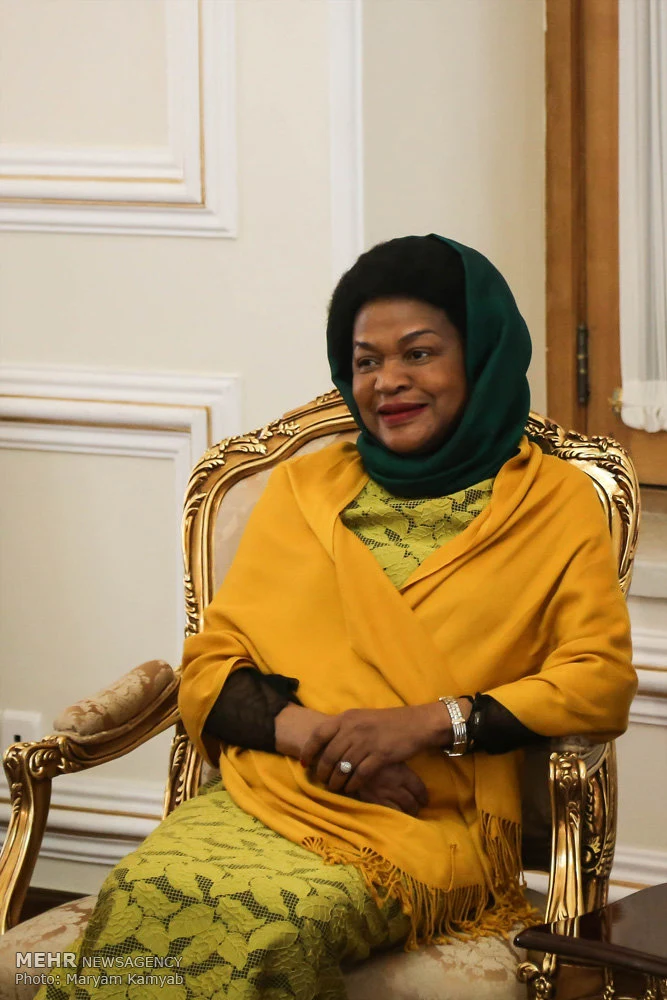
- 11. Maryam Kamyab / Mehr News AgencyBaleka Mbete during the 3 September 2017 meeting with Iran’s foreign minister