In this biography
Quick facts
- Born
- 18 May 1912
- Died
- 5 May 2003
- Birthplace
- Qutubeni, Engcobo district, present-day Eastern Cape, South Africa
- Country
- South Africa
- Nationality
- Not independently established
- Known for
- Building ANC organisation, mentoring colleagues and participating in the transition after his 1989 release
- Early employment
- Mining, bakery and factory work
- ANC membership
- Joined in 1940
- Family partnership
- Married Albertina Thethiwe in 1944
- Secretary-general
- Elected in December 1949
- Release
- 15 October 1989
- Later office
- ANC deputy president, 1991–1994
Why this life matters
His influence often depended on relationships and collective decisions rather than public performance. Following those practices reveals a career broader than friendship with Nelson Mandela, while retaining the consequential turn from civil resistance to an armed underground.
Timeline
Key moments
Rural childhood and wage work
Schooling and employment connect the Transkei, Johannesburg and East London.
Organising responsibilities
ANC membership and Youth League activity precede election as secretary-general.
Campaigns and restrictions
Joint organising, defiance, bans and the Treason Trial shape his work.
Underground and life sentence
A radio message precedes arrest and conviction in the sabotage prosecution.
Release and reconstruction
He returns to internal organisation, talks and the ANC deputy presidency.
Death and remembrance
He dies on 5 May; colleagues commemorate his collective approach to leadership.
Employment and local associations formed an organiser
Sisulu was born at Qutubeni in the Engcobo district on 18 May 1912. Interrupted schooling and the need to support his family led into wage work, including mining and factory employment. In Johannesburg he also attended night classes and participated in civic and mutual-aid associations.
He joined the ANC in 1940. Marriage to Albertina Thethiwe, a nurse, followed in 1944. Their household became part of a wider political network, but Albertina developed a public career of her own. Family responsibility and organising were intertwined rather than neatly separated spheres of life.
National office involved coordinating people and organisations
Youth League work preceded his election as ANC secretary-general in December 1949. The new Programme of Action required more than adopting a resolution: finance, communication and decisions about collective action had to be organised. Sisulu subsequently served in joint coordination with the Indian Congress and on the Defiance Campaign’s planning council.
These responsibilities brought repeated arrests and restrictions. Overseas travel in 1953 also widened his political contacts. The biographical record describes movement away from racial exclusivity towards a multiracial Congress alliance. Cooperation was a position developed through experience, not an assumption that differences between organisations had disappeared.
Underground leadership marked a change in methods
The Treason Trial ended in acquittal in 1961. That outcome must be distinguished from the later Rivonia prosecution. After the ANC’s banning, Sisulu joined the armed underground; this was not simply a continuation of public, nonviolent campaigning under another name.
His preserved radio message of 26 June 1963 explained going underground as a means of maintaining organisation and leadership. He said he remained inside South Africa. Arrest at Liliesleaf followed in July, and a life sentence for planning political sabotage in June 1964. The broadcast’s exact physical location is not established here.
Prison did not end the work of political education
On Robben Island, Sisulu helped younger prisoners understand the ANC’s earlier history. SAHO describes an organised syllabus in which his lectures formed an important component. Learning in prison involved shared discussion as well as formal study, under conditions intended to constrain both.
At his funeral, Mandela recalled a colleague who listened, drew others into responsibility and promoted collective leadership across organisational divisions. Smuts Ngonyama similarly described teaching through conversation. These are sympathetic participants’ recollections, not proof that prison politics lacked disagreement. They nevertheless identify practices through which Sisulu exercised influence without relying only on office.
Release brought rebuilding, international contact and negotiation
Released on 15 October 1989, Sisulu helped reconstruct the ANC inside the country and joined the May 1990 Groote Schuur talks. The party elected him deputy president in 1991. Its legal re-establishment required renewed structures and relationships, not merely the return of familiar names.
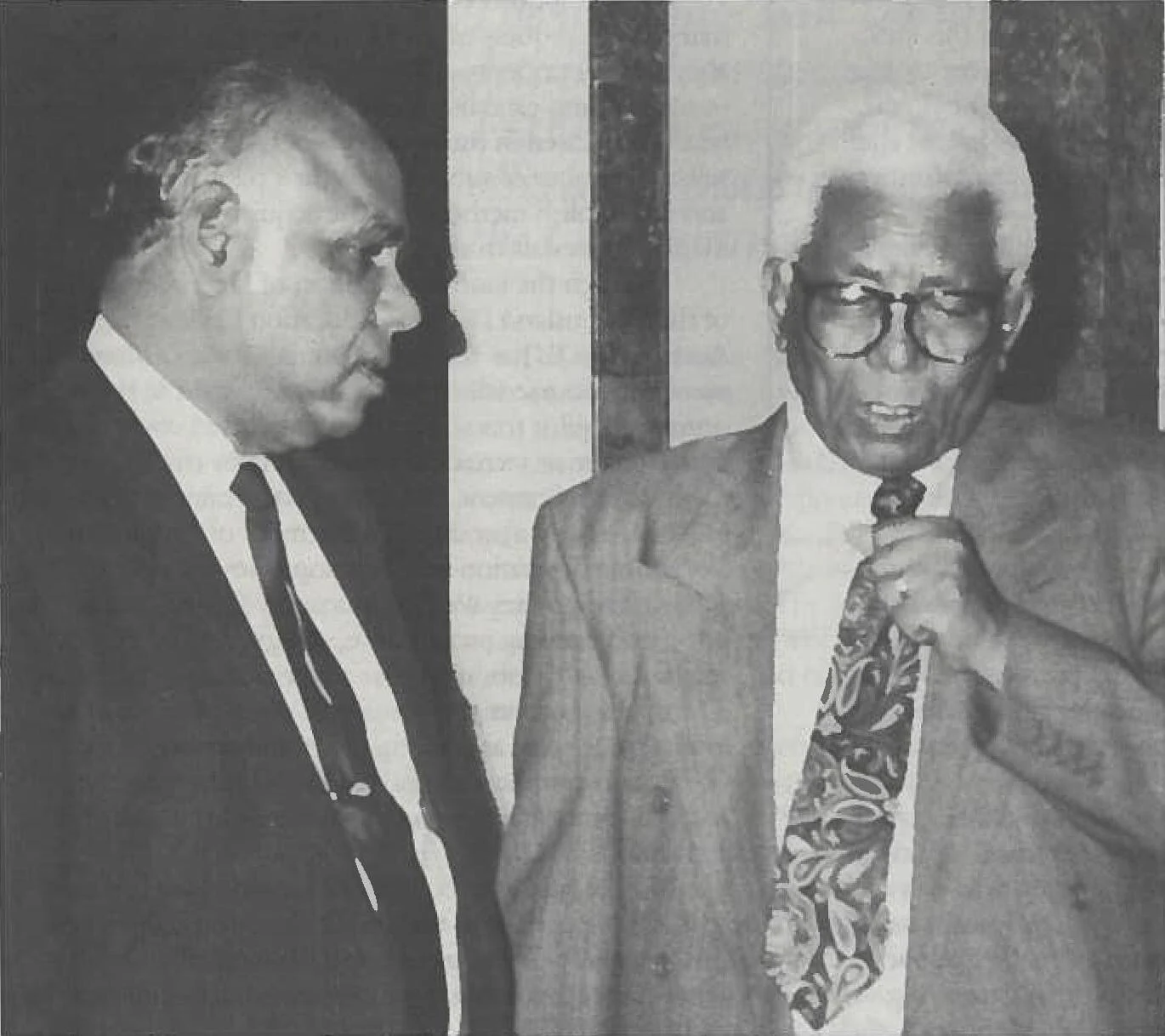
A September 1991 Commonwealth of Learning visit, shown in the photograph, included discussion of education beyond apartheid. His work therefore also involved practical international contacts. Retirement from active politics followed in 1994. He died on 5 May 2003; Mandela’s tribute placed the partnership with Albertina alongside their shared political commitments.
Quick answers
Frequently asked questions about Walter Sisulu
- Was Sisulu president of South Africa?
- No. His later deputy presidency was an ANC party office.
- Did he remain solely a nonviolent campaigner?
- No. His career included participation in the armed underground.
- Was the Treason Trial his life-sentence case?
- No. It ended in acquittal; the later Rivonia prosecution produced the life sentence.
- Who appears beside him in the photograph?
- Commonwealth of Learning president James Maraj is at left; Sisulu is at right.
Keep exploring
Lives connected to this story
- Nelson Mandela
Follow a long political partnership without reducing either career to the other.
- Oliver Tambo
Compare internal organising with the ANC leadership maintained abroad.
- Ahmed Kathrada
Explore prison education and the later return to democratic institutions.
- Winnie Madikizela-Mandela
Compare the effects of imprisonment, restrictions and public responsibility.
Sources and further reading
Explore the evidence
These references support the biography and offer further reading. Official records, first-person accounts and independent reporting provide different perspectives; image records document attribution and licensing.
- 1. South African History OnlineWalter Ulyate Sisulu: selected early-life, family and prison passages
- 2. Peter Joyce / O’Malley ArchivesSisulu, Walter Max Ulyate: biographical entry and subsequent chronology
- 3. Walter Sisulu / O’Malley Archives26 June 1963 ANC radio broadcast: preserved opening text
Only the preserved opening is used; its text does not establish a particular broadcasting building.
- 4. Nelson Mandela / Polity17 May 2003 funeral tribute: collective leadership and companionship
A funeral recollection is identified as testimony, not a neutral assessment of every political dispute.
- 5. Smuts Ngonyama / City PressThe man who made freedom fighters: selected prison and post-release recollections
- 6. ANC National Executive Committee / SAHO archiveDecember 1950 draft report: Council of Action and protest decisions
- 7. Commonwealth of LearningCOMLEARN, April 1992: September 1991 Sisulu visit paragraph
The visitor paragraph supports the education discussion. Its erroneous description of the conviction as treason is not adopted.
- 8. Commonwealth of Learning / Wikimedia CommonsSisulu visits Commonwealth of Learning: complete supplied photograph