In this biography
Quick facts
- Born
- Not verified in the reviewed primary sources
- Birthplace
- Not verified in the reviewed primary sources
- Country
- Timor-Leste
- Nationality
- Not independently established
- Known for
- Justice administration, land-policy proposals, a procurement conviction and presidential pardon, and later coordination of justice-sector reform
- Former portfolio
- Minister of justice in the Parliamentary Majority Alliance government, documented in contemporary official and trial-observer records
- Policy work
- Discussed land-title regularisation and cooperation on professional legal training
- 2012 case
- Convicted of economic involvement in business and sentenced to five years; acquitted of mismanagement and abuse-of-power charges in that trial
- 2014 pardon
- Received a presidential pardon on 30 August 2014; a pardon is distinct from an acquittal
- Separate later case
- In July 2019, an appeal overturned the criminal conviction in a Gleno-prison case but retained civil compensation
- Dated later role
- Government reporting identified her as Justice Sector Reform Working Group coordinator during a May 2026 mission to Portugal
Why this life matters
Her career brings together the construction of legal institutions, accountability for senior officials, disputed appeal procedures and the distinction between a pardon and an acquittal.
Timeline
Key moments
Land-policy discussion
As justice minister, discussed title regularisation, disputes and proposed land-law mechanisms at a university lecture.
Legal-profession cooperation
Discussed technical cooperation with Portugal’s Bar Association and the preparation of an independent body of lawyers.
Procurement conviction
The Dili District Court imposed a five-year sentence for economic involvement in business; the appeal upheld her conviction.
Appeal-process scrutiny
JSMP examined her trial and appeals and raised concerns about judicial impartiality without treating them as an acquittal.
Presidential pardon
Received a pardon after approximately 18 months served, according to JSMP’s account.
Separate conviction overturned
The Court of Appeal acquitted her in the later Gleno-prison case while retaining civil compensation, according to Lusa’s report of the judgment.
Reform roadmap presented
Presented the justice working group’s action plan to the Council of Ministers.
Justice-reform mission
As working-group coordinator, met Portuguese justice institutions and monitored Timorese legal-training scholarship recipients.
Justice administration and institution building
Lúcia Lobato’s ministerial record includes efforts to develop Timor-Leste’s legal institutions and address contested property rights. At a university lecture in 2010, the justice minister discussed land-title regularisation, property disputes, expropriation and safeguards against concentrated ownership. She acknowledged that resolving uncertain ownership required time, public funding and trained personnel, and that proposed legislation still needed parliamentary approval.
In 2011 she met the president of Portugal’s Bar Association to discuss technical cooperation and preparation of an independent body of lawyers. The official account distinguished Portuguese technical assistance from Timor-Leste’s responsibility for financing it. At the time, the first group of lawyers was undertaking training at the Judicial Training Centre in Dili.
The procurement conviction and contested appeals
Her tenure also led to a high-profile procurement prosecution. The Judicial System Monitoring Programme, or JSMP, records that the Dili District Court sentenced her to five years in June 2012 for economic involvement in business, while acquitting her of mismanagement and abuse-of-power charges. The Court of Appeal upheld her conviction. During trial she denied direct involvement in procurement logistics and defended choosing a higher bid on quality grounds.
JSMP also scrutinised the appeal process, questioning the participation of the same judges at successive appeal stages and its implications for impartiality. Those concerns are part of the case’s documented controversy, but were not themselves a judgment overturning the conviction.
Sources for this section: [3]
Pardon and a separate later acquittal
President Taur Matan Ruak pardoned Lobato on 30 August 2014. JSMP reported that she had served approximately 18 months and criticised the implications of poorly regulated pardons for public confidence and equal treatment. A pardon ended punishment through presidential authority; it should not be presented as a court finding that the earlier offence had never occurred.
A separate case concerned construction of Gleno prison. In July 2019, Lusa reported that the Court of Appeal overturned the criminal conviction arising from that later proceeding while retaining civil compensation exceeding US$124,000. Lobato challenged the apparent inconsistency in an interview. That appellate acquittal must remain distinct from the 2012 conviction and the 2014 pardon.
Return to justice-sector reform
Lobato later returned to government-led justice reform. In June 2024, the Council of Ministers heard her presentation as coordinator of the Justice Sector Reform Working Group. The group proposed a roadmap of priorities, recommendations and measures to strengthen the judicial system. The cabinet supported its continued work, rather than announcing that every proposed reform had already been implemented.
Government reporting documents her in the same coordinating role during a May 2026 mission to Portugal. Discussions covered judicial recruitment, case management, specialist training and institutional independence. She also met Timorese scholarship recipients studying law. This later record shows renewed institutional involvement, while the earlier criminal judgments, procedural criticisms and pardon remain material parts of her public career.
Quick answers
Frequently asked questions about Lúcia Lobato
- Was Lúcia Lobato acquitted in the 2012 procurement case?
- JSMP records a conviction for economic involvement in business and acquittals on other charges in that trial. Her conviction was upheld on appeal. The later July 2019 acquittal concerned a separate Gleno-prison case.
- What did the 2014 pardon mean?
- President Taur Matan Ruak granted it on 30 August 2014 after approximately 18 months served. A presidential pardon is different from a judicial acquittal and should not be described as erasing the underlying finding of guilt.
- What was the outcome of the later Gleno-prison case?
- Lusa’s July 2019 report says the Court of Appeal overturned the criminal conviction but retained civil compensation exceeding US$124,000. This was not a blanket reversal of every earlier proceeding involving her.
- What later government work is documented?
- Official reports identify her as Justice Sector Reform Working Group coordinator in June 2024 and during a May 2026 mission involving Portuguese justice institutions and Timorese legal-training scholarship recipients. These are dated role records, not a claim that she is justice minister again.
Keep exploring
Lives connected to this story
- Taur Matan Ruak
Read about the president who exercised the pardon power in Lobato’s 2014 case.
- Aniceto Guterres Lopes
Explore another Timorese political figure whose career connects law, human rights and the development of national institutions.
Sources and further reading
Explore the evidence
These references support the biography and offer further reading. Official records, first-person accounts and independent reporting provide different perspectives; image records document attribution and licensing.
- 1. Government of Timor-Leste · October 2010Justice minister speaks on legality and land/property legislation
Read the complete substantive original Portuguese government report, published 5 October 2010 about the 27 September lecture. It supports her justice portfolio, proposed land-policy mechanisms and acknowledgement of resource/time constraints. A proposed law is not described as already enacted or as her sole-authored achievement.
- 2. Government of Timor-Leste · October 2011Ministry of Justice received the Chairman of the Bar Association of Portugal
Read the complete substantive original report. It identifies her as justice minister in 2011 and records proposed technical cooperation on professional legal training, with financing borne by Timor-Leste. It does not establish her own academic qualifications, birthday or citizenship; none is inferred.
- 3. Judicial System Monitoring Programme · 9 September 2013Corruption trial involving the former Minister of Justice Luçia Lobato and the right to a fair trial
Read the original trial-observer report’s substantive trial, verdict, appeal and impartiality-analysis passages through PDF extraction. Its actual cover dates it 9 September 2013 despite the 2012 upload-path directory. It gives her full name, the June 2012 economic-involvement conviction, acquittals on mismanagement/abuse-of-power counts, defence explanation and upheld appeal. JSMP’s criticism of repeated appellate judges is attributed, not turned into proof of judicial wrongdoing or an acquittal. The original court judgment itself was not retrieved. No full PDF pixel inspection is claimed.
- 4. Judicial System Monitoring Programme2014 Overview of the Justice Sector — presidential pardons
Read the original annual report’s presidential-pardons section on printed pages 14–15 through PDF extraction, not the entire 76-page report. It records 30 August 2014, approximately 18 months served and JSMP’s concerns about the pardon framework. Its criticism is attributed and the pardon is distinguished from acquittal. Unrelated sexual-offence cases discussed in the same section are not attributed to Lobato.
- 5. Lusa · published by PT Jornal · 15 July 2019Recurso timorense absolve ex-ministra timorense da Justiça
Read the complete substantive actual Lusa report via original-page HTTP after the browsing tool failed. It reports the 11 July 2019 appellate judgment notified on 15 July, quotes the criminal acquittal and records retained civil compensation. The journalist interviewed Lobato directly; her objections remain attributed. This is a published report of the judgment, not a claim that its full court text was independently retrieved. The separate Gleno-prison case is never conflated with the 2012 conviction.
- 6. Government of Timor-Leste · 5 June 2024Meeting of the Council of Ministers on June 5th, 2024
Read the complete relevant original cabinet-release passage. It identifies Lobato as working-group coordinator and records presentation/support of the proposed roadmap. Cabinet support is not proof of completed implementation.
- 7. Government of Timor-Leste · May 2026 missionJustice Sector Reform coordinator’s institutional mission to Portugal
Read the full substantive actual original government report via HTTP after web-tool opening failed. It dates the mission 4–15 May 2026, identifies her as working-group coordinator, and describes judicial recruitment, training, case management and scholarship monitoring. Her role is anchored to these dated records; no continuous appointment through an unverified October date is asserted.
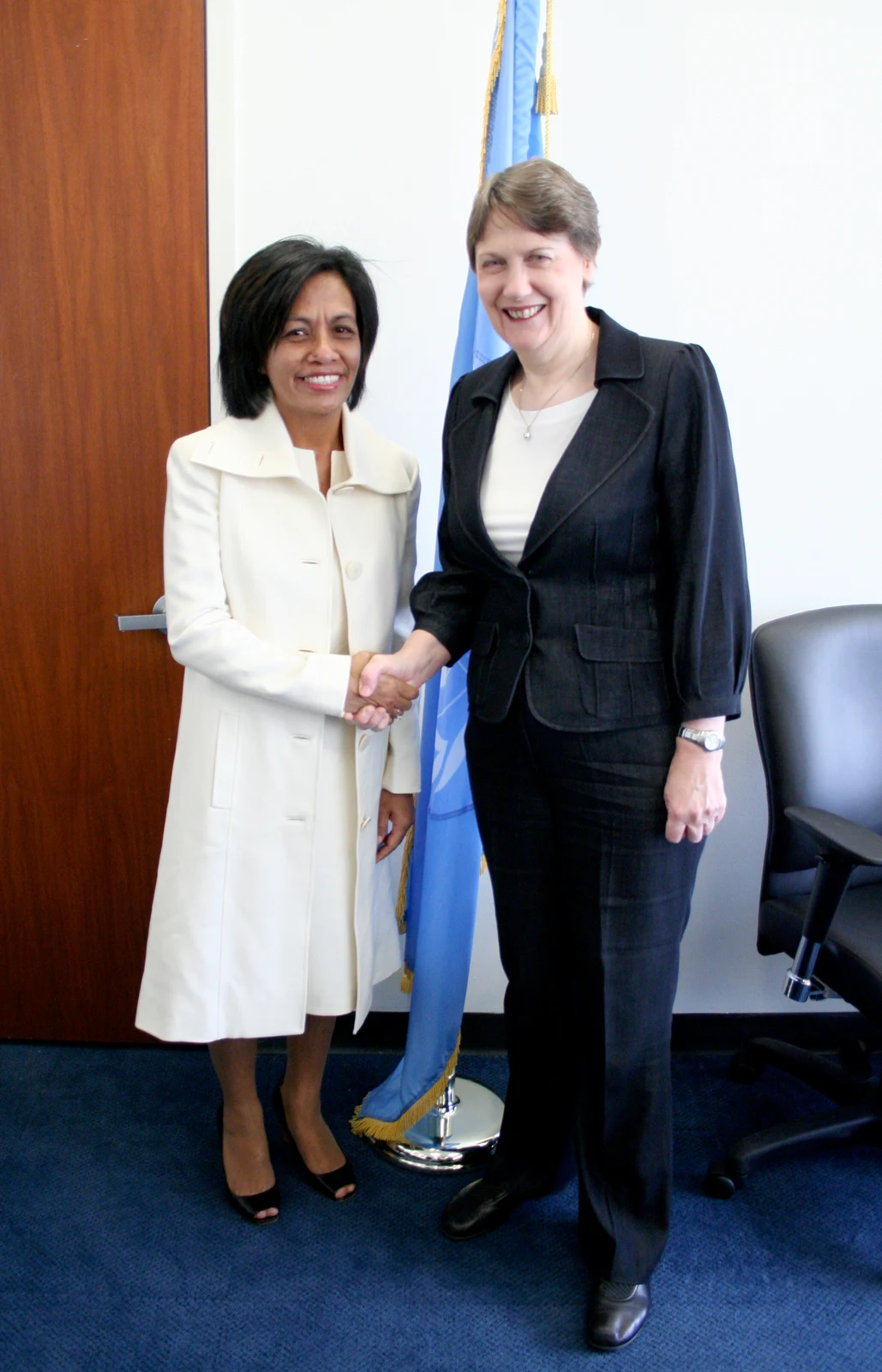
- 8. Wikimedia Commons · Maureen Lynch / UNDPLobato-Clark.jpg — preserved historical CC BY 2.0 source review
Complete exact Commons wikitext, full imageinfo/EXIF and preserved original-source review read. Photographer Maureen Lynch/UNDP, title UNDP-USA-10-164; the actual current Flickr source confirms matching subjects/credit but now displays CC BY-NC-ND 2.0. This is NOT a current commercial grant. Reuse relies explicitly on the original CC BY 2.0 grant preserved by FlickreviewR’s 29 April 2010 reviewed-pass-change record (then changing to BY-SA 2.0), with the original legal code’s continuing-grant terms checked. No UN/government=PD claim. Caption says 15 April 2010 and camera clock 16 April; no exact capture day is asserted in alt. Root inspected the complete actual 2096×3258 file: Lobato left, Helen Clark right; both remain in the supplied frame. Credit identifies the title, photographer, source, historical licence, current restriction and processing. No crop, enlargement, endorsement or blanket personality-rights clearance.
- 9. UNDP · Maureen Lynch · Flickr originalUNDP-USA-10-164 — current source now displays CC BY-NC-ND 2.0
Read the exact actual original Flickr HTML via HTTP, including title UNDP-USA-10-164, caption naming Maureen Lynch/UNDP, both subjects and the meeting, and current structured/visible licence CC BY-NC-ND 2.0. Commercial reuse is NOT based on that current licence or on UN/government status; it relies on Commons’ verified earlier CC BY 2.0 grant, with the later restriction disclosed prominently.
- 10. Creative CommonsAttribution 2.0 Generic — Legal Code, sections 3, 4, 7(b) and 8
Read the actual CC BY 2.0 legal-code grant, attribution requirements, section 7(b) and section 8. The historical grant is perpetual subject to compliance and is not withdrawn by later release under different terms; recipients receive the same original grant. Preserve title/author/source/licence credit and identify processing changes. This reuse assessment does not assert worldwide personality/model clearance or UNDP endorsement.