In this biography
Quick facts
- Born
- 7 October 1931
- Died
- 26 December 2021
- Birthplace
- Klerksdorp, South Africa
- Country
- South Africa
- Nationality
- Not independently established
- Known for
- Non-violent opposition to apartheid, the 1984 Nobel Peace Prize and truth-and-reconciliation leadership
- Full name
- Desmond Mpilo Tutu
- Born
- 7 October 1931, Klerksdorp
- Early profession
- Teacher before Anglican ministry
- Nobel Peace Prize
- 1984
- Archbishop of Cape Town
- 1986–1996
- Died
- 26 December 2021, Cape Town
Why this life matters
Tutu made religious leadership a platform for political equality without holding party or presidential office. His life also reveals the difference between advocating reconciliation and possessing the power to deliver justice, compensation or forgiveness on another person’s behalf.
Timeline
Key moments
Family and teaching
Modest family circumstances and education lead to work in schools.
Priesthood and study
Ordination, theological study and teaching precede senior church positions.
National platform
Council-of-churches leadership, the Nobel award and the Cape Town archbishopric expand his influence.
TRC leadership
He chairs a statutory commission with distinct truth, amnesty and reparation functions.
Founding chair of The Elders
He works internationally before becoming an Elder Emeritus.
Death
He dies in Cape Town on 26 December.
Teaching and family life preceded the famous public role
Desmond Mpilo Tutu was born in Klerksdorp in 1931 to a teacher father and a mother who worked in domestic service. Illness and limited family resources shaped his early years. He trained as a teacher and married Leah Shenxane in 1955; family life remained important throughout a demanding public career.
Apartheid’s discriminatory education system helped drive his decision to leave teaching for theology. He did not begin as a national political office-holder. The change of vocation joined practical work with young people to a conviction that institutions should recognise, rather than diminish, the dignity of those they served.
Study and church appointments built an independent platform
Ordained priest in 1961, he pursued further theological study in Britain and taught in southern Africa. The succession of teaching, pastoral and theological-education positions gave him experience beyond one congregation. In 1975 he became the first Black dean of St Mary’s Cathedral in Johannesburg.
Service as bishop of Lesotho was followed by leadership of the South African Council of Churches from 1978. That organisation offered a national platform while many liberation leaders were banned, imprisoned or in exile. His church position did not make him an ANC official; it provided an independent institutional base from which to challenge racial domination.
Non-violence did not mean accepting the status quo
Tutu advocated sanctions and disinvestment as pressure for political change. The 1984 Nobel Peace Prize amplified that campaign internationally. He also opposed violence within oppressed communities: UCT’s account recalls his intervention with others to save a man threatened by a crowd in 1985.
In 1986 he became the first Black archbishop of Cape Town. His argument linked the humanity of oppressor and oppressed without pretending their power was equal. Reconciliation, in this view, required an end to domination, not simply a quieter public atmosphere. His visibility belonged within a much larger resistance movement, including organisations and activists working outside church structures.
The TRC made truth public but could not remove every conflict over justice
After the democratic transition, Tutu chaired the Truth and Reconciliation Commission. Public hearings gave survivors a forum that the old state had denied them. He became closely associated with its emotional and moral language, but its authority came from legislation and its work involved many commissioners, staff and witnesses.
Conditional amnesty remained controversial. Families challenged its effects on their access to courts in the AZAPO case, although the Constitutional Court upheld the provision. That ruling did not require every survivor to regard the bargain as just or to forgive a perpetrator. Nor could Tutu personally guarantee the later reparations and prosecutions on which confidence in reconciliation also depended.
Democracy did not end his criticism of power
Tutu continued to challenge inequality, corruption and violence after apartheid. He supported the rights of sexual minorities and criticised the government’s refusal to grant the Dalai Lama a visa. His standards were not confined to those who had once been his political opponents.
In 2013 he said he would no longer vote for the ANC, according to his Foundation’s account. The declaration separated gratitude for a liberation movement from endorsement of its governing record. His defence of equality also extended beyond familiar positions within religious institutions, showing that Christian conviction and criticism of church or state could coexist.
International peace work extended the same concerns beyond South Africa
Tutu helped bring The Elders together in 2007 and chaired the group until 2013, continuing as Elder Emeritus. Its account describes visits addressing divided communities, political conflict and humanitarian needs. These were efforts to encourage dialogue, not executive powers to impose settlements.
He died in Cape Town on 26 December 2021. His legacy combines an unusually effective public voice with the limits of moral persuasion. Remembering those limits makes the achievements more specific: he helped people hear victims, challenged accepted hierarchies and criticised allies, while leaving later generations responsible for implementing rights and confronting unfinished injustice.
Quick answers
Frequently asked questions about Desmond Tutu
- Was Tutu South Africa’s president?
- No. His influence came through church leadership, campaigning and the TRC, not presidential office.
- Did non-violence mean he opposed sanctions?
- No. He advocated sanctions and disinvestment as non-violent pressure against apartheid.
- Could he personally grant forgiveness for every victim?
- No. Statutory decisions and an individual survivor’s response were different matters.
- Did he cease criticising government after 1994?
- No. He continued speaking against corruption, inequality and discrimination under democratic government.
Keep exploring
Lives connected to this story
- Thabo Mbeki
Compare the responsibilities of a democratic executive with an independent church-based critic.
- Nelson Mandela
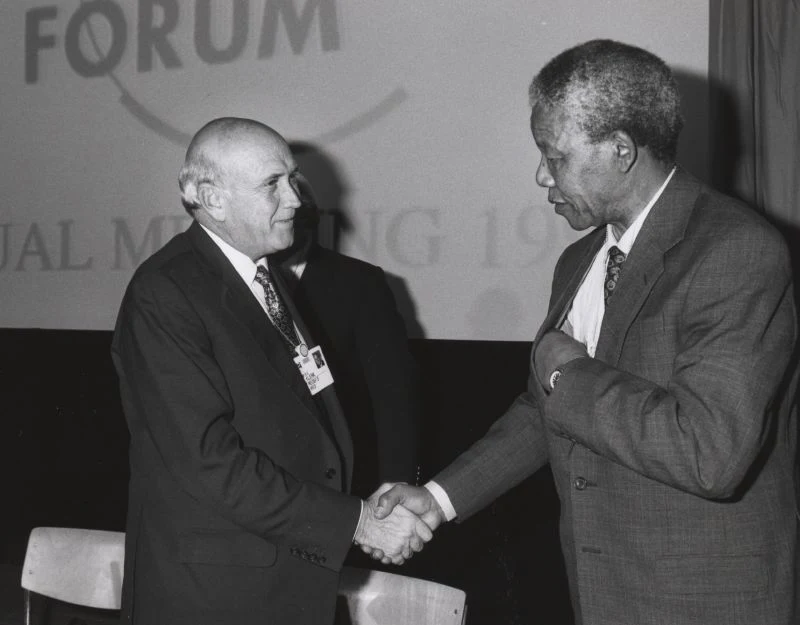
Place TRC leadership within the wider democratic transition.
- F. W. de Klerk
Read a former state president whose accountability disputes reached the TRC.
Sources and further reading
Explore the evidence
These references support the biography and offer further reading. Official records, first-person accounts and independent reporting provide different perspectives; image records document attribution and licensing.
- 1. Desmond & Leah Tutu Legacy FoundationOur founders: selected family, education, advocacy and death record
- 2. Nobel PrizeDesmond Tutu: curriculum vitae, selected ordination and study chronology
Indexed CV distinguishes 1960 deacon ordination from 1961 priesthood; direct page returned 403. Conflicting summary dates are not silently combined.
- 3. Nobel PrizeDesmond Tutu: award-time biography, selected church appointments
- 4. Nelson Mandela FoundationDesmond Tutu: selected church leadership and anti-apartheid biography
- 5. University of Cape Town26 December 2021 obituary: selected non-violence, archbishopric and later advocacy passages
Selected career and advocacy passages read. Its degree-year discrepancies are not adopted; the obituary’s photograph and text are not republished under its ND licence.
- 6. South African History Archive2011 retrospective: first public hearings, committees and unfinished work
- 7. Constitutional Court / SAFLIIAZAPO v President, 25 July 1996: selected amnesty and civil-liability reasoning
- 8. Wits Law School / Department of Justice archiveAZAPO: short reference summary, not the judgment itself
- 9. The EldersDesmond Tutu: selected founding chair and later peace work
Work-with-The-Elders passages used; the page’s erroneous 1994 TRC appointment label is not adopted.
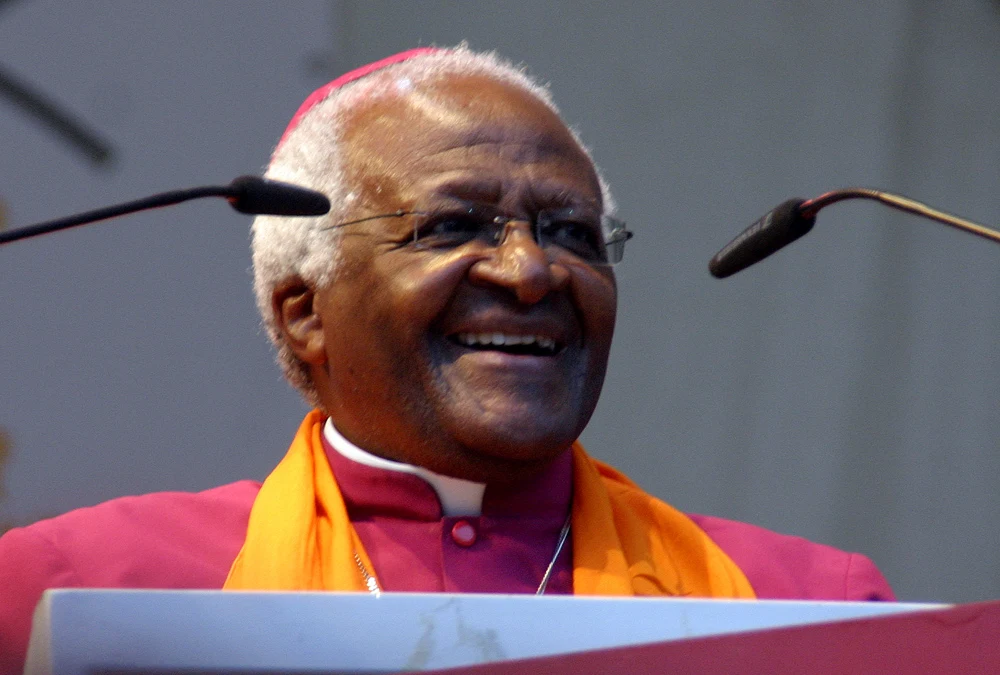
- 10. Elke Wetzig / Wikimedia CommonsDesmond Tutu at Kirchentag, 7 June 2007: complete author-supplied frame
First own-author revision, single binary and current migrated CC BY-SA3.0 read. The complete author-published 1000×675 frame is retained; no claim of access to a larger camera file.