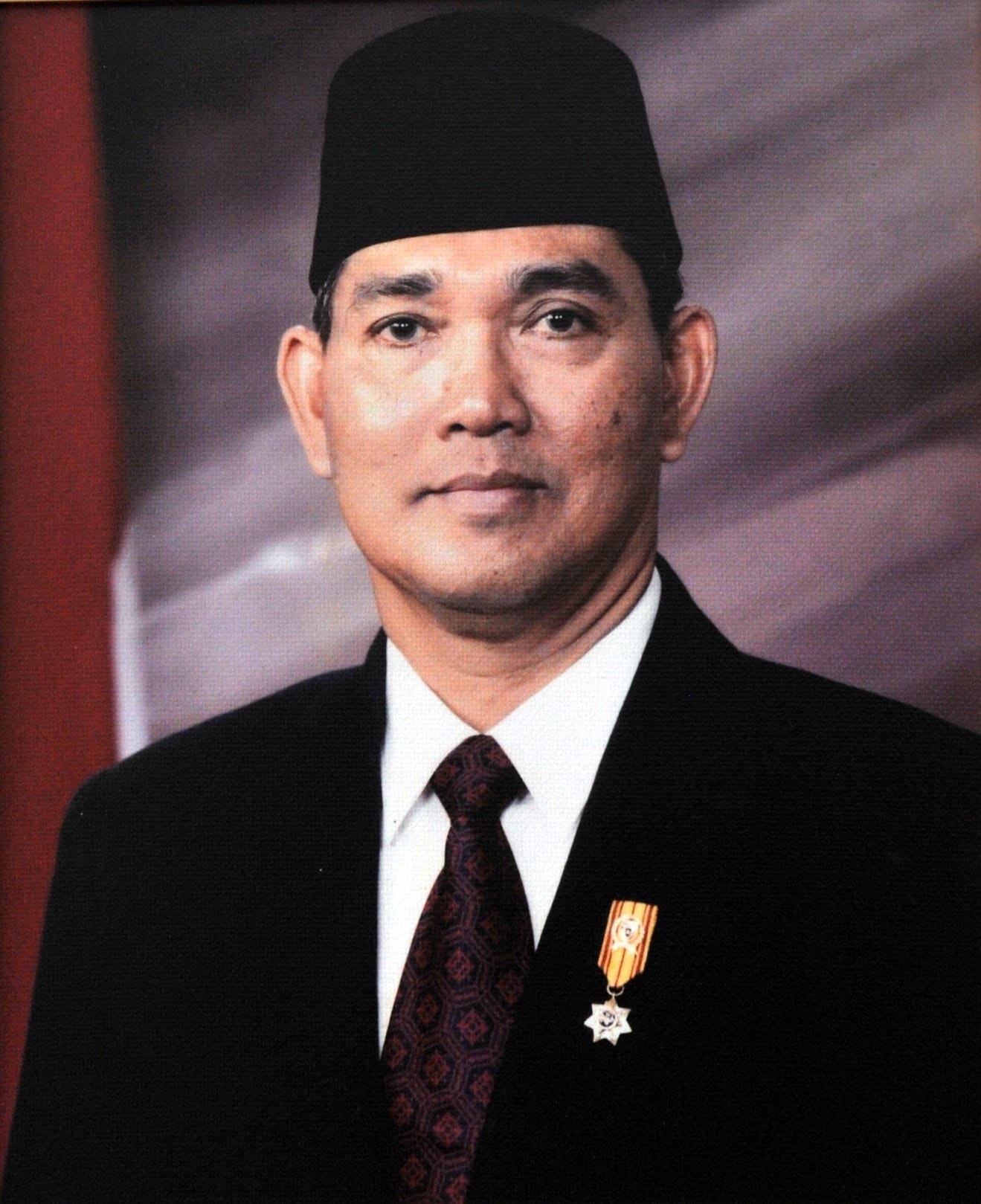
In this biography
Quick facts
- Born
- 15 November 1935
- Died
- 2 March 2026
- Birthplace
- Surabaya, East Java
- Country
- Indonesia
- Nationality
- Indonesian
- Known for
- Serving as armed forces commander during the late New Order and as vice president from 1993 to 1998
- National office
- Vice president, 1993–1998
- Military command
- ABRI commander, 1988–1993
- Army office
- Chief of Staff of the Army, 1986–1988
- Civil office
- Governor of Jakarta, 1982–1987
Why this life matters
Try Sutrisno’s ascent from military engineering to the vice presidency connects urban government, the armed forces’ political role and the unresolved rights record of Indonesia’s late New Order.
Timeline
Key moments
Graduated from the military academy
Entered the army engineering branch and began a career in operational and staff commands.
Became governor of Jakarta
Moved from regional military command to lead the national capital for five years.
Became armed forces commander
Took command of ABRI after two years as chief of staff of the army.
Santa Cruz massacre occurred
Indonesian troops killed demonstrators in Dili while Try commanded ABRI, raising enduring questions of command accountability.
Selected as vice president
Served beside Suharto until March 1998, shortly before the president’s resignation.
Died in Jakarta
Died at Gatot Soebroto Army Hospital and was buried at Kalibata Heroes Cemetery.
An engineering officer rises through the army
Try Sutrisno was born in Surabaya in 1935 and entered military education after the independence era. He graduated from the army academy in 1959 and served in the engineering branch before moving through staff, territorial and command assignments. He later worked as a presidential adjutant, which brought him close to the centre of the New Order.
His career advanced through East Java and national commands. In 1982 he was appointed governor of Jakarta, reflecting the era’s frequent movement of officers into civilian administration. The capital was expanding rapidly, making the post important for infrastructure, land, housing and the visible order of the state.
Army chief and commander of ABRI
Try became army chief in 1986 and commander of the Indonesian Armed Forces, then known as ABRI, in 1988. The position carried authority beyond defence because the armed forces held appointed legislative seats, territorial networks and an explicit social-political function.
His command belonged to the late New Order, when economic growth coexisted with restrictions on political competition and military operations in conflict regions. A biography that lists promotions without examining the institution’s coercive power would miss the central public question attached to his tenure.
Santa Cruz and command accountability
On 12 November 1991 Indonesian troops fired on a procession at Santa Cruz cemetery in Dili, East Timor, killing and wounding demonstrators. The massacre occurred while Try commanded ABRI. Indonesian authorities investigated and disciplined some personnel, but later scrutiny found that accountability did not reach the full chain of command.
Timor-Leste’s Commission for Reception, Truth and Reconciliation concluded that the investigations were not independent and did not establish full command responsibility. The available record does not by itself show that Try ordered the shooting; it does make the massacre indispensable to assessing the institution he led and the limits of the state response.
Vice president and later public life
The People’s Consultative Assembly selected Try as vice president in 1993. He completed his term in March 1998, two months before mass protest, economic crisis and elite defections forced Suharto to resign. Try was therefore the last vice president to serve a full five-year term entirely within the New Order.
In later life he remained active in veterans’ and constitutional-nationalist circles and frequently emphasised Pancasila and national unity. He died at 06:58 on 2 March 2026 at Gatot Soebroto Army Hospital in Jakarta. President Prabowo Subianto led his military funeral at Kalibata Heroes Cemetery.
Quick answers
Frequently asked questions about Try Sutrisno
- Who was Try Sutrisno?
- Try Sutrisno was an army general, armed forces commander and sixth Vice President of Indonesia. Try Sutrisno’s ascent from military engineering to the vice presidency connects urban government, the armed forces’ political role and the unresolved rights record of Indonesia’s late New Order.
- What is Try Sutrisno best known for?
- Try Sutrisno is best known for serving as armed forces commander during the late New Order and as vice president from 1993 to 1998.
- When and where was Try Sutrisno born?
- Try Sutrisno was born on 15 November 1935 in Surabaya, East Java.
- When did Try Sutrisno die?
- Try Sutrisno died on 2 March 2026.
Sources and further reading
How this biography was checked
Core dates and offices are checked against the sources below. This profile was last reviewed on 3 October 2026.
- Secretariat of the Vice President of IndonesiaVice presidents of Indonesia from 1945 to the present
- President of the Republic of IndonesiaThe long national service of General Try Sutrisno
- Ministry of State Secretariat of IndonesiaState secretary conveys condolences after Try Sutrisno’s death
- Timor-Leste Commission for Reception, Truth and ReconciliationChega! final report
- Wikimedia CommonsOfficial vice-presidential portrait and licensing record