In this biography
Quick facts
- Born
- 20 August 1946
- Birthplace
- Sidlaghatta, present-day Karnataka, India
- Country
- India
- Nationality
- Indian
- Known for
- Co-founding Infosys, developing its international software-services business and advocating corporate governance and distributed delivery
- Full name
- Nagavara Ramarao Narayana Murthy
- Postgraduate education
- Master’s degree, IIT Kanpur, 1969
- Infosys CEO
- 1981–2002
- Current official designation
- Founder; not Infosys’s current CEO or board chairman (reviewed 23 October 2026)
Why this life matters
Murthy’s career helps explain the growth of Indian software exports through engineering skills, international client relationships, distributed project delivery and access to capital. His reputation for governance also invites scrutiny of how founders, boards and employees share power.
Timeline
Key moments
Engineering education
Born in Sidlaghatta on 20 August 1946; completes engineering studies and a master’s at IIT Kanpur in 1969.
Computing and early enterprise
Works at IIM Ahmedabad, later attempts Softronics and joins Patni Computer Systems.
Seven founders establish Infosys
Murthy and six colleagues establish the company in Pune.
Public-market milestones
An Indian IPO and listing in 1993 precede the Nasdaq ADS listing in March 1999.
CEO succession and chairmanship
Leaves the CEO role in 2002; remains executive chairman until 2006 and non-executive chairman until 2011.
Return and second departure
Returns as executive chairman in June 2013, leaves executive duties in June 2014 and the chairmanship in October 2014.
Public debate and founder status
Defends his long-workweek position in 2024; current official material identifies him as Founder while other executives lead Infosys.
Engineering education and an early computing environment
Nagavara Ramarao Narayana Murthy was born on 20 August 1946 in Sidlaghatta, in present-day Karnataka. He studied electrical engineering at the National Institute of Engineering and completed a master’s degree at IIT Kanpur in 1969. These educational institutions supplied the technical foundation for a career usually narrated through his later business success.
He joined IIM Ahmedabad as chief systems programmer, working there from 1969 to 1971. Its computer centre offered experience with an early time-sharing system under J. Krishnayya. He subsequently worked elsewhere, attempted a company called Softronics and, after that venture failed, joined Patni Computer Systems in Pune. Infosys therefore followed employment and an unsuccessful enterprise; it was not his first encounter with computing or the risks of running a business.
Infosys began with seven founders and family support
In 1981 Murthy co-founded Infosys with Nandan Nilekani, S. Gopalakrishnan, S. D. Shibulal, K. Dinesh, N. S. Raghavan and Ashok Arora. The company began in Pune and moved its headquarters to Bangalore in 1983. Its official history identifies Data Basics Corporation in New York as its first client. The organization was oriented towards serving overseas customers from its early years.
IIT Kanpur’s profile credits his wife, Sudha Murthy, with providing ₹10,000 in starting capital. Corporate histories often express the initial sum as US$250; historical dollar equivalents differ across accounts, so the rupee figure is more useful than an asserted exact conversion. Sudha’s support mattered, while her own engineering and writing career should not be reduced to the role of a founder’s spouse.
Distributed delivery required an organization behind the idea
Murthy became closely associated with Infosys’s Global Delivery Model: coordinating software work across client locations and delivery centres, including centres in India. It combined access to engineering talent with international sales, communications and project management. The company’s claim that this guaranteed superior work is promotional; the practical model involved people dividing and coordinating tasks across distance.
The transition required investment in facilities, computers and telecommunications. Independent reporting in 2006 also documented competition for staff, pricing pressure and the difficulty of winning or absorbing very large outsourcing contracts. Such constraints help explain the business more clearly than a story of low costs alone. The company’s annual reports acknowledge risks from client concentration, interrupted communications, execution failures and changing demand.
Leadership changed through several distinct roles
Murthy served as CEO from 1981 to 2002. He was executive chairman from 2002 to 2006, then non-executive chairman and chief mentor until 2011. The board appointed him Chairman Emeritus effective 21 August 2011. Nandan Nilekani, Gopalakrishnan and Shibulal each held the CEO role in subsequent periods, demonstrating the importance of the wider founding team.
He returned as executive chairman on 1 June 2013 while Shibulal remained CEO. His executive chairmanship ended on 14 June 2014 and his non-executive chairmanship on 10 October. The 2014–2015 annual report says he declined a further Chairman Emeritus role to avoid perceived conflicts. As reviewed in October 2026, Infosys’s profile calls him Founder; its current governance material identifies Nilekani as chairman and Salil Parekh as CEO.
Sources for this section: [8] · [9] · [10] · [11] · [4] · [15]
Governance and education extend beyond a founder’s reputation
Governance also produced a consequential dispute in 2017. After Vishal Sikka resigned as CEO on 18 August, the board blamed persistent personal attacks associated with Murthy and rejected allegations of governance failures. Murthy said his concern was governance and denied seeking money, power or positions for his children. These were opposing accounts, not established findings of misconduct; Nilekani returned as non-executive chairman on 24 August amid broader board changes.
He also chaired IIM Ahmedabad’s board of governors from 2002 to 2007, returning to an institution where he had once worked. Its archives describe his defence of the institute’s autonomy during disputes with government. His later activities include investment through Catamaran and support for research through the Infosys Science Foundation. His Padma Shri in 2000 and Padma Vibhushan in 2008 recognize a career extending beyond one job title.
The workweek debate is part of his public record
Murthy’s argument that young Indians should work very long weeks attracted sustained disagreement. At the CNBC Global Leadership Summit in November 2024, he defended the position associated with a 70-hour week and connected hard work with national development. NDTV reported both that defence and his criticism of the move towards a five-day working week. These are attributed views, not established findings about the best way to raise productivity.
A biographical account should distinguish his advocacy from a demonstrated company-wide working-hours rule. It should also distinguish a founder’s recollection of his own schedule from employees’ circumstances. His legacy combines an influential software-export business, institutional commitments and contested prescriptions about work. Following that complete record gives readers more than either an entrepreneurial slogan or a verdict based on one controversial remark.
Quick answers
Frequently asked questions about N. R. Narayana Murthy
- Did Narayana Murthy found Infosys alone?
- No. The seven founders were Murthy, Nandan Nilekani, S. Gopalakrishnan, S. D. Shibulal, K. Dinesh, N. S. Raghavan and Ashok Arora.
- Is Narayana Murthy the current CEO of Infosys?
- No. He was CEO from 1981 to 2002. The official governance material consulted in October 2026 identifies Salil Parekh as CEO and managing director.
- Was Murthy permanently Chairman Emeritus after 2011?
- No. He held that designation from August 2011 before returning as executive chairman in 2013. The 2014–2015 annual report records that he declined a further Emeritus role after his second departure.
- Did Infosys start when it listed on Nasdaq?
- No. It was founded in 1981. Its Indian IPO and listing were in 1993, and its Nasdaq ADS listing followed in March 1999.
Keep exploring
Lives connected to this story
- Jamsetji Tata
Compare two distinct periods of Indian enterprise: colonial manufacturing and the later international software-services industry.
- Richard Branson
Contrast Infosys’s professional-services organization with the expansion of Virgin through a shared consumer brand.
- S. Gopalakrishnan
Follow a fellow Infosys co-founder’s technical operations, chief executive role and later research support.
Sources and further reading
Explore the evidence
These references support the biography and offer further reading. Official records, first-person accounts and independent reporting provide different perspectives; image records document attribution and licensing.
- 1. IIT KanpurSri Narayan Murthy: alumnus profile and early career
Read the biographical and early-career paragraphs. The institution’s older profile has stale employee and directorship information; these are excluded. The rupee start-up figure is retained without converting it into a supposedly exact historical dollar value.
- 2. IIM Ahmedabad ArchivesShri N R Narayana Murthy: education and 2002–2007 chairpersonship
Read birth, education and IIMA chairpersonship. Its simplified Infosys retirement summary omits the 2013–2014 return, so dated company filings control that chronology.
- 3. IIM Ahmedabad ArchivesNarayana Murthy: oral-history introduction, 1969–1971 employment
- 4. InfosysN. R. Narayana Murthy: current official founder profile
- 5. InfosysFounders: all seven founding members
- 6. InfosysCompany history and defining milestones
- 7. InfosysAnnual Report 1999: incorporation, Indian IPO and Nasdaq ADSs
- 8. InfosysForm 20-F 2010: Murthy’s CEO, executive and non-executive roles
- 9. InfosysLeadership succession, 30 April 2011: Chairman Emeritus appointment
- 10. Infosys / PR NewswireBoard appoints Murthy Executive Chairman, 1 June 2013
- 11. InfosysAnnual Report 2014–2015: departures, Emeritus decision and business risks
Read printed page 19 / PDF page 33 for both chairmanship departures and the explicit decision against Chairman Emeritus, plus selected business-risk passages. Announcements anticipating an Emeritus appointment are superseded by this later account.
- 12. InfosysInvestor conference call, 18 August 2017: the board’s account of Sikka’s departure
Read selected board explanations of Sikka’s resignation and the governance dispute. The board’s criticism and rejection of allegations remain attributed; Murthy’s published response and the separate 24 August leadership announcement supply the other position and ensuing change. No misconduct finding is inferred.
- 13. Moneycontrol / N. R. Narayana MurthyMurthy’s complete response to the board, 18 August 2017
- 14. Infosys / PR NewswireBoard changes and Nilekani’s appointment, 24 August 2017
- 15. InfosysCorporate governance: ESG Report 2025–2026
Read board composition, the chairman/CEO roles and the labelled 2026 board photograph. Current founder status is cross-checked with the official founder profile; no unsourced current executive role is assigned to Murthy.
- 16. CIO / John Ribeiro, IDG News ServiceInfosys Turns 25, Faces New Set of Hurdles, 31 July 2006
- 17. NDTVMurthy defends the 70-hour workweek at the CNBC summit, 15 November 2024
Read the dated November 2024 account of remarks at the CNBC summit. The position is attributed to Murthy; the account is not evidence of Infosys imposing a 70-hour policy or of the economic merits of that schedule.
- 18. Universitätsarchiv St.Gallen / Wikimedia Commons31st ISC Symposium, 2001: Murthy, HSGN 028/01586
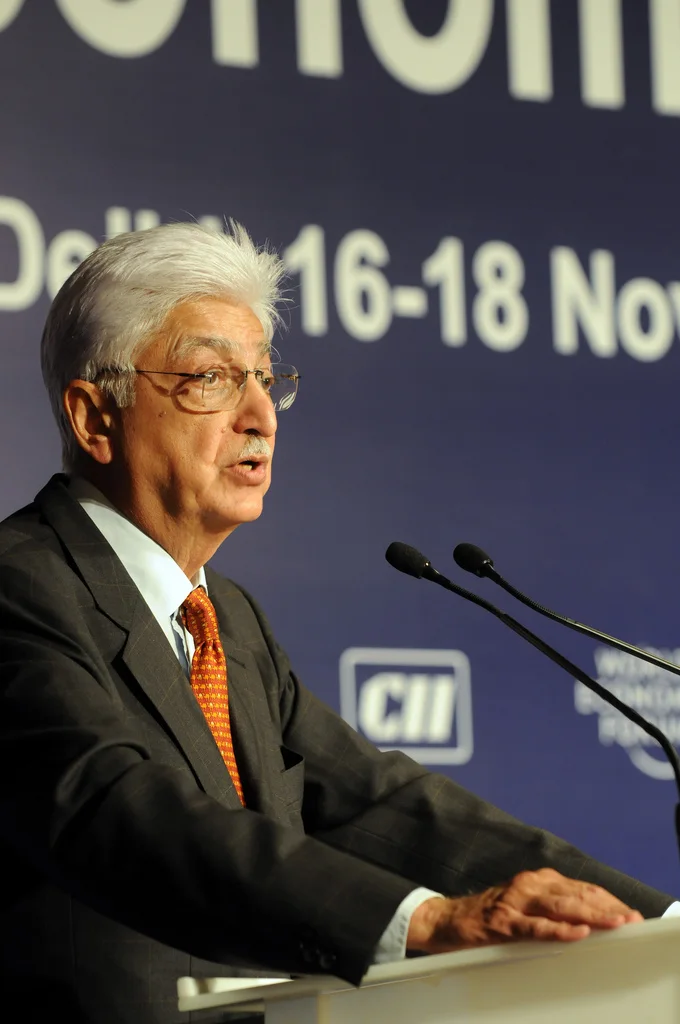
Read archive inventory, creator, 2001 date, full-file history and VRT permission. EXIF orientation is applied without cropping. This is an event portrait, not a 1981 founding photograph.
- 19. Creative CommonsAttribution-ShareAlike 4.0 International licence