
The short answer
What did Infosys actually sell in 1993, and when did trading begin? The answer lies in the share-capital record and dated reports. This guide examines financing mechanics and disclosure beyond the company’s earlier founding story.
Chronology
A timeline of the turning points
Public-company preparation
The company changes its name and becomes a public limited company before the offer.
Issue and allotment
The capital record identifies 1,376,000 new shares at ₹95 and an April 29 allotment.
Exchange trading
Company reports record an opening price of ₹145, distinct from the offer price.
Later financing
A private placement and then a US ADS offering are separate transactions.
A public company and a listed company are different stages
Infosys began in 1981, but its conversion into a public limited company occurred in 1992 before the 1993 offering. The company’s investor FAQ distinguishes these legal and market milestones. Becoming a public company did not itself mean that its shares were already trading on an exchange, just as the later IPO did not establish the software business from the beginning.
The public offering created a wider shareholder relationship and new expectations of disclosure. For a services company, outside investors had to assess an enterprise whose principal resources included employees, client relationships and delivery capability. The transaction’s significance was therefore both financial and institutional: it connected the business to public capital and to continuing obligations toward investors beyond the founding group.
The capital table identifies a fresh issue, not just a founder sale
The historical share-capital table reproduced in Infosys’s 2025 offer document records an IPO entry of 1,376,000 equity shares at ₹95. Its note specifies a face value of ₹10 plus a premium of ₹85. The new shares increased the company’s paid-up equity capital. That is a fresh issue by the company, different from existing shareholders merely selling their own shares to new owners.
Face value is an accounting denomination, not the amount an IPO applicant necessarily pays or a measure of business value. The offer price combined that denomination with the premium. Keeping the terms separate avoids repeating inconsistent summaries that substitute another face value or price. This guide uses the statutory capital record for the transaction mechanics rather than a retrospective wealth anecdote.
Sources for this section: [1]
Offer, allotment and listing did not happen on one date
Company reports place the public offer in February 1993. The capital-history note records allotment on 29 April, while the 1999 annual report places the Indian stock-exchange listing in June. These events answer different questions: when investors were offered shares, when shares were allocated and when exchange trading began. An anniversary article should not treat all three as the IPO’s single day.
The same 1999 report says trading opened at ₹145 compared with the ₹95 offer price. One was the subscription price in the primary transaction; the other was a market trading price. Neither is a present quotation. Nor does the difference establish a return achieved by every applicant, since actual allocation, purchase, sale, fees and later corporate actions vary among investors.
Underwriting recollections require attribution and reconciliation
A 2011 interview with Enam co-founder Vallabh Bhansali describes Enam as merchant banker and underwriter and characterises the issue as barely subscribed. The introduction also describes underwriter participation. The later statutory note calls the public issue fully subscribed. These descriptions need not mean that public demand was effortless: underwriting commitments and final subscription are different aspects of completing an issue.
The interview’s recollected listing price also differs from the company’s repeated ₹145 record. This article gives precedence to the documented company figure and preserves the interview as an attributed recollection of a difficult transaction. It does not adopt the widely repeated Morgan Stanley 13-percent rescue story without a reconciled transaction record. A memorable financing legend should not override the primary capital table.
The 1994 placement and 1999 ADS offer raised different questions
Infosys’s 1999 report describes a private placement of 550,000 shares at ₹450 each in October 1994. It then records the March 1999 issue of 2,070,000 American depositary shares at US$34 per ADS, equivalent at that time to 1,035,000 underlying equity shares. These were later financing transactions, not missing stages of the original 1993 Indian offer.
An ADS is a depositary instrument representing an interest in underlying shares. The historical ratio in the 1999 transaction was two ADSs to one equity share. Later ratios and exchange arrangements changed, so applying today’s share structure backward would distort the record. The US market entry also involved a different disclosure and investor setting from the earlier Indian exchange listing.
Public ownership made governance an ongoing task
Infosys’s finance retrospective links capital-market development with financial reporting, employee share ownership and independent-director structures. That is a company account of its institutional choices, not proof that every later governance question was resolved. The 2017 board dispute and Nandan Nilekani’s return as non-executive chairman demonstrate that a public-market reputation still requires continuing accountability.
The distinct contribution of the IPO history is to show how a private founders’ venture acquired public shareholders through a documented new issue, followed by allotment, trading and further capital access. Historical prices and share counts are presented in their original context, without a hypothetical present fortune. A useful reading follows the cash, securities and obligations created by each transaction rather than treating later commercial success as inevitable in 1993.
Continue the chronology
Related history guides
Connected biographies
Founders and later public-market responsibilities
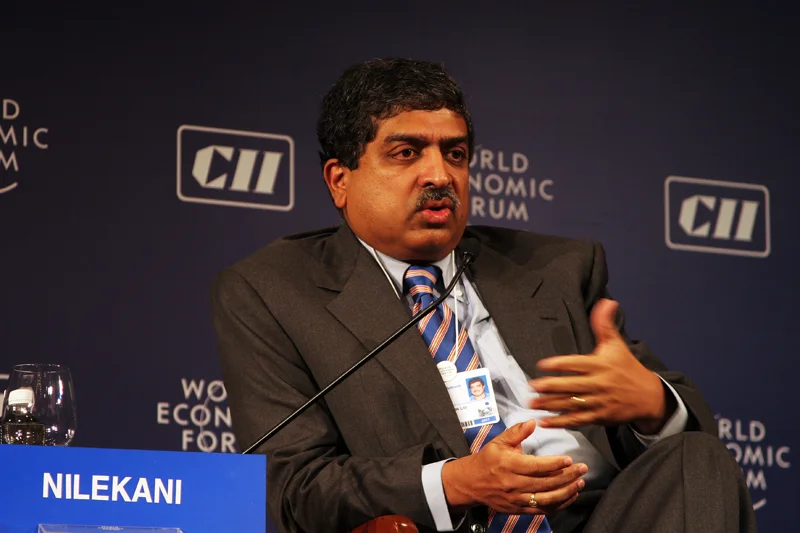
1955–present
Nandan Nilekani
Infosys co-founder, non-executive chairman and former UIDAI chairmanNandan Nilekani is an Indian technology entrepreneur who co-founded Infosys in 1981 and chaired UIDAI from 2009 to 2014. He returned as Infosys’s non-executive chairman in 2017 and has supported education and public digital infrastructure.Read biography
1946–
N. R. Narayana Murthy
Infosys co-founder and former chief executiveN. R. Narayana Murthy is an Indian engineer and entrepreneur who co-founded Infosys with six colleagues in 1981. He served as chief executive until 2002 and later held chairmanship roles. His career also includes education, investment and public debate about work and economic development.Read biographyQuick answers
Common questions
- What was the historical issue price?
- ₹95 per share: face value ₹10 plus an ₹85 premium, according to the capital-history note.
- Was June 1993 the offer month?
- No. The offer was in February, allotment is recorded on 29 April, and exchange listing followed in June.
- Was the 1999 US offering the same IPO?
- No. It was a later ADS offering, with a historical ratio of two ADSs to one underlying equity share.
- Does the article calculate a present investment value?
- No. It explains historical transactions and preserves their original share and price context.
Primary and institutional sources
How this history was checked
The later statutory capital table and 1999 report anchor the mechanics. The Enam interview is attributed and its price recollection is not substituted for the repeated company record; later transaction terms are not current advice. This article was reviewed on 23 October 2026.
- Infosys2025 Letter of Offer, historical capital table and note: 1993 issue and allotment
- InfosysAnnual Report 1999, shareholder FAQ: Indian listing and US ADS transaction
- InfosysShare Details: historical unadjusted issue and listing figures
- InfosysInvestor FAQ: public-company conversion and distinct offerings
- InfosysAnnual Report 2009–2010, shareholder-information history
- InfosysThe Finance Journey, 2011 retrospective
- The Economic Times / Partha SinhaVallabh Bhansali’s Enam underwriting recollections, 19 August 2011
- Reuters / Business StandardGovernance dispute and Nilekani return, August 2017
- Infosys / PR NewswireActual board appointment, 24 August 2017
- World Economic Forum / Wikimedia CommonsLater contextual Nilekani photograph, December 2007
- Creative CommonsAttribution-ShareAlike 2.0 Generic licence