In this biography
Quick facts
- Born
- 24 July 1945
- Birthplace
- Bombay, British India (now Mumbai, Maharashtra, India)
- Country
- India
- Nationality
- Indian
- Known for
- Wipro’s diversification into computing and services, and a large philanthropic endowment focused initially on education
- Family enterprise
- Father Mohamed Hasham Premji founded the oil business in 1945
- Leadership begins
- Takes over the family business in 1966
- Foundation
- Formally established on 9 March 2001
- Dated role check
- Wipro Founder Chairman and non-executive, non-independent director, checked 23 October 2026
Why this life matters
His career joins industrial diversification, professional management and institutional philanthropy. Understanding it requires separating his father’s founding role, his own leadership, Wipro’s governance and the foundation’s public-purpose work.
Timeline
Key moments
Birth and a separate corporate founding
Born in Bombay; his father establishes Western India Vegetable Products in the same year.
Returns from Stanford
Interrupts engineering studies after his father’s death to run the family business.
Diversification
Consumer products, industrial engineering and computing broaden Wipro’s activities.
Completes his degree
Returns to the remaining requirements and completes his Stanford engineering degree.
Foundation and public commitment
Establishes the foundation in 2001 and signs the Giving Pledge in 2013.
Endowment and executive succession
Earmarks additional economic benefits for philanthropy and leaves executive leadership on 30 July.
His father founded the company before he could lead it
Azim Hasham Premji was born in Bombay on 24 July 1945. That year his father, Mohamed Hasham Premji, established the vegetable-oil enterprise that became Wipro. Azim’s later title of Founder Chairman should not be read as a claim that he personally founded a company in the year of his birth. The family business supplied a platform he would substantially change.
He began engineering studies at Stanford in the 1960s. His father’s death brought him back to India in 1966, before he had completed the degree. Taking over a manufacturing business at a young age meant learning production, sales and finance while carrying responsibility for an existing enterprise, employees and shareholders.
Diversification was a sequence of managerial decisions
Premji expanded beyond cooking fats into consumer products and industrial equipment before computing became central. The sequence matters: the software-services company familiar today did not appear in finished form in 1966. Wipro accumulated manufacturing, distribution and technical capabilities while evaluating opportunities in a changing Indian economy.
Professional managers also shaped the transition. Business Today’s retrospective describes Premji’s recruitment of Ashok Soota to lead technology products. Decisions about people and organization were as consequential as choosing a promising sector. Premji’s leadership provided continuity and capital allocation, while engineers, sales teams and successive executives supplied expertise that a single owner could not possess in every field.
Computers opened a route towards international services
Wipro moved into information technology around the turn of the 1980s. The opportunity included locally supplied computers, followed by software, engineering research and services for customers abroad. Stanford’s account of Premji’s 2006 talk describes a gradual shift from manufacturing machines to supplying technical work as hardware became more standardized.
In that discussion he emphasized experimentation, customer feedback and a workplace able to tolerate unsuccessful ideas. These were his management arguments, not independently proven explanations for every Wipro result. They nevertheless illuminate how he presented innovation: changing routines and behaviour could matter alongside new products. He also returned to his unfinished studies and eventually completed the Stanford engineering degree.
Executive retirement did not remove him from governance
After more than five decades of executive involvement, Premji’s term as executive chairman ended on 30 July 2019. The company’s AGM notice explained his wish for the next generation to take over and proposed a non-executive, non-independent directorship. His son Rishad became executive chairman. This was a change in responsibility rather than the disappearance of the family from ownership and governance.
At the 23 October 2026 review, Wipro’s official profile identifies Azim as Founder Chairman and a non-executive, non-independent director. The 2024 AGM documentation records a further appointment from July 2024. A non-executive board role should not be described as running daily operations, and a historical chairman’s profile should not substitute for checking the current title.
Philanthropy involved an endowment with a distinct design
Azim Premji Foundation was formally established on 9 March 2001. It initially concentrated on education, working with public systems and educators; later institutions included a university in Bengaluru. Premji’s role was to help establish a durable organization and funding base. The day-to-day work belonged to teachers, field teams, university staff and partner organizations.
In March 2019 he earmarked all economic benefits in an additional approximately 34 per cent of Wipro shares held through controlled entities for philanthropic purposes. The announcement valued the total contributed endowment at about $21 billion at that time. Economic entitlement and voting control were distinct: contemporary reporting explained that the family retained voting rights over the additional shares. Wipro itself was not donated in its entirety.
Institutional aims require assessment beyond the donor’s reputation
The foundation describes a long-term approach built on public systems, field institutions, universities and grants. Education remained central as work expanded into other needs. Its account acknowledges limits to what any organization can achieve and to how some social values can be measured. An endowment’s announced market value is neither immediate cash expenditure nor a verified measurement of learning.
Premji’s significance therefore rests on both business transformation and a sustained attempt to organize philanthropy. Evaluating either requires attention to governance, implementation and results over time. Admiration for personal giving does not automatically settle questions about corporate conduct or educational effectiveness; equally, the scale of the challenge does not erase the resources and institutional work involved.
Quick answers
Frequently asked questions about Azim Premji
- Did Azim Premji establish Wipro in 1945?
- His father Mohamed Hasham Premji founded the vegetable-oil enterprise in 1945. Azim, born that year, took over after his father’s death in 1966.
- Did he finish his Stanford degree?
- Yes. He interrupted his engineering studies in 1966 and later completed the remaining requirements. The checked profiles differ about the precise completion year, which is not asserted here.
- Did he give away all of Wipro in 2019?
- No. He committed additional economic benefits associated with approximately 34 per cent of its shares to philanthropy; that was not a transfer of the entire company or all corresponding voting rights.
- What is his Wipro role at this review?
- Wipro’s official profile, checked on 23 October 2026, calls him Founder Chairman and a non-executive, non-independent director. His executive chairmanship ended in July 2019.
Keep exploring
Lives connected to this story
- N. R. Narayana Murthy
Compare Wipro’s diversification from manufacturing with Infosys’s establishment as a software-services venture.
- Shiv Nadar
Follow another route from Indian computer hardware to global services and educational institution building.
- Ratan Tata
Examine a different relationship between charitable institutions and a business holding company.
Sources and further reading
Explore the evidence
These references support the biography and offer further reading. Official records, first-person accounts and independent reporting provide different perspectives; image records document attribution and licensing.
- 1. WiproAzim H. Premji: current official leadership profile
- 2. Wipro2024 AGM notice: birth date, education and director appointment
- 3. The Economic Times / Wipro clipping archivePremji, an IT giant and a pioneer donor, 25 July 2015
The dated ET clipping supplies family and 1966 chronology. Its claim of an Indian listing in 1945 conflicts with Wipro’s later filings. Its 1995 education milestone is also ambiguous beside profiles using 1999 or 2000; neither disputed year is asserted. Later degree completion is independently supported by Stanford and Wipro.
- 4. Business Today / Wipro clipping archiveThe Visionary: diversification, managers and technology, 2019
Selected indexed timeline and Soota passages were read. The clipping’s 1982 IT-products milestone is kept distinct from other sources’ 1981 entry/computer milestone; no full clipping-archive review is claimed.
- 5. Stanford Graduate School of BusinessAzim Premji: Failure is Essential, 2006
- 6. Wipro / SEC2019 AGM notice: executive retirement and non-executive role
- 7. Azim Premji Foundation / Wipro / SECAnnouncement of additional economic-rights commitment, 13 March 2019
The 13 March 2019 statement concerns economic benefits and a then-valued endowment, not all voting control, an immediate cash gift or a current wealth estimate.
- 8. Business Standard / Dev ChatterjeePremji family retains voting rights, 15 March 2019
- 9. Azim Premji FoundationHistory and Timeline: establishment and institution building
- 10. Azim Premji FoundationPurpose and Approach: public systems and limits
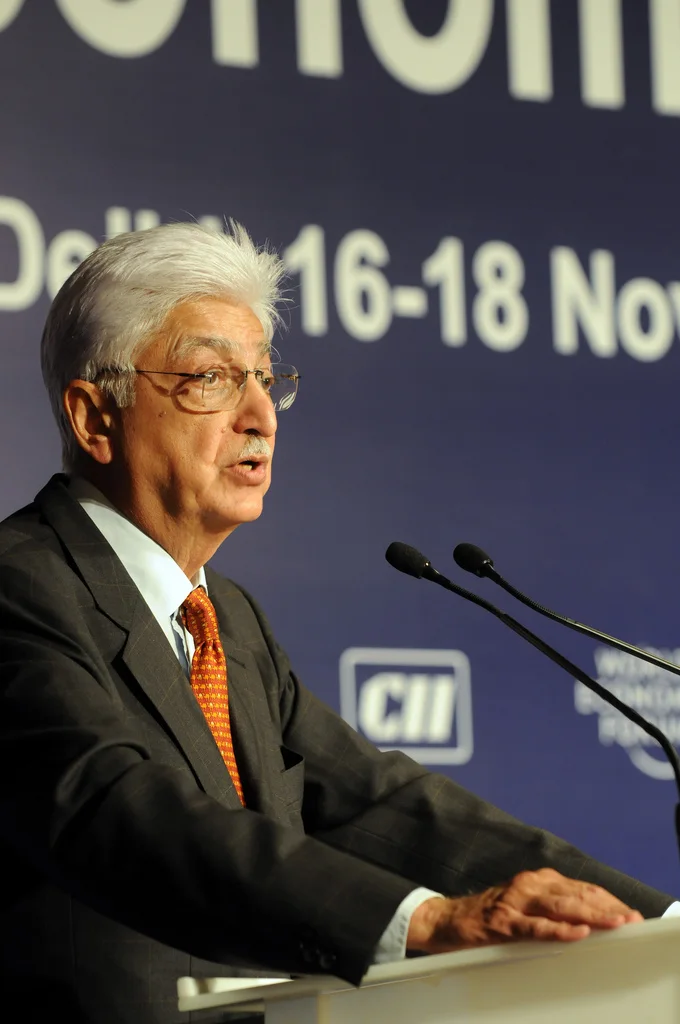
- 11. World Economic Forum / Wikimedia CommonsAzimpremji: Dana Smillie photograph, 17 November 2008
WEF identifies Premji and Dana Smillie; complete supplied frame is preserved under the documented CC BY-SA licence.
- 12. Creative CommonsAttribution-ShareAlike 2.0 Generic licence