
In this biography
Quick facts
- Born
- 3 August 1942
- Birthplace
- Bombay, British India (now Mumbai, Maharashtra, India)
- Country
- India
- Nationality
- Indian
- Known for
- Thermax’s restructuring, professional management and support for education organisations
- Education
- Economics; postgraduate medical and psychiatric social work at TISS
- Thermax career
- Joins in 1985; leads human resources from 1991; chairperson 1996–2004
- Separate retirements
- Chairperson in October 2004; non-executive director in August 2018
- Predecessors
- A. S. Bhathena founded the predecessor business; Rohinton Aga led its expansion
Why this life matters
Her career illuminates the difference between family ownership, a board’s responsibilities and day-to-day management. The turnaround involved painful workforce decisions as well as institutional reform and eventual recovery.
Timeline
Key moments
Born in Bombay
Later studies economics and social work and undertakes a short Fulbright-supported period in the United States.
Human resources
Enters Thermax in 1985 and becomes head of its HR function in 1991.
Unexpected succession
Becomes chairperson after the sudden death of her husband Rohinton Aga.
Restructuring and recovery
External advice, business exits, workforce reductions and a reconstituted board accompany the turnaround.
Chair succession
Meher Pudumjee takes over the chair in October; Anu remains a non-executive director.
Beyond the board
Leaves the Thermax board in August 2018; continues educational and civic commitments.
Human-resources work preceded the 1996 succession
Aga entered Thermax in 1985 and led its human-resources function from 1991. That experience involved recruitment, communication and organisational relationships. It supplied knowledge of the workforce and company culture even though she did not come from a technical or financial-management background. Later accounts sometimes compress entry into HR and promotion to head of HR; the company chronology distinguishes them.
Rohinton Aga died suddenly in February 1996, and she became chairperson. The following year her son Kurush died in a road accident, adding a further personal loss during an already difficult transition. Her retrospective interviews describe uncertainty and the need for outside support. Personal resilience was part of the story, but it did not by itself resolve Thermax’s operational and strategic problems.
The turnaround required admitting failures and changing structures
Thermax faced an industrial downturn, an overextended business portfolio and weak performance. Aga supported bringing in Boston Consulting Group despite resistance within management. Contemporary reporting in 2000 described an operating loss masked by treasury income, unsuccessful power-project expectations and a balance-sheet clean-up. Those details qualify a simple claim that the company suddenly failed, or that general economic conditions explained everything.
The response combined exits from non-core activities, cost control, greater customer attention and changes in accountability. Prakash Kulkarni assumed the managing-director role, while the board was reconstituted with independent directors and family members moved away from executive functions. The subsequent recovery was therefore an organisational effort involving managers, advisers and employees, not a result produced by one chairperson acting alone.
Professionalisation had human costs as well as governance benefits
Restructuring included reductions in employment and the closure or sale of activities. Aga’s later account presented these decisions as necessary to restore the business, while acknowledging an earlier failure to protect outside shareholders’ interests. They were consequential choices for workers as well as investors. A responsible biography should retain those costs alongside improved results and the company’s later reputation.
Her ownership connection did not disappear when she relinquished operational powers. The family remained influential through shareholding and board participation, while professional executives took responsibility for daily management. That distinction is central to the case: independent directors and a managing director can alter decision-making without eliminating promoter ownership. Governance reform is a division of responsibilities that must continue to function, not a guarantee against future mistakes.
Two retirements marked a deliberately extended succession
In October 2004 Aga stepped down as chairperson and her daughter Meher Pudumjee succeeded her. Thermax’s 2004–2005 annual report identifies Pudumjee as chairperson and Kulkarni as managing director, with Anu Aga still a director. The records make clear that chair succession did not mean an immediate departure from the board or the transfer of all operational duties to her daughter.
She retired from the board in August 2018. Contemporary reporting linked the decision to age and governance expectations for promoter and professional directors. The company overview checked on 23 October 2026 describes her as a former chairperson, not its current chief executive or chair. Her long corporate association and continuing family connections should not be converted into a present operational office.
Education and civic responsibility became a larger part of her work
Aga’s later public work returned to interests that preceded her industrial leadership. She supported educational organisations including Akanksha and Teach For India and helped establish Thermax’s social-initiative work. Teach For India’s current organisational record continues to include her. These are different institutions, with their own leaders and methods; support for them is not proof of uniform educational outcomes.
She has also spoken about communal harmony, corporate ethics and business obligations beyond financial performance. Her oral history discusses resistance to corruption and the responsibility of owners to society. Her significance lies in bringing those concerns into conversation with hard commercial decisions, including unpopular ones. The resulting career is neither an uncomplicated corporate success story nor philanthropy detached from how a business treats its stakeholders.
Quick answers
Frequently asked questions about Anu Aga
- Did Anu Aga found Thermax?
- No. Her father A. S. Bhathena founded its predecessor business, and her husband Rohinton Aga led its development. She joined Thermax in 1985 and became chairperson in 1996.
- When did she leave Thermax?
- She retired as chairperson in October 2004 and remained a non-executive director until August 2018. Those were separate transitions.
- What changed during the turnaround?
- Thermax reduced non-core activities and costs, reconstituted its board and placed operations under professional management. Workforce reductions were part of those changes.
- Who succeeded her as chairperson?
- Meher Pudumjee became chairperson in October 2004. The managing director’s operational responsibilities remained a separate office.
Keep exploring
Lives connected to this story
- Kiran Mazumdar-Shaw
Compare an unexpected family-business succession with the creation and expansion of a biotechnology venture.
- Azim Premji
Compare the separation of executive roles and ownership with different institutional approaches to education philanthropy.
Sources and further reading
Explore the evidence
These references support the biography and offer further reading. Official records, first-person accounts and independent reporting provide different perspectives; image records document attribution and licensing.
- 1. ThermaxCompany overview: Anu Aga, family predecessors and 2018 board retirement
Current corporate account gives precise 1985 entry, 1991 HR leadership and August 2018 board retirement. It takes precedence over summaries compressing these stages.
- 2. ThermaxLegacy milestones: 1996 chair appointment and 2001 board reconstitution
- 3. ThermaxAnnual Report 2025–2026: historical leadership chronology
- 4. Harvard Business School, Baker LibraryCreating Emerging Markets: Anu Aga interviews, 2017 and 2021
- 5. IIM Bangalore / Ganesh PrabhuAnu Aga: A Culture of Innovation and Openness, March 2002
- 6. Business Today / Roop KarnaniThermax’s Strategic Overhaul, 7 August 2000
Contemporary reporting distinguishes operating loss from treasury-supported net profit. Forecasts of recovery are not presented as already achieved in 2000.
- 7. Business Today / Anu AgaHow Anu Aga scripted Thermax’s turnaround: first-person retrospective, 2012
First-person account is attributed; cost reductions and independent directors are not treated as proof that all stakeholder interests were satisfied.
- 8. The Financial ExpressAnu Aga retires from the Thermax board, 9 August 2018
- 9. School Choice CampaignAnu Aga: education, birth date and historical advocacy profile
- 10. Teach For IndiaCurrent organisational team and board listing
- 11. The Indian Express / Anuradha MascarenhasPostcards from the Past: Anu Aga’s recollections, 2023
- 12. ThermaxAnnual Report 2004–2005: Meher Pudumjee as chairperson
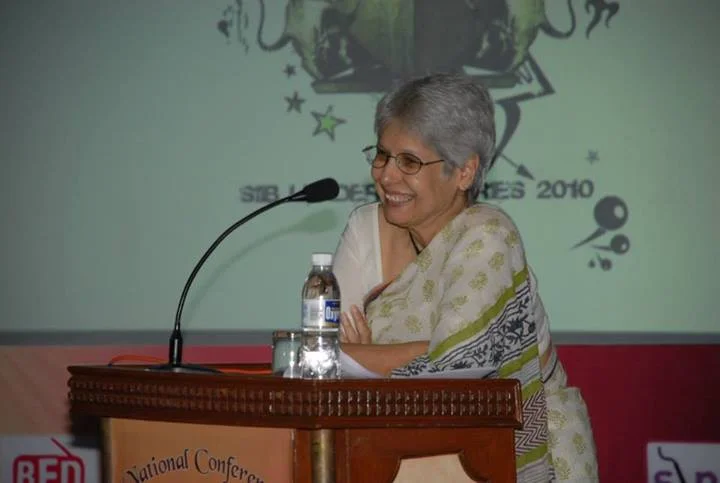
- 13. Nsnehasingh / Wikimedia CommonsAnu Aga: complete conference photograph and file history
The source records 19 August 2014, but a visible 2010 conference backdrop prevents a confident event-date claim. Complete frame and uncertainty retained.
- 14. Creative CommonsAttribution-ShareAlike 4.0 International licence
Social work came before industrial leadership
Anu Aga was born in Bombay on 3 August 1942. She studied economics and completed postgraduate training in medical and psychiatric social work at the Tata Institute of Social Sciences. A Fulbright-supported period in the United States broadened that professional exposure. Her education was directed toward people and social institutions, rather than engineering or an early plan to run an industrial company.
The family business predated her corporate career. Her father, A. S. Bhathena, established the predecessor Wanson India enterprise; her husband Rohinton Aga helped develop the engineering business that became Thermax. Keeping these roles separate explains both her connection to the company and the expertise she had to acquire. She inherited responsibility within an existing organisation, not credit for its original founding.
Sources for this section: [9] · [1] · [4]